Protagoras’s Paradox, also known as the “Paradox of the Court,” is a philosophical dilemma arising from a legal dispute between the ancient Greek sophist Protagoras and his pupil Euathlus. The paradox deals with the concepts of legal reasoning, contradiction, and the interpretation of agreements. This dilemma presents a nuanced conflict that challenges the application of logic in real-world situations, particularly within the legal sphere.
To fully understand the paradox, World History Edu presents the background of the key figures involved.
Who was Protagoras?
Protagoras (c. 490–420 BCE) was one of the most prominent sophists of ancient Greece, known for his relativistic views on truth and morality. He famously said, “Man is the measure of all things,” implying that truth and knowledge are subjective and vary according to individual perception.
Image: A philosopher, possibly Democritus. Casting of bust of the Villa of the Papyri
Who was Euathlus?
Euathlus was a student of Protagoras who sought to learn the art of law and rhetoric.

Euathlus was a student of Protagoras, the famed ancient Greek sophist and philosopher. Image: Protagoras by Spanish painter Jusepe de Ribera, 1637
The Story Behind Protagoras’s Paradox
The paradox emerges from a legal arrangement between Protagoras and Euathlus.
The story goes that Euathlus wanted to study law and become a successful lawyer, so he approached Protagoras for tutelage. The agreement they reached was rather unconventional: Euathlus would not pay Protagoras for his legal education upfront. Instead, Euathlus would only have to pay Protagoras once he won his first court case. This deferred payment plan was acceptable to both parties at the time, but things became complicated after Euathlus completed his studies.
Known primarily from a legal anecdote illustrating the “Paradox of the Court,” Euathlus agreed to pay Protagoras for his education in rhetoric only after winning his first case.
After finishing his education, Euathlus chose not to practice law immediately. He delayed taking any cases, which effectively postponed the time when he would be required to pay Protagoras. Frustrated by the delay in payment, Protagoras decided to sue Euathlus for the agreed amount, and it is here that the paradox comes into play.
The Paradoxical Arguments
Both Protagoras and Euathlus presented seemingly sound but contradictory arguments in court. The core of the paradox lies in the reasoning each party used to justify their claims.
Protagoras’s Argument
Protagoras argued that, regardless of the outcome of the case, he was entitled to payment. He reasoned as follows:
- If the court rules in Protagoras’s favor, Euathlus would have to pay the agreed-upon fee because the court’s decision would enforce the contract.
- If the court rules in Euathlus’s favor, Euathlus would win his first court case, which would trigger the clause in the original agreement that obligated him to pay Protagoras.
In other words, Protagoras claimed that whether he won or lost the case, he was entitled to payment. If he won the case, he would receive the money by court order. If Euathlus won the case, he would owe Protagoras the fee for winning his first legal case, as stipulated in their agreement.
Euathlus’s Argument
Euathlus, on the other hand, argued that he should not be required to pay Protagoras, no matter the outcome of the case:
- If the court rules in Euathlus’s favor, then by law, he would not owe Protagoras anything because the court would have ruled that no payment was due.
- If the court rules in Protagoras’s favor, Euathlus would still not owe anything, since he would not have won his first case, meaning the condition of their agreement (payment upon winning a case) had not yet been met.
Thus, Euathlus contended that whether he won or lost the case, he was not obligated to pay Protagoras. If the court ruled in his favor, no payment would be due by law. If Protagoras won, Euathlus would not have won his first case, and thus the payment condition would not be triggered.
The Logical Structure of the Paradox
The paradox arises because both arguments seem logically valid, yet they lead to opposite conclusions.
Protagoras asserts that he should be paid regardless of the court’s decision, while Euathlus insists that he should not pay, no matter the outcome.
The reasoning on both sides creates a circular problem, with each party using the other’s success as the basis for their own argument:
- Protagoras claims he should be paid if he wins the case by court order or if Euathlus wins his first case.
- Euathlus argues that if he wins the case, he does not have to pay by law, and if Protagoras wins, the condition of their agreement has not been fulfilled.
Both arguments rely on a form of logical self-reference, where the outcome of the case is used to argue for the opposite outcome in terms of payment. This kind of reasoning is similar to other classical paradoxes, such as the “Liar Paradox” (where a statement refers to itself in a contradictory manner, like “This statement is false”).
Potential Solutions and Interpretations
The paradox does not have a universally agreed-upon resolution, but it has been interpreted and analyzed from various philosophical perspectives over the centuries.
Legal Perspective
From a strictly legal standpoint, the court would likely have to decide the case based on the specific terms of the agreement and contract law. If the contract between Protagoras and Euathlus was interpreted literally, the court might rule in favor of Protagoras, as the agreement stipulated payment upon winning the first case.
However, if the court took into account the spirit of the agreement—that Euathlus should only pay after achieving success in the legal profession—it might rule in favor of Euathlus.
Logical Perspective
From a logical perspective, Protagoras’s Paradox illustrates the limitations of deductive reasoning when applied to real-world situations that involve self-referential conditions.
The paradox exposes how certain types of logical constructs can lead to contradictions or circular reasoning. One possible way to resolve the paradox is to recognize that the terms of the agreement are inherently flawed or incomplete. The paradox arises because the agreement does not adequately address all possible outcomes, particularly the scenario where Euathlus avoids practicing law altogether.
Another approach is to view the paradox as an example of the difference between formal logic and practical reasoning. In formal logic, both Protagoras’s and Euathlus’s arguments can be seen as valid within their respective frameworks, but in practical terms, the legal system might prioritize one argument over the other based on fairness or equity rather than strict logical consistency.
Philosophical Perspective
Philosophically, the paradox can be seen as a reflection of Protagoras’s broader views on relativism and the subjectivity of truth. Protagoras famously held that truth and morality are not absolute but depend on individual perspectives.
In the paradox, both Protagoras and Euathlus offer equally valid but conflicting interpretations of their agreement, which aligns with Protagoras’s belief that different perspectives can yield different truths.
Some philosophers have suggested that the paradox serves as a critique of sophistry itself. The sophists, including Protagoras, were often criticized for their ability to use rhetorical skill to argue both sides of an issue, regardless of the truth. The paradox can be seen as an example of how sophistry, when taken to its logical extreme, leads to irresolvable contradictions.
Modern Relevance and Interpretation
Protagoras’s Paradox continues to be of interest in contemporary discussions of legal theory, contract law, and the philosophy of language. It raises questions about the nature of agreements, the role of interpretation in legal disputes, and the limits of formal logic in resolving practical problems.
Contract Law and Interpretation
In the modern context of contract law, Protagoras’s Paradox highlights the importance of clear and precise language in drafting agreements. The paradox emerges because the agreement between Protagoras and Euathlus contains ambiguous terms that allow for multiple interpretations.
Today, legal systems place a strong emphasis on the careful wording of contracts to avoid such ambiguities and ensure that all possible outcomes are accounted for.
In situations where contracts do contain ambiguous terms, courts often rely on principles of fairness, equity, and the intention of the parties to resolve disputes. In the case of Protagoras and Euathlus, a modern court might examine the underlying purpose of the agreement (to provide Euathlus with legal education in exchange for payment after success in his career) and rule in a way that aligns with that purpose, rather than strictly adhering to the literal terms of the agreement.
Self-Reference and Logical Paradoxes
The paradox also remains relevant in discussions of self-referential logical problems. Self-reference occurs when a statement refers to itself in a way that creates a contradiction or circular reasoning. Protagoras’s Paradox is one of many examples of this phenomenon, along with other famous paradoxes like the Liar Paradox (“This statement is false”) and Russell’s Paradox in set theory.
Philosophers and logicians continue to study self-referential paradoxes to understand their implications for the foundations of logic and mathematics. Protagoras’s Paradox serves as a reminder that real-world situations often involve complexities that cannot be fully captured by formal logical systems, particularly when agreements or statements refer back to themselves in contradictory ways.
Conclusion
Protagoras’s Paradox is a fascinating philosophical dilemma that illustrates the challenges of legal reasoning, logical consistency, and the interpretation of agreements. The paradox arises from a legal dispute between the sophist Protagoras and his pupil Euathlus, each of whom presents a seemingly valid but contradictory argument about whether payment is due under their agreement.
The paradox exposes the limitations of formal logic when applied to real-world situations, particularly those involving self-referential conditions. It also highlights the importance of clear and precise language in legal agreements and the role of interpretation in resolving disputes. From a philosophical perspective, the paradox can be seen as an expression of Protagoras’s relativism, where different perspectives yield different truths.
While there is no definitive resolution to Protagoras’s Paradox, it continues to be of interest in modern discussions of legal theory, logic, and the philosophy of language. Its enduring relevance lies in the questions it raises about the nature of truth, the role of interpretation in legal reasoning, and the limits of formal logic in capturing the complexities of human agreements and disputes.
Questions and Answers
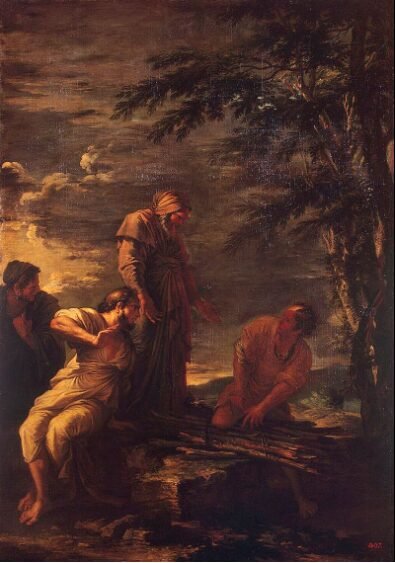
When Euathlus delayed pursuing legal practice, Protagoras sued him, leading to a paradox: if Protagoras won, Euathlus owed him; if Euathlus won, he still owed Protagoras under their agreement. Image: “Democritus and Protagoras” by Italian Baroque painter Salvator Rosa depicts them; though it’s said Democritus taught Protagoras, this is likely apocryphal.
Who were the sophists in ancient Greece?
The sophists were itinerant teachers who provided instruction in subjects such as politics, history, law, rhetoric, science, and mathematics. They taught wealthy young men, charging substantial fees and claiming to prepare them for political office and legal argumentation, which was highly valued in the litigious society of ancient Athens.
What subjects did the sophists teach?
The sophists taught a wide range of subjects, including politics, history, law, rhetoric, science, and mathematics. They also instructed students in the finer points of grammar and debate, aiming to equip them with skills for public speaking and legal disputes.
How did the sophists attract students and promote their services?
Sophists traveled between cities, giving public lectures, taking on students, and engaging in public debates. These debates served as a form of advertisement for their rhetorical skills, demonstrating their ability to argue persuasively on various topics.
How did Plato depict the sophists?
Plato portrayed the sophists negatively, depicting them as deceitful charlatans who exploited wealthy youth and their families by charging high fees for lessons that, in his view, could be learned for free through public education. He criticized their emphasis on rhetoric over true knowledge and their relativistic approach to truth.
Who was Protagoras, and what was his famous philosophical view?
Protagoras of Abdera was a famous sophist best known for his relativistic claim that “man is the measure of all things.” He believed that knowledge and experience were subjective, varying from person to person, and that objective truth was less important than individual interpretation.
Why did Plato have a particular disdain for Protagoras?
Plato criticized all sophists, but he seemed to reserve special disdain for Protagoras because of his relativistic philosophy. Protagoras’s view that truth was subjective clashed with Plato’s belief in absolute truths. Additionally, little of Protagoras’s work survived, so Plato’s critiques largely shaped modern perceptions of him.
What is Protagoras’s Paradox, also known as the Paradox of the Court?
Protagoras’s Paradox arises from a legal dispute between Protagoras and his student Euthalos. The agreement between them was that Euthalos would only pay Protagoras after winning his first court case.
However, Euthalos avoided taking cases after completing his education, leading Protagoras to sue him for payment. Both sides presented paradoxical arguments: Protagoras argued that he should be paid regardless of the outcome, while Euthalos argued that he did not owe payment in either case.
What was Protagoras’s argument in the paradox?
Protagoras argued that if he won the case, Euthalos would have to pay him by court order. If Euthalos won the case, he would still owe payment because, according to their original agreement, Euthalos would have won his first case, thereby triggering the payment.
What was Euthalos’s counterargument in the paradox?
Euthalos argued that if he won the case, the court would rule that he owed Protagoras nothing. If Protagoras won, Euthalos still would not have to pay because he would not have won his first case, meaning the condition for payment had not been fulfilled.
Why is Protagoras’s Paradox still discussed today?
Protagoras’s Paradox remains unresolved and is used as a thought-provoking exercise in logic and legal reasoning. It continues to be discussed in modern law schools, illustrating the complexity of contractual agreements and the challenges of interpreting legal conditions.





