Queen Hatshepsut, one of ancient Egypt’s most remarkable and enigmatic rulers, ascended to the throne during the 18th Dynasty, around 1479 BCE. As the daughter of Pharaoh Thutmose I and Queen Ahmose, Hatshepsut was born into royalty and became Egypt’s fifth pharaoh. Her reign lasted for over two decades, during which she solidified her legacy as a powerful and successful ruler.

Hatshepsut ruled as Pharaoh from around 1479 – 1458. Image: Kneeling figure of Queen Hatshepsut, from Western Thebes, Deir el-Bahari, Egypt, c. 1475 BC. Neues Museum
Early Life and Royal Lineage
Hatshepsut was born into one of Egypt’s most influential families. Her father, Thutmose I, was a prominent military leader who expanded Egypt’s borders and secured the nation’s prosperity. Her mother, Ahmose, was of royal lineage, linking Hatshepsut to the line of Amun, one of Egypt’s most revered gods.
As a young girl, Hatshepsut was groomed for a role of great importance, though initially, her destiny appeared to align with a life as a queen or regent rather than as a reigning pharaoh. She married her half-brother, Thutmose II, who succeeded their father as king. Their union followed the Egyptian tradition of royal siblings marrying to preserve the purity of the royal bloodline. Together, they had one daughter, Neferure.
Upon the death of Thutmose II, Hatshepsut became regent for his young son and her stepson, Thutmose III, who was too young to rule. This moment marked a pivotal shift in her life and Egypt’s history.

Thutmose II was the father of Thutmose III – Relief of Thutmose II in Karnak Temple complex.
READ MORE: Powerful Ancient Egyptian Deities that Protected Ra during his Journey through the Underworld
Assumption of Power

Head of a statue of ancient Egyptian pharaoh Queen Hatshepsut with her fake royal beard
Initially, Hatshepsut acted as regent for the young Thutmose III, but within a few years, she made an unprecedented decision—she proclaimed herself pharaoh. In doing so, she effectively sidelined her stepson, though he remained the official heir and was depicted in some reliefs alongside her. It was highly unusual for a woman to assume the full title and responsibilities of pharaoh, but Hatshepsut managed to secure the support of key officials, priests, and military leaders to legitimize her rule.
To reinforce her authority, Hatshepsut adopted the full regalia and symbols of kingship. She took on titles reserved for male rulers and depicted herself in traditional male attire, including the false beard associated with pharaohs. This visual transformation was not an attempt to conceal her gender but rather a demonstration that she was following in the footsteps of her male predecessors, assuming the sacred role of Egypt’s sovereign.
Religious Legitimacy and Divine Birth
One of the most critical components of Hatshepsut’s reign was her relationship with the religious establishment, particularly the powerful priesthood of Amun. She understood the importance of divine legitimacy in maintaining power, and she cultivated the idea that her rule was ordained by the gods.
Hatshepsut emphasized her connection to Amun, Egypt’s chief deity, by promoting the story of her divine birth. According to inscriptions, Amun had visited her mother in the form of Thutmose I and conceived Hatshepsut through divine will. This narrative, which was depicted in reliefs at her mortuary temple in Deir el-Bahri, was a direct claim to divine sanction, reinforcing her right to rule.
By associating herself so closely with Amun, Hatshepsut not only strengthened her position as pharaoh but also secured the loyalty of the powerful priesthood of Karnak, ensuring religious and political stability throughout her reign.
Achievements and Contributions

Hatshepsut — Statue of Hatshepsut on display at the Metropolitan Museum of Art
Hatshepsut’s reign was marked by prosperity, architectural achievements, and an emphasis on trade rather than military conquest. She worked diligently to restore Egypt’s wealth after years of military campaigns under her predecessors.
Trade Expeditions
One of her most famous accomplishments was the expedition to Punt, a region believed to be in modern-day Somalia or Eritrea. This journey, which is depicted in detail at Deir el-Bahri, brought back vast riches, including gold, ivory, ebony, and exotic animals. It also established stronger trade ties with Punt, boosting Egypt’s economy and securing valuable resources for the kingdom.

Land of Punt — Egyptian soldiers from Hatshepsut’s expedition to the Land of Punt as depicted from her temple at Deir el-Bahri
Architectural Innovations
Hatshepsut oversaw an extensive building program that not only beautified Egypt but also solidified her legacy. The most significant of these projects was her mortuary temple at Deir el-Bahri, a masterpiece of ancient Egyptian architecture. Situated in the cliffs of western Thebes, the temple was designed to honor both Hatshepsut and the god Amun. Its colonnaded terraces, grand statues, and intricate reliefs depicted her divine birth, major achievements, and connection to the gods.
She also commissioned numerous other temples, obelisks, and monuments, many of which were dedicated to Amun. Her contributions to the Temple of Karnak, in particular, were substantial, including the erection of towering obelisks, one of which still stands today.
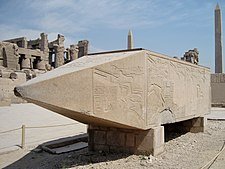
Hatshepsut was a prolific builder, sanctioning more than hundred construction projects in her two-decade reign, including the tallest obelisks in the world at the time. | A Fallen obelisk of Hatshepsut – Karnak.
Peace and Prosperity
Hatshepsut’s reign was relatively peaceful, focusing more on diplomacy and trade than on warfare. While Egypt maintained its military strength, she concentrated on economic growth and infrastructural development. This period of stability allowed Egypt to flourish, and it became one of the wealthiest and most powerful nations in the ancient world.
Challenges to Her Rule

Head of an Osiride Statue of Queen Hatshepsut, 5th Pharaoh of the New Kingdom
Though Hatshepsut’s reign was largely successful, she likely faced significant opposition. The idea of a female pharaoh was foreign to traditional Egyptian views of kingship. Her assumption of the throne may have raised eyebrows among conservative factions within the court, the priesthood, and the military.
To counter any dissent, Hatshepsut cleverly employed both political acumen and divine symbolism. By emphasizing her divine birth and close connection to Amun, she bolstered her claim to the throne, making it difficult for opponents to openly challenge her legitimacy without risking the wrath of the gods.
Hatshepsut also maintained a delicate balance in her relationship with Thutmose III. Although he was sidelined for much of her reign, he was not completely excluded from power. Thutmose III was educated in military and administrative matters, ensuring he was prepared to assume full control when the time came. This coexistence allowed for a relatively smooth transition after Hatshepsut’s death.

Thutmose III was the sixth pharaoh of the 18th Dynasty. Nicknamed by modern scholars as the Napoleon of Egypt, Thutmose III is credited with sending ancient Egypt to its greatest height, militarily and economically. His reign lasted for more than 50 years. And in that time, he conquered places in northern Syria and Nubia.
Disappearance from History and Legacy
After Hatshepsut’s death around 1458 BCE, Thutmose III became the sole ruler of Egypt and went on to become one of its most celebrated warrior pharaohs. However, approximately 20 years into his reign, efforts were made to erase Hatshepsut’s legacy. Her name and images were chiseled off monuments, and her statues were defaced or destroyed.
Historians have debated the reasons for this posthumous campaign against her memory. Some suggest that Thutmose III sought to assert his own authority by eliminating any reminders of his stepmother’s reign, while others believe it was a broader attempt to restore the traditional order, where only males held the highest office in the land.
Despite these attempts to erase her from history, Hatshepsut’s legacy endured. Many of her monuments survived, and her achievements were so significant that they could not be entirely forgotten. Her mortuary temple at Deir el-Bahri remains one of Egypt’s most iconic structures, and modern archaeologists and Egyptologists have restored much of her story.

Hatshepsut’s images and sculptors went through unimaginable indignity in the years following her death – The image of Hatshepsut has been deliberately chipped away and removed – Ancient Egyptian wing of the Royal Ontario Museum
Rediscovery and Modern Interpretation
Hatshepsut’s true significance was not fully appreciated until the 19th and 20th centuries when modern archaeologists began to uncover the extent of her contributions to Egyptian history. In 1903, British archaeologist Howard Carter discovered her tomb in the Valley of the Kings, though it was not until 2007 that her mummy was positively identified using DNA and dental evidence.
Today, Hatshepsut is recognized as one of ancient Egypt’s most successful and capable pharaohs. Her reign challenges traditional notions of gender and power in the ancient world. She demonstrated that a woman could rule as effectively as a man, and her accomplishments as a builder, diplomat, and administrator have cemented her place among Egypt’s greatest leaders.
Conclusion
Queen Hatshepsut’s reign as pharaoh was a remarkable period in ancient Egyptian history. As a daughter of Amun and a self-proclaimed king, she navigated the complexities of a male-dominated political system and left an indelible mark on her nation. Through her architectural achievements, trade expeditions, and ability to maintain stability, she secured a legacy that continues to inspire historians and scholars to this day.
READ MORE: Notable Female Rulers of Ancient Egypt
Questions and Answers

Hatshepsut was the fifth ruler of Egypt’s 18th Dynasty, reigning from 1479 to 1458 BCE. Her name means “Foremost of Noble Women.” Her royal name, Ma’at-ka-re, translates to “spirit of harmony and truth.” Image: A stone statue of Hatshepsut
What was Hatshepsut’s relationship to Thutmose I and Thutmose II?
Hatshepsut was the daughter of Thutmose I and Queen Ahmose. She married her half-brother Thutmose II, following the common practice of royal intermarriage in ancient Egypt to preserve royal bloodlines.
Who were Hatshepsut’s children?
Hatshepsut had a daughter, Neferu-Ra, with Thutmose II. Thutmose II also had a son, Thutmose III, by a minor wife named Isis, who would later succeed Hatshepsut.
How did Hatshepsut become pharaoh of Egypt?
After the death of her husband, Thutmose II, Hatshepsut initially served as regent for the young Thutmose III. However, she took the unprecedented step of declaring herself pharaoh, adopting the full regalia of a male ruler and legitimizing her reign by linking herself to the god Amun.
Why did Hatshepsut depict herself as a male king?
Hatshepsut depicted herself as a male king to legitimize her rule in a society where the role of pharaoh was traditionally held by men. She adopted the symbols of kingship, including the false beard, and portrayed herself as the divine daughter of Amun to gain acceptance.

Osirian statues of Hatshepsut at her tomb, one stood at each pillar of the extensive structure, note the mummification shroud enclosing the lower body and legs as well as the crook and flail associated with Osiris—Deir el-Bahri
What was Hatshepsut’s role as the “God’s Wife of Amun”?
Hatshepsut held the title “God’s Wife of Amun,” a prestigious religious role traditionally given to royal women. This position gave her influence over the powerful priesthood of Amun and helped her establish divine legitimacy for her claim to the throne.

The Hawk of the Pharaoh, Hatshepsut—Temple at Luxor
What challenges did Hatshepsut face as a female pharaoh?
Hatshepsut’s reign was unconventional, as Egypt had no precedent for a female pharaoh. Her decision to rule in her own right, rather than as a regent, likely caused friction within the royal court. However, she maintained her power for over 20 years through political alliances and religious legitimacy.
What happened to Hatshepsut after her death?
After Hatshepsut’s death, her stepson, Thutmose III, became the sole ruler. He later initiated a campaign to erase her legacy, removing her name and images from monuments. Despite this, many of her monuments, including her temple at Deir el-Bahri, survived and have been rediscovered by modern scholars.

Damnatio memoriae of Hatshepsut in Deir el-Bahari





