The rivalry between Sparta and Athens, two of the most prominent city-states of ancient Greece, was rooted in their contrasting political systems, cultural values, and historical circumstances.
While they temporarily united to repel common threats, particularly during the Persian Wars, their mutual suspicions and competition for dominance ultimately led to one of history’s most famous conflicts, the Peloponnesian War (431–404 BCE).
Below, World History Edu presents a detailed exploration of the events and dynamics that triggered and exacerbated their rivalry.
Contrasting Systems of Governance

While Athens is remembered for its intellectual and cultural legacy, and Sparta for its discipline and military prowess, their intertwined histories remind us of the potential for both collaboration and conflict among even the greatest of civilizations. Image: The Acropolis imagined in an 1846 painting by German painter Leo von Klenze
Athens and Sparta were fundamentally different in terms of their governance, culture, and societal organization.
- Athens: A democracy where political participation was open to all male citizens. Athens valued intellectual pursuits, artistic innovation, and naval power. Its Delian League was seen as a mechanism to project its influence across the Aegean Sea and beyond.
- Sparta: An oligarchic and militaristic society focused on land-based military dominance. Governed by a mixed constitution, including two kings and a council of elders, Spartan society emphasized discipline, austerity, and the maintenance of a strict social hierarchy. The Peloponnesian League, led by Sparta, opposed Athens’ growing influence.
This ideological divide created natural tension, as Athens sought to promote its democratic ideals while Sparta championed its conservative, oligarchic principles.
The Persian Wars and Athenian Naval Supremacy
The Persian Wars (499–449 BCE) provided an initial arena for cooperation between Athens and Sparta but also laid the groundwork for future discord.
- Sparta’s Leadership in the Early Persian Wars: During the Persian invasions of 490 and 480 BCE, Sparta played a leading role in the land battles, particularly at Thermopylae and Plataea. Sparta’s dominance on land reinforced its reputation as Greece’s military leader.
- Athens’ Naval Success: Athens, however, emerged as the key naval power, especially following the decisive Greek victory at the Battle of Salamis (480 BCE). This marked a turning point where Athens began to overshadow Sparta in terms of influence within the Greek world.
The aftermath of the Persian Wars highlighted Athens’ ambitions to expand its power. Athens spearheaded the creation of the Delian League in 478 BCE, ostensibly to defend against future Persian aggression. However, over time, the league evolved into an Athenian empire, sparking concerns in Sparta and its allies.
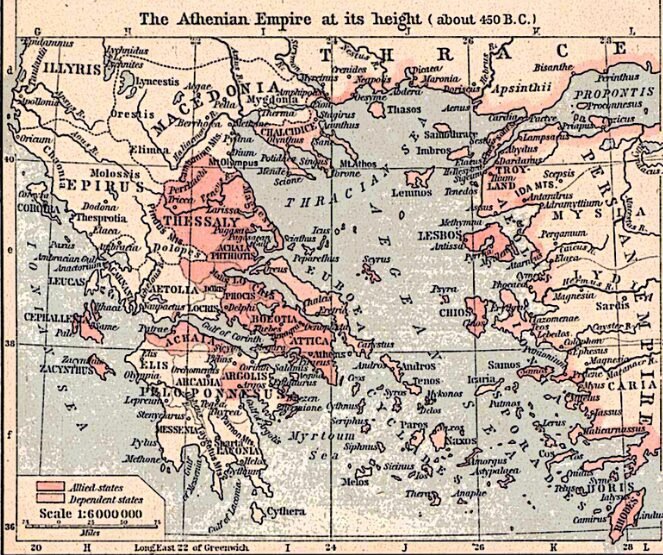
The Athenian Empire around 450 BC
The Transformation of the Delian League
Athens’ control over the Delian League became a significant source of tension.
- Centralization of Power: Athens centralized the league’s treasury on its own territory and used its naval superiority to enforce contributions from member states. Cities that resisted Athenian dominance, such as Naxos and Thasos, were subdued and forced back into the league.
- Imperial Overreach: Athens used league funds for its own projects, such as the construction of the Parthenon. This behavior angered not only the league’s members but also Sparta, which viewed Athenian imperialism as a direct challenge to its own influence.
Sparta, as the leader of the Peloponnesian League, began to position itself as the defender of Greek autonomy against Athenian hegemony.

Sparta and Peloponnesian League (red) at the outset of the Peloponnesian War around 431 BC
The First Peloponnesian War (460–445 BCE)
This early phase of conflict between Athens and Sparta, though less destructive than the later Peloponnesian War, was a key moment in the escalating rivalry.
- Athenian Expansion: Athens expanded its influence into central Greece, allying with Argos and other city-states. This encroached on Spartan interests, particularly in the Peloponnesus.
- Helot Revolt and Spartan Distrust: A major earthquake in 464 BCE devastated Sparta, triggering a helot revolt. Athens offered military assistance, but Sparta rejected it, suspecting that Athens might exploit the situation to weaken Sparta. This incident significantly strained their relationship.
- Peace of Callias and Temporary Respite: The First Peloponnesian War ended with the Thirty Years’ Peace (445 BCE), which temporarily eased tensions. However, the peace was precarious, as neither side fully trusted the other.
Economic and Trade Rivalry
Economic factors also fueled tensions. Athens’ dominance in maritime trade conflicted with Spartan interests.
- Athenian Naval Power: Athens controlled key trade routes in the Aegean and Mediterranean, leveraging its fleet to enforce economic dominance.
- Spartan Resource Dependency: Sparta’s economy relied heavily on agriculture and its helot population. As Athens became wealthier and more powerful, Sparta feared being overshadowed economically.
Cultural and Ideological Opposition
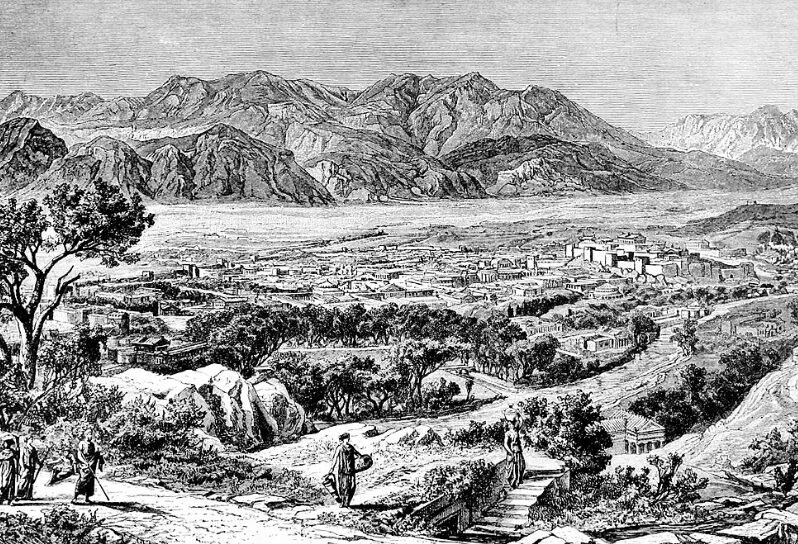
Depiction of ancient Sparta
The rivalry was also ideological, stemming from the stark differences between their ways of life.
- Athenian Democracy vs. Spartan Oligarchy: Athens’ promotion of democracy and free speech contrasted sharply with Sparta’s militaristic and oligarchic values. Athens saw Sparta as backward and authoritarian, while Sparta viewed Athens as decadent and destabilizing.
- Cultural Hegemony: Athens’ flourishing arts, philosophy, and drama during its Golden Age under Pericles were admired but also resented by other city-states, including Sparta. Athens’ sense of cultural superiority added another layer of tension.
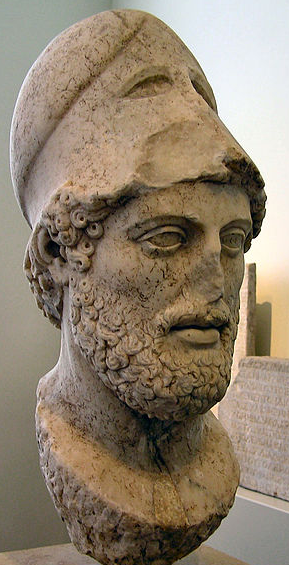
His antidemocracy and pro-Sparta policies often brought him into direct confrontation with Athenian pro-democracy statesman Pericles. Image: Bust of Pericles
The Megarian Decree and Immediate Triggers
The Megarian Decree, issued by Athens around 432 BCE, banned Megarian merchants from Athenian markets and ports. Megara was an ally of Sparta, and the decree caused significant economic hardship.
- Impact on Sparta: The decree was perceived as an affront to Spartan authority and an example of Athens’ overreach. It became one of the immediate catalysts for the outbreak of the Peloponnesian War.

Name vase of the Spartan artist known as the Rider Painter (Laconian black-figured kylix, c. 550–530 BCE)
The Peloponnesian War (431–404 BCE)

The Peloponnesian War epitomized the rivalry between Athens and Sparta.
- Sparta’s Land Power vs. Athens’ Naval Strength: The war was characterized by a clash of strategies. Sparta excelled in land battles, while Athens relied on its navy and fortifications.
- Alliances and Proxy Wars: Both sides formed alliances, drawing much of the Greek world into the conflict. This prolonged the war and intensified the devastation.
- Athens’ Overreach: The disastrous Sicilian Expedition (415–413 BCE) marked a turning point. Athens’ failed attempt to expand its influence in Sicily weakened its position and emboldened Sparta.
- Spartan Victory: With Persian financial support, Sparta built a navy and eventually defeated Athens in 404 BCE, bringing the Peloponnesian War to an end. However, the rivalry left both city-states weakened, paving the way for the rise of Macedon under Philip II and Alexander the Great.
Long-Term Consequences
The rivalry between Athens and Sparta reshaped the Greek world.
- Decline of Both Powers: The protracted conflict drained resources and manpower, diminishing both Athens and Sparta as major powers.
- Rise of Macedon: The weakened Greek city-states were unable to resist the expansion of Macedon, which eventually united Greece under its rule.
- Legacy of the Rivalry: Despite its destructive nature, the rivalry between Athens and Sparta is remembered for its cultural and historical significance, providing valuable insights into the complexities of ancient Greek politics and society.
Conclusion
The rivalry between Sparta and Athens was driven by deep-seated differences in governance, culture, and ambition. While external events like the Persian Wars and economic competition played a role, it was their ideological opposition and quest for dominance that ultimately brought them into conflict. This rivalry not only shaped the history of ancient Greece but also left a lasting legacy on Western political and philosophical traditions.
Frequently Asked Questions

The rivalry between Athens and Sparta was as complex as it was consequential. It was fueled by their ideological differences, territorial ambitions, and mutual mistrust, culminating in a conflict that reshaped the ancient Greek world. Image: Artist’s impression of the Theatre of Dionysus
What were the fundamental differences between Athens and Sparta?
Athens was a democratic, culturally vibrant city-state focused on intellectual pursuits, trade, and art, while Sparta was a militaristic autocracy emphasizing discipline, warfare, and austerity.
How did Athens contribute to Western culture?
Athens is celebrated as the birthplace of democracy, Western philosophy (through Socrates, Plato, and Aristotle), theater (via playwrights like Sophocles and Euripides), and architectural achievements like the Parthenon.
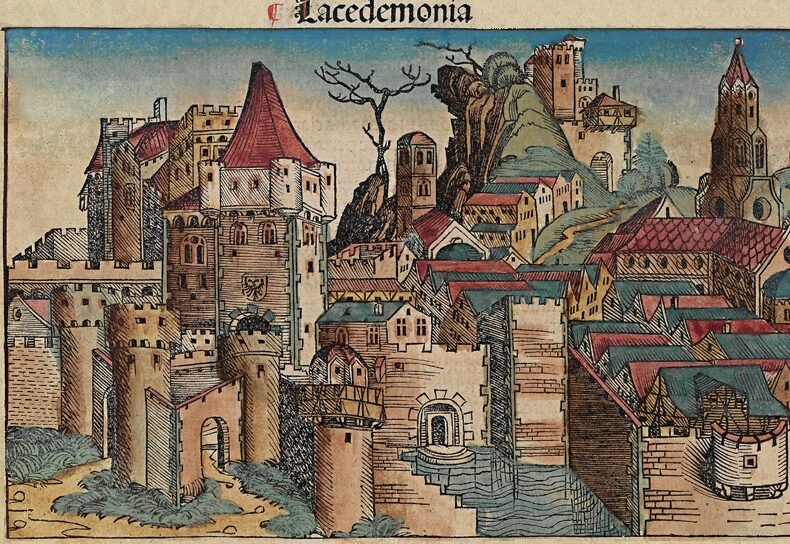
Medieval depiction of Sparta from the Nuremberg Chronicle (1493)
What was the Spartan social structure like?
Spartan society revolved around a warrior elite supported by helots (state-owned serfs). Male citizens trained as soldiers from childhood, while women underwent physical training to ensure strong offspring.

Jean-Pierre Saint-Ours, The Selection of Children in Sparta, 1785. A Neoclassical imaging of what Plutarch describes.
What brought Athens and Sparta together temporarily?
During the Greco-Persian Wars (490–479 BCE), Athens and Sparta united to repel Persian invasions, with Sparta excelling in land battles and Athens dominating naval warfare.
What was the Delian League, and why did it cause tensions with Sparta?
The Delian League, led by Athens, was an alliance to protect against future Persian threats. It evolved into an Athenian empire, enriching Athens and alarming Sparta, leading to increased rivalry.

The Delian League in 431 BC
What triggered the Peloponnesian War?
Tensions over Athens’ expansionist ambitions and dominance through the Delian League clashed with Sparta’s efforts to preserve Greek stability via the Peloponnesian League, leading to war in 431 BCE.
What were the key events of the Peloponnesian War?
Major events included the Plague of Athens (430 BCE), the failed Sicilian Expedition (415–413 BCE), and Sparta’s controversial alliance with Persia, which enabled its naval victory in 404 BCE.

Greece at the beginning of the Peloponnesian War
How did Sparta’s dominance after the Peloponnesian War backfire?
Sparta’s imposition of oligarchic governments alienated allies, and its overreach led to resentment and military defeats, such as the pivotal Battle of Leuctra in 371 BCE, marking its decline.
What lessons can be learned from the Athens-Sparta rivalry?
The rivalry highlights the dangers of internal conflict and the fragility of alliances, emphasizing the need for unity and the value of balancing diverse societal strengths.
How does the Athens-Sparta conflict influence modern thought?
The contrasting ideologies of Athens and Sparta continue to inform debates on governance, freedom, and societal priorities, showcasing the enduring impact of their historical legacy.





