The Seven Years’ War (1756–1763) was a global conflict that reshaped the geopolitical landscape of Europe, North America, and beyond. It engaged most major European powers, split into two main coalitions. On one side, Britain and Prussia aligned strategically against France and Austria, with Spain, Saxony, Sweden, and Russia backing the latter. This war, encompassing various regional conflicts such as the French and Indian War in North America, the Anglo-Spanish War, and the Spanish-Portuguese War, remains a defining event of 18th-century history.
Origins of the Conflict
The root causes of the Seven Years’ War lay in unresolved tensions from the War of the Austrian Succession (1740–1748). That earlier conflict had left Austria weakened and determined to reclaim its territory of Silesia, lost to Prussia. Concurrently, colonial rivalries between Britain and France intensified, particularly in North America, where competition over the Ohio River Valley created friction.
The mid-18th century also witnessed a significant shift in European alliances known as the Diplomatic Revolution of 1756. Austria abandoned its traditional rivalry with France, entering into a surprising alliance, while Prussia secured British support. These realignments created a volatile backdrop that exploded into open conflict.
Theaters of War

The Battle of Kunersdorf (12 August 1759)
Europe
In Europe, the Seven Years’ War centered on Prussia’s struggle to maintain dominance against Austria and its allies. Under Frederick the Great, Prussia achieved early victories, such as the Battle of Rossbach in 1757, where Frederick’s tactics decisively defeated Franco-Austrian forces. However, the Prussians also faced setbacks, particularly against Russian and Austrian armies, as seen in the Battle of Kunersdorf in 1759.
The Treaty of Hubertusburg in 1763 ended the European conflict, affirming Prussia’s hold on Silesia and establishing it as a major power within the Holy Roman Empire. Austria, though failing to regain Silesia, retained its status as a dominant European player, solidifying internal reforms in preparation for future conflicts.
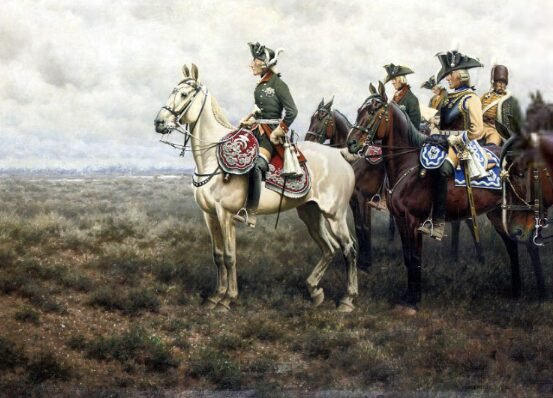
Frederick the Great and staff at Leuthen
North America
Known as the French and Indian War, this theater involved Britain and France vying for control over the North American continent. The British initially suffered defeats, such as at Fort William Henry, but turned the tide with victories at key locations like Quebec in 1759. The capture of Quebec marked a turning point, leading to Britain’s dominance over French Canada.
Asia
In India, the war manifested as the Third Carnatic War, part of a broader struggle between Britain and France for colonial supremacy. British forces under Robert Clive secured critical victories, such as the Battle of Plassey in 1757, which established British dominance in Bengal. The fall of French strongholds like Pondicherry by 1761 effectively ended French colonial ambitions in India.
The Caribbean and the Philippines
Britain also targeted French and Spanish colonies in the Caribbean and Asia. The capture of Havana in 1762 and Manila in the Philippines underscored Britain’s naval superiority and strategic focus on crippling its adversaries’ colonial economies.
Key Battles and Strategies
The Seven Years’ War showcased evolving military strategies and technologies. European armies relied on disciplined infantry formations, supported by cavalry and artillery. Frederick the Great’s use of rapid movements and concentrated attacks, exemplified at Leuthen, revolutionized military tactics. In North America, irregular warfare involving Native American allies and settlers played a crucial role, particularly in the dense forests of the frontier.
Naval warfare was equally pivotal. Britain’s dominance at sea allowed it to cut off French supplies, blockade ports, and support far-flung campaigns, such as those in India and the Caribbean.
Consequences
The Treaty of Paris (1763) redrew the global map. Britain emerged as the preeminent colonial power, gaining Canada, Florida, and territories in India while ceding the lucrative Caribbean islands of Guadeloupe and Martinique back to France. Spain gained Louisiana but lost Florida to Britain.
Prussia’s survival and success elevated it to a great power, challenging Austria for dominance within the Holy Roman Empire and paving the way for German unification over a century later. Conversely, France’s defeat weakened its position in Europe and abroad, setting the stage for internal unrest and eventual revolution.
The war left all participants economically strained. Britain’s victory came at the cost of a soaring national debt, prompting new taxation policies in the American colonies that fueled revolutionary sentiments. France’s financial woes deepened, contributing to the fiscal crises that culminated in the French Revolution.
Cultural and Historical Legacy
The Seven Years’ War is remembered not only for its military and political outcomes but also for its influence on subsequent events. It solidified Britain’s maritime empire, reshaped European alliances, and demonstrated the interconnectedness of global conflicts. Through the war, the balance of power in Europe was altered, colonial empires were expanded or dismantled, and the seeds of future revolutions were sown.
Frequently Asked Questions

Prussian Leibgarde battalion at Kolín, 1757
What were the primary alliances in the Seven Years’ War?
The war featured Britain and Prussia against France, Austria, and their allies, including Spain, Russia, and Sweden.
Why did the war begin?
Tensions from the unresolved War of the Austrian Succession, colonial rivalries between Britain and France, and Austria’s desire to reclaim Silesia from Prussia sparked the conflict.
What was the Diplomatic Revolution of 1756?
It was a realignment of alliances, with Austria partnering with France and Prussia allying with Britain, shifting traditional rivalries in Europe.
What were the key theaters of the war?
The conflict spanned Europe, North America (French and Indian War), India (Third Carnatic War), the Caribbean, and the Philippines.
How did Britain achieve dominance in North America?
Through decisive victories like the capture of Quebec in 1759, Britain gained control over French Canada and expanded its colonial empire.
What role did Frederick the Great play in the war?
Frederick’s military leadership, marked by victories like Rossbach and Leuthen, secured Prussia’s status as a great power despite facing multiple adversaries.

The Battle of Leuthen in Silesia, by German painter Carl Röchling
What were the major outcomes of the Treaty of Paris (1763)?
Britain gained Canada, Florida, and parts of India, while France retained only a few territories. Spain gained Louisiana but lost Florida.
How did the war influence future conflicts?
The war set the stage for the American Revolution by straining British finances and policies, weakened France ahead of its revolution, and reshaped European and colonial power dynamics.
Seven Years’ War Timeline (1754–1763)

The Battle of Rossbach in Saxony





