Songhai Empire – History, Accomplishments and Major Facts
The Songhai Empire was a massive, multicultural West African state that spanned between the 15th and 16th centuries CE. With an area primarily covering western Sahel, Songhai kings rose to...
Throughout history, several empires have achieved vast territorial expansions and exerted immense influence over large portions of the world.
Here are some of the largest empires in world history based on territorial size and influence:
At its peak, the British Empire was the largest in history and was often said that “the sun never sets” on it. It included territories in North America, Africa, Asia, and the Pacific.
Established by Genghis Khan, it spanned from Eastern Europe to Asia, including China, making it the largest contiguous land empire in history.
At its height, it stretched from Eastern Europe to Alaska, making Russia a major world power.
With territories in the Americas, Africa, Asia, and Oceania, Spain’s conquests began with the voyages of Columbus and continued for several centuries.
The last imperial dynasty of China, it controlled vast territories in East Asia.
Spanning from Spain in the west to India in the east, it was one of the largest Muslim empires in terms of territory.
The Persian Empire (Achaemenid Empire)
Established by Cyrus the Great, it spanned three continents: Europe, Asia, and Africa.
Lasted for over 600 years, and at its height, it controlled much of Southeastern Europe, Western Asia, and Northern Africa.
One of the most influential empires in terms of culture, law, politics, and infrastructure. Its territories spanned from the British Isles to North Africa and the Middle East.
One of the largest empires on the Indian subcontinent, established by Chandragupta Maurya.
Following the Umayyads, the Abbasids controlled a vast Muslim empire, which became a center for science, culture, and commerce.
It’s worth noting that the concept of “largest” can be measured in different ways, such as landmass, population, duration, or influence. The list above emphasizes landmass but also takes into account the global influence of these empires.
Here are some of the largest empires in history based on their peak population:
At its height in the early 20th century, the British Empire governed over a quarter of the world’s population, with estimates of up to 458 million people.
In the late 18th century, during its peak, the Qing Dynasty had a population of around 300 million, governing the vast territory of China and its surrounding regions.
By the early 20th century, just before the Russian Revolution, the empire’s population was estimated to be over 170 million.
At its height around the mid-9th century, the Abbasid Caliphate, which stretched from North Africa to Central Asia, had a population estimated to be between 30 to 60 million.
At its peak in the 2nd century AD, estimates suggest the Roman Empire had a population of around 50 to 90 million inhabitants.
One of ancient India’s largest empires, during the reign of Ashoka in the 3rd century BC, had a population that some estimate to be around 50 million.
Under Darius the Great in the 5th century BCE, the empire might have had a population of about 35 million, spanning three continents.
During the 8th century, the Umayyad’s territory from Spain to India had a population that could be estimated between 20 to 30 million.
In the late 16th century, at its height, the Ottoman Empire’s population was around 25 to 35 million.
In the 17th century, the Spanish Empire, which included territories in Europe, the Americas, and Asia, had a population of over 12 million in the Americas alone.
Estimating populations in ancient and even some relatively recent empires can be challenging due to a lack of accurate census data and differing methods of estimation. However, these figures provide a rough approximation of the vast numbers of people these empires encompassed.

The Songhai Empire was a massive, multicultural West African state that spanned between the 15th and 16th centuries CE. With an area primarily covering western Sahel, Songhai kings rose to...
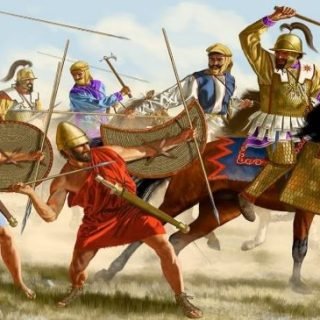
Over the course of human history, empires such as the Byzantine Empire and the Roman Empire have been considered as some of the largest and longest running empires. However, in...

An empire is formed when a nation’s sovereignty extends beyond its borders and into other territories. The enormity of an empire depends on several factors. Some of them include population,...





