What was the October 1973 Arab-Israeli War?
The October 1973 War, also known as the Yom Kippur War (in Israel) or the Ramadan War (in Arab countries), was a significant conflict that pitted Israel against a coalition...
The Yom Kippur War, in October 1973, saw Israel combatting a coalition led by Egypt and Syria. The conflict began on the Jewish holiday, Yom Kippur, and had significant geopolitical ramifications.
[caption id="attachment_25036" align="aligncenter" width="363"] The Yom Kippur War was a conflict fought between Israel and a coalition of Arab states, primarily Egypt and Syria, in October 1973.[/caption]
Here are some major facts about the war:
The war began on the Jewish holiday of Yom Kippur, the Day of Atonement, when many Israelis were fasting and observing religious traditions.
The war was primarily a result of the ongoing Arab-Israeli conflict. Egypt and Syria sought to regain territories lost to Israel during the 1967 Six-Day War, specifically the Sinai Peninsula and the Golan Heights.
The major participants were Israel, Egypt, and Syria. However, other Arab nations like Jordan, Iraq, and Morocco also provided support to the Arab coalition.
The war concluded with a ceasefire on October 25, 1973. While it ended in a military stalemate, both sides experienced significant casualties and equipment losses.
The war had profound implications for the Middle East. It eventually paved the way for the Camp David Accords between Egypt and Israel, leading to a peace treaty. Additionally, the war’s aftermath saw significant shifts in superpower alignments in the region.
The war led to the 1973 oil crisis, as Arab oil-producing countries imposed an oil embargo on nations that supported Israel, causing oil prices to skyrocket worldwide.
While the war did not immediately result in significant territorial changes, the subsequent peace process, particularly the Camp David Accords, led to Israel’s withdrawal from the Sinai Peninsula in exchange for peace with Egypt.
The United States was the primary supporter of Israel, supplying the country with weapons and resources.
The Soviet Union mainly supported the Arab states, particularly Egypt and Syria, by supplying them with weapons and military hardware.
[caption id="attachment_25029" align="aligncenter" width="600"]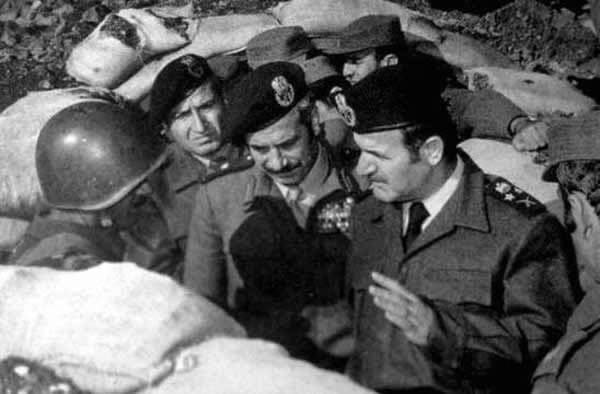 Syrian President Hafez al-Assad (right) with soldiers, 1973[/caption]
The war underscored the necessity of peace negotiations and paved the way for subsequent peace talks between Israel and its Arab neighbors. Additionally, the trauma of the surprise attack had lasting effects on Israel’s military doctrine and preparedness.
While the immediate military outcome was inconclusive, the war’s political ramifications led to Egypt, the most significant Arab military power, gradually shifting its stance and eventually making peace with Israel, altering the dynamics in the region.

The October 1973 War, also known as the Yom Kippur War (in Israel) or the Ramadan War (in Arab countries), was a significant conflict that pitted Israel against a coalition...





