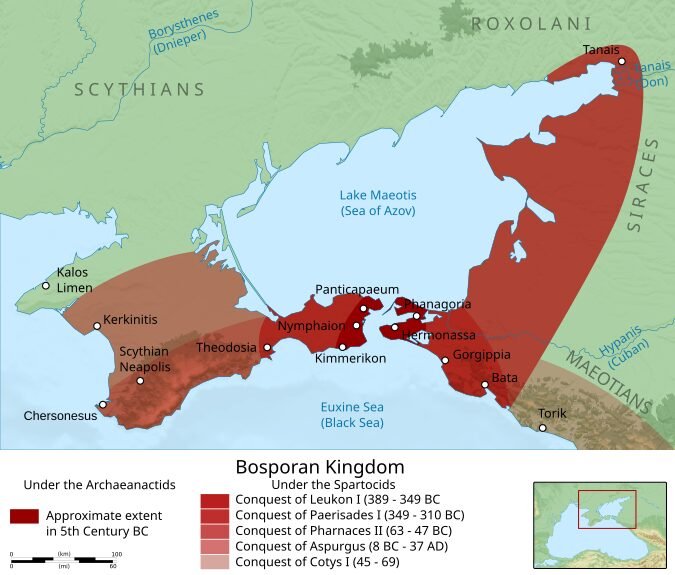
A map illustrating the early expansion of the Bosporan Kingdom, prior to its annexation by Mithridates VI of Pontus.
The Bosporan Kingdom, also known as the Kingdom of the Cimmerian Bosporus, was a significant ancient Greco-Scythian state that emerged along the eastern Crimean Peninsula and the Taman Peninsula, surrounding the modern-day Strait of Kerch. The state derived its name from the Cimmerian Bosporus, the ancient term for this strategic waterway. The Bosporan Kingdom is often celebrated as the first truly Hellenistic state where a blended population adopted Greek language, culture, and governance under aristocratic leadership.
Foundations and Governance
The kingdom was initially established as a cluster of Greek colonies before evolving into a cohesive state. Governed by the Spartocid dynasty for centuries, the Bosporan Kingdom had a unique dual governance system. Rulers portrayed themselves as archons (leaders) to Greek subjects while adopting the role of kings to their Scythian and Sarmatian neighbors. This diplomatic adaptability helped the Bosporan kings maintain control over diverse ethnic groups, a feature regarded as exceptional in ancient history.
Geography and Strategic Importance of the Kingdom
The Bosporan Kingdom’s territory encompassed both the Crimean and Taman peninsulas, connected by the Kerch Strait. This region served as a crossroads between Europe and Asia, linking the Black Sea to the Sea of Azov. Its position made it a key player in the trade networks connecting the Greek world to the steppes of Eurasia, the Caucasus, and beyond. The surrounding geography, including the fertile Pontic-Caspian Steppe and the temperate Crimean coastline, provided resources for both agriculture and trade.
Economic Prosperity
The kingdom’s wealth stemmed primarily from its export of wheat, fish, and slaves. As the economic hub of the Black Sea, it gained the moniker “Jewel of the Black Sea.” The thriving trade allowed the kingdom to support an affluent aristocracy, whose opulence is evident from archaeological finds in burial mounds, or kurgans. Excavated artifacts, including gold jewelry, Greek pottery, and other luxury goods, highlight the integration of Greek craftsmanship with local cultural elements.
Greek Colonization and Urban Development
Greek settlers, primarily from Miletus, founded the region’s earliest colonies in the 7th and 6th centuries BCE. Key cities included Panticapaeum (modern Kerch), the kingdom’s capital, and Phanagoria, its second-most prominent city. Other notable settlements, such as Nymphaeum, Myrmekion, and Gorgippia, played roles in establishing a vibrant urban network. These cities were not only trade hubs but also centers of Hellenistic culture, religion, and governance.
Dynastic History
The earliest ruling family, the Archaeanactids, governed from 480 to 438 BCE. Little is known about their reign, but they likely laid the groundwork for the kingdom’s consolidation.
In 438 BCE, the Spartocid dynasty replaced the Archaeanactids and ruled until approximately 110 BCE. This era marked significant territorial and economic expansion. Under rulers like Satyrus I and Leucon I, the Spartocids unified the region, subdued rival cities, and transformed the kingdom into a grain-exporting powerhouse, closely allied with Athens.
The Spartocid dynasty established a unique dual governance, presenting as archons to Greeks and kings to barbarians. They expanded the kingdom’s influence and facilitated economic growth through trade.
In the late 2nd century BCE, the kingdom fell under the influence of Mithridates VI of Pontus. After his death in 63 BCE, his descendants continued to play a role in the Bosporan throne, ensuring continuity despite Roman encroachment.
Military and Cultural Synthesis
The Bosporan military reflected the cultural amalgamation of Greek and Scythian influences. The kingdom’s armies comprised Greek soldiers, Thracian mercenaries, and a large contingent of Scythian cavalry and infantry. This diverse composition enabled the Bosporans to repel invasions and expand their territories. Simultaneously, the blending of cultures shaped the region’s art, religion, and traditions, fostering a distinct Greco-Scythian identity.
Golden Age and Roman Client Kingdom
The kingdom experienced a renaissance during the 1st and 2nd centuries CE under Roman patronage. King Sauromates II (late 2nd century CE) extended the kingdom’s reach across the Crimean Peninsula, defeating the Scythians and solidifying control over key territories.
From 63 CE, the Bosporan Kingdom became a Roman client state, maintaining relative autonomy while receiving military and economic support. Roman emperors, including Nero and Galba, intermittently incorporated the region into their provinces but largely allowed the Bosporan rulers to govern as local kings under Roman oversight.

Archaeological Legacy
The Bosporan Kingdom left behind a rich archaeological legacy. Excavations of cities such as Panticapaeum and Phanagoria have uncovered remains of temples, theaters, and residential quarters, showcasing Hellenistic architectural styles. The kurgans, burial mounds scattered across the region, have yielded treasures such as gold phiales, Attic pottery, and intricately crafted ornaments. These artifacts provide insights into the kingdom’s wealth and cultural hybridity.
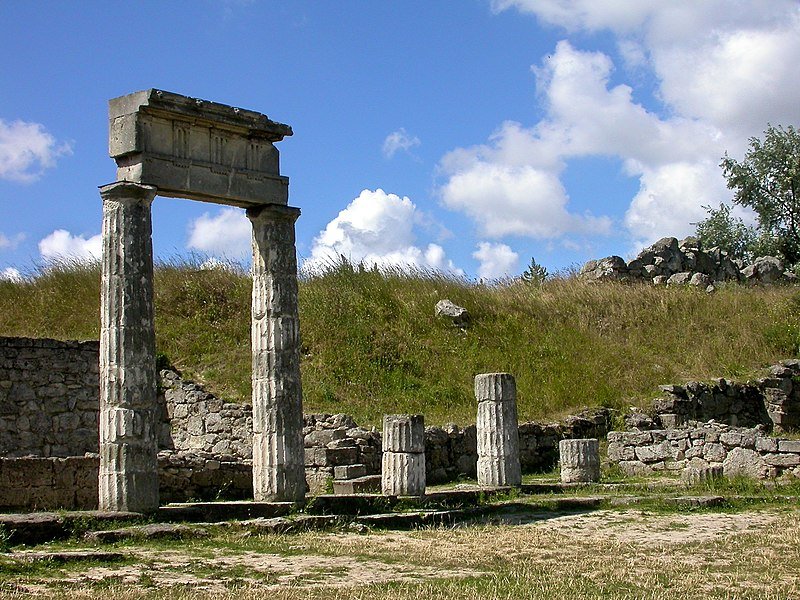
The ruins of Panticapaeum, located in modern-day Kerch, once served as the capital of the Bosporan Kingdom.
Economic and Cultural Exchange
The Bosporan economy thrived on its role as a trade intermediary. It exported surplus grain to Greece and imported luxury goods like wine and olive oil. Over time, the local culture integrated Greek, Scythian, and later Roman influences, as seen in the kingdom’s religious practices and artistic expressions. Deities from Greek mythology coexisted with local gods, reflecting the region’s diverse spiritual landscape.
Later Period and Decline
By the 3rd and 4th centuries CE, the kingdom faced challenges from migrating Gothic and Hunnic tribes. The Bosporan economy suffered due to disrupted trade routes, and the kingdom’s autonomy gradually diminished. Coins from the late 4th century CE, minted by the last known king Rhescuporis VI, suggest that the kingdom retained some independence until it was eventually absorbed into Gothic or Hunnic domains.
Despite setbacks, the region witnessed a revival under Byzantine protection in the 5th and 6th centuries CE. Cities like Phanagoria became cultural and economic centers again, while the Byzantine Empire reasserted control over key territories. Coins and inscriptions from this era suggest that local rulers continued to govern under Byzantine suzerainty.
Coinage and Artistic Achievements
Bosporan coinage, produced from the 5th century BCE onwards, is a testament to the kingdom’s economic and political stability. Early coins depicted Greek gods and mythological creatures, while later issues featured portraits of Roman emperors alongside Bosporan kings. These coins reflect the kingdom’s shifting allegiances and cultural affiliations.
In art, the kingdom produced exquisite jewelry, pottery, and sculpture, blending Greek styles with local motifs. The fusion of Hellenistic and indigenous elements in Bosporan artifacts highlights the kingdom’s unique position at the crossroads of civilizations.





