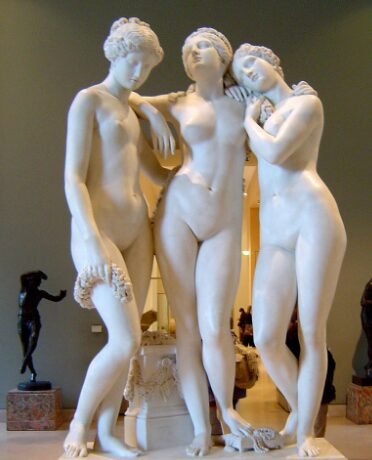
The lasting legacy of the Charites in Western culture is evident in their continued influence on ideals of beauty, charm, and grace. Their attributes are celebrated in art, literature, and social customs, serving as timeless symbols of harmonious and joyous living. Image: Les Trois Grâces by Genevan-born French sculptor James Pradier, 1831. Louvre, Paris, France
The Charites, also known as the Graces, are a trio of goddesses in Greek mythology who personify beauty, charm, and grace. They play a crucial role in the pantheon of Greek deities, representing the essential qualities that bring joy and harmony to both gods and humans. The Charites are often depicted as attendants of other major gods and goddesses, participating in divine festivities and assisting in the affairs of love, creativity, and social life.
The Origins and Names of the Charites
The Charites are typically considered the daughters of Zeus, the king of the gods, and Eurynome, an Oceanid or sea nymph. However, there are variations in their parentage across different sources. Some myths suggest they are the daughters of Dionysus and Aphrodite, reflecting their association with festivities and beauty.
The three most commonly named Charites are:
- Aglaea: Often translated as “Splendor” or “Radiance,” Aglaea embodies the beauty and brilliance of grace and charm. She is sometimes also associated with the creative arts, given her connection to splendor and radiance.
- Euphrosyne: Her name means “Mirth” or “Joy,” representing the delight and happiness that come from beauty and grace. Euphrosyne embodies the joyous and pleasurable aspects of life, bringing cheer to both gods and mortals.
- Thalia: Meaning “Good Cheer” or “Blooming,” Thalia is associated with the flourishing and bountiful aspects of nature. She represents the prosperity and exuberance that come from the harmonious interaction of beauty and charm.
Depictions and Symbols
The Charites are usually depicted as young, beautiful women dancing in a circle or standing in a close embrace, symbolizing the unity and interdependence of their qualities. They are often portrayed nude or lightly draped, emphasizing their natural beauty and the purity of their grace.
Their symbols include:
- Roses: Representing beauty and love, often seen in their hands or woven into garlands they wear.
- Myrtle: A plant sacred to Aphrodite, symbolizing love and immortality.
- Musical Instruments: Such as lyres and flutes, highlighting their association with the arts and harmonious celebrations.
Roles and Functions
The Charites have various roles and functions in Greek mythology, often revolving around their core attributes of beauty, charm, and grace:
Attendants of Aphrodite: As goddesses of beauty, the Charites are closely associated with Aphrodite, the goddess of love and beauty. They attend to her, enhancing her beauty and charm, and participate in the rituals and festivities that celebrate love and attraction.
Companions of the Muses: The Charites are also linked with the Muses, the goddesses of the arts and sciences. They inspire and support the Muses in their creative endeavors, embodying the aesthetic and joyous aspects of artistic creation.
Divine Hosts: The Charites are often depicted as hosts of divine banquets and celebrations, ensuring that the gatherings are filled with joy, beauty, and harmony. They serve nectar and ambrosia to the gods, enhancing the pleasures of divine feasts.
Patronesses of Social Grace: Among mortals, the Charites are revered as patronesses of social grace and good manners. They are invoked in social gatherings, weddings, and festivals to bring joy, charm, and harmonious interactions.
Symbols of Fertility and Growth: Thalia, in particular, is associated with the blooming of nature and the bountiful aspects of growth and fertility. The Charites collectively represent the flourishing of life and the harmonious balance necessary for prosperity.
Mythological Narratives
While the Charites do not have many myths centered exclusively on them, they frequently appear in various mythological narratives, illustrating their integral role in the Greek mythological landscape.
The Birth of Aphrodite: The Charites are present at the birth of Aphrodite, welcoming her and adorning her with beautiful garments and jewelry. Their presence underscores the connection between beauty, love, and grace.
The Wedding of Peleus and Thetis: At the famous wedding of Peleus and Thetis, which ultimately led to the Trojan War, the Charites were among the divine guests. Their participation highlights the celebration of divine beauty and harmony in social events.
The Labors of Heracles: In some versions of the myth, Heracles receives the help of the Charites during his labors, particularly in obtaining the girdle of Hippolyta, the queen of the Amazons. Their assistance signifies the importance of charm and persuasion in achieving goals.
Hephaestus and Aglaea: Aglaea, one of the Charites, is sometimes depicted as the wife of Hephaestus, the god of blacksmiths and craftsmen. This union symbolizes the harmony between creative artistry and splendor.
The Cult and Worship of the Charites
The worship of the Charites was widespread in ancient Greece, with various cities and regions having their own cults and festivals dedicated to these goddesses. The primary centers of their worship included:
Orchomenus in Boeotia: This city was one of the most significant centers of worship for the Charites. The temple of the Charites in Orchomenus was a renowned site, and the city hosted the Charitesia festival, which included athletic and musical competitions in their honor.
Athens: In Athens, the Charites were honored with the Charitesia festival, which celebrated the arts, beauty, and social harmony. The festival included musical and theatrical performances, reflecting the Charites’ association with the Muses and the arts.
Sparta: The Spartans also revered the Charites, and their worship in Sparta emphasized the aspects of grace and harmony in social and martial contexts.
Paros: On the island of Paros, the Charites were worshiped as fertility goddesses, and their cult was linked to agricultural festivals celebrating the bountiful harvests.
The rituals and offerings to the Charites typically included flowers, music, dance, and sometimes animal sacrifices. The celebrations were characterized by joyous and harmonious activities, reflecting the qualities embodied by the Charites.
The Legacy of the Charites
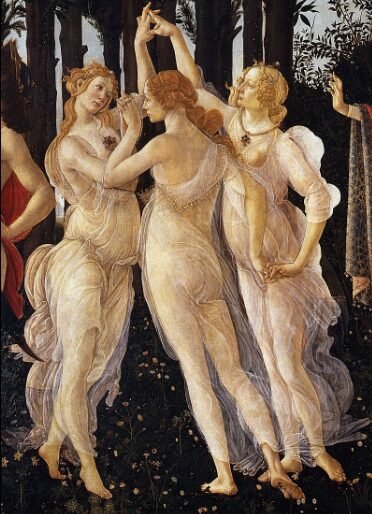
As attendants of the Greek goddess Aphrodite and companions of the Muses, the Charites embody the harmonious and joyous aspects of life, enhancing the beauty and delight of the world. Image: The Three Graces, from Italian painter Sandro Botticelli’s painting Primavera in the Uffizi Gallery.
The Charites have left an enduring legacy in Western culture, influencing various aspects of art, literature, and social customs. Their representation of beauty, charm, and grace has continued to inspire and shape cultural ideals.
Art and Sculpture: The Charites have been a popular subject in classical art, with numerous sculptures, paintings, and mosaics depicting them in various poses. Their portrayal in art has often emphasized their harmonious and graceful qualities, serving as an ideal of beauty and elegance.
Literature: The Charites have been referenced in various literary works throughout history. In poetry, they are often invoked as muses or symbols of inspiration, representing the joyous and harmonious aspects of creation.
Renaissance and Neoclassical Art: During the Renaissance and Neoclassical periods, the Charites were frequently depicted in art, embodying the ideals of beauty, harmony, and grace that were central to these movements. Artists such as Botticelli and Raphael created renowned works featuring the Charites, celebrating their timeless appeal.
Modern Influence: The influence of the Charites extends into modern times, with their qualities of beauty, charm, and grace continuing to be valued in contemporary culture. They are often referenced in discussions of aesthetics, social etiquette, and the arts.
Raphael’s “The Three Graces”
“The Three Graces,” painted by renowned Italian artist Raphael between 1504-1505, depicts the Charites of Greek mythology, symbolizing beauty, charm, and grace. This Renaissance masterpiece captures three young maidens in an elegant, harmonious pose, reflecting the period’s ideals of classical beauty and humanistic aesthetics.
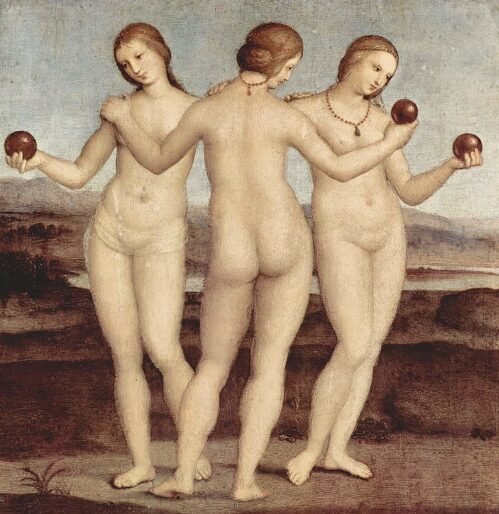
The Three Graces by renowned Italian painter Raphael, 1504–1505.
Frequently Asked Questions about the Charites
The Charites, also known as the Graces, are a group of goddesses in Greek mythology who preside over charm, grace, beauty, creativity, and fertility. They are typically depicted as young, beautiful maidens and are associated with the arts, particularly dance and song.
Below are some frequently asked questions about these characters from Greek mythology:
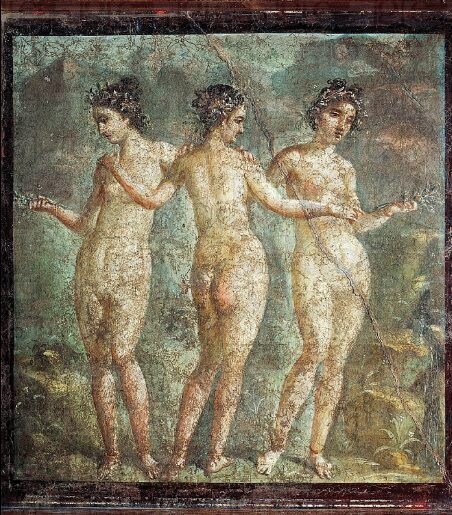
The Charites, or Graces, hold a significant place in Greek mythology as goddesses of beauty, charm, and grace. Their presence in mythological narratives, artistic depictions, and cultural practices highlights their importance in both divine and mortal realms. Image: The Three Graces in a fresco at Pompeii, 1-50 AD
What are the names of the three primary Charites?
The three primary Charites are Aglaea, Euphrosyne, and Thalia.
What does each of the three primary Charites represent?
Aglaea represents beauty, Euphrosyne represents joy, and Thalia represents festivity and abundance.
Who are the parents of the Charites according to Greek mythology?
The Charites were believed to be the daughters of Zeus, the king of the gods, and the nymph Eurynome.
With which major Greek goddess are the Charites often depicted as companions?
The Charites are often depicted as companions of Aphrodite, the goddess of love and beauty.
Besides Aphrodite, with which other gods are the Charites associated?
The Charites are also associated with other gods, such as Apollo and Dionysus.
What roles do the Charites play in Greek culture and mythology?
The Charites are invoked in prayers and offerings to promote beauty, grace, and harmony in daily life. They are considered divine protectors of the arts and creativity and their influence is felt throughout Greek culture.
Where were the Charites believed to reside in some versions of the myth?
In some versions of the myth, the Charites were believed to reside on Mount Olympus alongside the other major Greek gods.
How were the Charites typically depicted in art and literature?
The Charites were often depicted in art and literature as beautiful young maidens, often dancing or in close embrace, symbolizing their unity and the harmonious qualities they embody.
What is the significance of the Charites in relation to the arts in Greek mythology?
The Charites are considered divine protectors of the arts and creativity. They are associated with dance, song, and other artistic expressions, reflecting their roles in bringing beauty, joy, and festivity to both gods and humans.
How did the Charites influence daily life and culture in ancient Greece?
The Charites influenced daily life and culture by being invoked in prayers and offerings to bring beauty, grace, and harmony. Their presence in various aspects of life underscored the importance of these qualities in Greek society.
What forms of artistic expression commonly depicted the Charites in ancient Greece?
The Charites were commonly depicted in poetry, drama, sculpture, and other forms of artistic expression, highlighting their significance in the cultural and artistic landscape of ancient Greece.
What plant is often associated with the Charites due to its symbolic representation of love and immortality?
Myrtle is often associated with the Charites, symbolizing love and immortality, and is a plant sacred to Aphrodite.
How do the roles of the Charites reflect their association with the gods Apollo and Dionysus?
The Charites reflect their association with Apollo and Dionysus through their roles in promoting creativity, joy, and festivity. Apollo, as the god of music and arts, and Dionysus, as the god of wine and festivities, align with the Charites’ domains of beauty, grace, and joyous celebration.
What does the depiction of the Charites as dancers and singers signify in Greek mythology?
The depiction of the Charites as dancers and singers signifies their embodiment of harmonious and joyous qualities. It emphasizes their role in enhancing the aesthetic and pleasurable aspects of life, both divine and mortal.
How are the Charites invoked in prayers and offerings, and what is the purpose of these invocations?
The Charites are invoked in prayers and offerings to promote beauty, grace, and harmony. These invocations aim to bring their beneficial qualities into daily life and social interactions, fostering a culture of joy and aesthetic appreciation.
In what way do the Charites represent the concept of unity and interdependence in Greek mythology?
The Charites represent the concept of unity and interdependence through their depiction as a trio often dancing in a circle or standing in a close embrace. This imagery symbolizes the harmonious blending of their individual qualities—beauty, joy, and festivity—into a cohesive and balanced whole.
What festivals or celebrations in ancient Greece were associated with the worship of the Charites?
Festivals such as the Charitesia in Orchomenus and Athens were associated with the worship of the Charites. These celebrations included athletic and musical competitions, reflecting the goddesses’ association with beauty, grace, and the arts.
How do the Charites contribute to the concept of fertility and growth in Greek mythology?
The Charites, particularly Thalia, contribute to the concept of fertility and growth by embodying the bountiful and flourishing aspects of nature. Their presence in agricultural festivals and their association with prosperity highlight their role in promoting growth and abundance.





