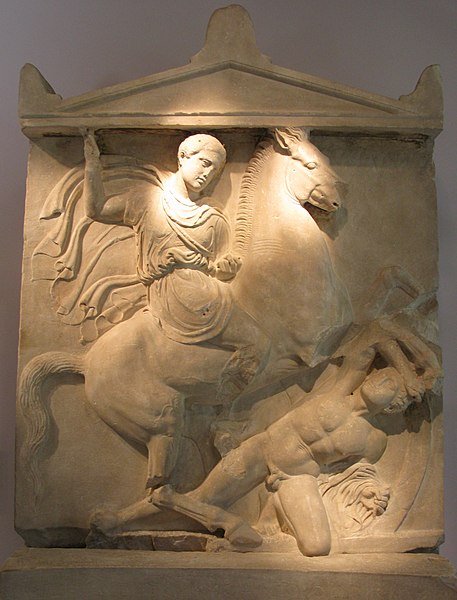
An Athenian cavalryman, Dexileos, depicted in heroic nudity fighting a Peloponnesian hoplite during the Corinthian War. Dexileos was killed near Corinth in the summer of 394 BC, likely at the Battle of Nemea or a nearby engagement.
The Corinthian War (395–387 BC) was a significant conflict in ancient Greece, primarily involving Sparta and a coalition of Greek city-states—Thebes, Athens, Corinth, and Argos—backed by the Achaemenid Empire. In the article below, World History Edu explores the causes, major events, and aftermath of the war under distinct headings to provide a structured understanding.
Causes of the Corinthian War
The Corinthian War was primarily rooted in the dissatisfaction with Spartan imperialism after the Peloponnesian War (431–404 BC). Despite Sparta’s victory in the Peloponnesian War, its behavior alienated both allies and former adversaries. Key causes include:
- Spartan Dominance Post-Peloponnesian War: Sparta monopolized the spoils of victory, including tributes and territory, creating resentment among former allies like Corinth and Thebes.
- Sparta’s Aggressive Policies: Spartan campaigns, such as the subjugation of Elis in 402 BC, further strained relations with allies, with Corinth and Thebes refusing to assist.
- Achaemenid Influence: Persia, threatened by Spartan incursions in Asia, provided financial backing to foment unrest in mainland Greece. Persian gold was used to bribe influential figures in Thebes, Athens, and Corinth to initiate anti-Spartan policies.
- Formation of the Alliance: Thebes, Athens, Corinth, and Argos formed a coalition in 395 BC, leveraging dissatisfaction with Sparta’s hegemony to challenge its dominance.
Early Stages of the War (395 BC)
The initial confrontation occurred at Haliartus, where Spartan forces, divided under Lysander and Pausanias, aimed to subdue Thebes. The premature advance of Lysander led to his death and a setback for Sparta. Pausanias failed to provide timely support, leading to his trial and exile. This early engagement demonstrated the vulnerabilities in Spartan strategy and emboldened the coalition.
The war gained momentum as Corinth and Argos joined the coalition. A council in Corinth managed the alliance, and smaller states across Greece also lent their support, further isolating Sparta.
Key Battles and Campaigns (394 BC)
Battle of Nemea
Sparta secured a significant victory at the dry riverbed of Nemea, defeating the coalition forces. The Spartans’ tactical superiority in hoplite warfare was evident, but the coalition remained united.
Naval Battle of Cnidus
This pivotal naval battle saw the Spartan fleet destroyed by a combined Persian and Athenian force led by Conon and Pharnabazus. The loss at Cnidus marked the end of Sparta’s aspirations to naval dominance and shifted the war’s momentum toward the coalition.
Battle of Coronea
Agesilaus II, returning from Asia, achieved a costly victory at Coronea. While successful on the battlefield, Sparta’s strategic position remained precarious, with coalition forces maintaining pressure.
Later Developments (393–388 BC)
Persia’s support for Athens allowed for the rebuilding of the Long Walls and the revival of Athenian naval power. Conon’s efforts, backed by Persian funding, enabled Athens to regain control of strategic islands like Scyros and Lemnos, reminiscent of the Delian League.
Internal divisions in Corinth weakened its position. The democratic faction, aligned with the coalition, expelled oligarchs who sought Spartan support. This dynamic highlighted the fragmented nature of Greek politics during the war.
Sparta conducted raids into enemy territory, but its inability to decisively defeat the coalition or regain naval supremacy left it vulnerable. The innovative tactics of Athenian generals like Iphicrates, who utilized peltasts to harass Spartan hoplites, showcased a shift in Greek military strategies.

The rebuilding of the walls of Athens in 393 BC.
The King’s Peace (387 BC)
Persia, now wary of Athens’ resurgence, shifted its support back to Sparta. Antalcidas, a Spartan envoy, negotiated a treaty with Persian satrap Tiribazus, resulting in the King’s Peace or Peace of Antalcidas.
Terms of the Treaty
The treaty stipulated:
- Persian control over Ionia and Cyprus.
- Autonomy for all other Greek city-states, prohibiting leagues or alliances.
- Spartan authority as the enforcer of peace.
This arrangement solidified Persian influence in Greek affairs and reaffirmed Sparta’s hegemonic role, albeit in a diminished capacity.
Aftermath and Legacy
Despite its weakened state, Sparta emerged as the enforcer of the King’s Peace, using the autonomy clause to suppress potential rivals, such as Thebes. Persia reasserted control over Asia Minor and established itself as a key powerbroker in Greek affairs. The rebuilding of Athens’ walls and fleet laid the foundation for its resurgence, culminating in the formation of the Second Athenian League in the mid-4th century BC.
Thebes suffered heavily, with the Boeotian League disbanded and Spartan garrisons imposed. However, Thebes’ eventual recovery led to the decisive Battle of Leuctra in 371 BC, which ended Spartan hegemony.
The Corinthian War demonstrated the volatility of Greek alliances and the persistent influence of external powers like Persia. Peace proved short-lived, as underlying tensions among Greek states persisted, setting the stage for future conflicts.
Frequently Asked Questions

Who were the main participants?
Sparta faced a coalition of Thebes, Athens, Corinth, and Argos, backed financially by the Achaemenid Empire.
What role did Persia play?
Initially, Persia financed the anti-Spartan coalition, but later shifted support to Sparta when Athens’ resurgence threatened Persian interests.
What were the key battles?
The Spartans won notable land victories at Nemea and Coroneia but suffered a decisive naval defeat at the Battle of Cnidus, ending their ambitions as a naval power.
What was the outcome of the war?
The King’s Peace (387 BC), dictated by Persia, ended the war, granting Persia control over Ionia, mandating Greek city-states’ autonomy, and reinforcing Spartan hegemony.
Why did Athens benefit post-war?
Athens capitalized on the weakened Sparta to rebuild its walls, reestablish its fleet, and regain islands, laying the foundation for the Second Athenian League.
How did the war impact Thebes and Corinth?
Thebes lost the Boeotian League and faced Spartan occupation, while Corinth was reintegrated into the Spartan-led Peloponnesian League.
What were the broader effects?
Persia consolidated control over Asia Minor, Sparta maintained dominance over mainland Greece, and Athens began its resurgence, setting the stage for future conflicts.





