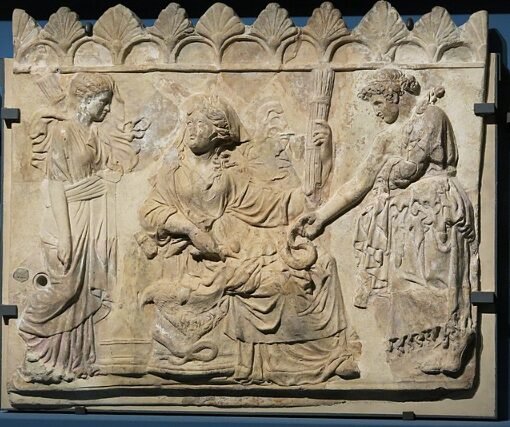
Known as Greece’s most famous secret rites, the Eleusinian ceremonies date back to a Bronze Age agrarian tradition, with links to Mycenaean religious practices. Image: Initiation to Eleusinian Mysteries. c. 100–50 BCE; relief, Louvre Museum (Paris, France)
The Eleusinian Mysteries were ancient religious rites held annually in honor of the goddess Demeter and her daughter Persephone in the city of Eleusis, near Athens. These ceremonies were deeply intertwined with the myth of Demeter’s search for Persephone after she was abducted by Hades, the god of the underworld. The Mysteries centered around themes of life, death, and rebirth, symbolized by the changing of the seasons, the cycle of crops, and the human soul’s journey to the afterlife.
READ MORE: Most Famous Chthonic Deities in Greek Mythology
Mythological Foundation: The Story of Demeter and Persephone
The myth at the heart of the Eleusinian Mysteries tells the story of Demeter, the goddess of the harvest and fertility, and her daughter Persephone. According to the myth, Persephone was abducted by Hades, who took her to the underworld to be his queen. Demeter, devastated by the loss of her daughter, roamed the earth in search of her. In her grief, she neglected her duties, causing the earth to become barren and the crops to wither, which resulted in famine.
Zeus, the king of the gods, intervened and ordered Hades to release Persephone. However, Persephone had eaten pomegranate seeds in the underworld, which bound her to Hades. As a compromise, it was decided that Persephone would spend part of the year in the underworld with Hades (the winter months) and the rest of the year with Demeter (the spring and summer), symbolizing the seasonal cycle of death and rebirth in nature.

Hades abducting Persephone, fresco in the small royal tomb at Vergina, Macedonia, Greece, circa 340 BC
This myth was at the core of the Eleusinian Mysteries, which celebrated the changing of the seasons, the fertility of the land, and the promise of life after death. Participants believed that by understanding the mysteries of Demeter and Persephone, they could gain insight into the mysteries of life, death, and the afterlife.

Demeter mourning Persephone by Evelyn de Morgan, 1906.
The Structure of the Eleusinian Mysteries
The Eleusinian Mysteries were divided into two parts: the Lesser Mysteries and the Greater Mysteries. Each part had its own rituals and significance, with the Greater Mysteries being the more important of the two.
The Lesser Mysteries
The Lesser Mysteries were held annually in early spring, usually in the month of Anthesterion (February or March). These rites were a form of preliminary purification for initiates, preparing them for participation in the Greater Mysteries. The Lesser Mysteries took place in the town of Agrae, near the banks of the River Ilissos, and were relatively small in scale compared to the Greater Mysteries.
During the Lesser Mysteries, initiates underwent purification rituals, including ritual washing and sacrifices. These acts of purification were meant to cleanse the initiates both physically and spiritually, preparing them for the more profound revelations of the Greater Mysteries. After completing the Lesser Mysteries, initiates were eligible to participate in the Greater Mysteries in Eleusis.
The Greater Mysteries
The Greater Mysteries were the primary and most important part of the Eleusinian Mysteries. They were held annually in the month of Boedromion (September or October) and lasted for nine days. The central ceremonies took place in Eleusis, but the festival began with events in Athens.
Some scholars suggest the use of psychoactive substances to induce visions, adding to the Mysteries’ enduring appeal over two millennia.
The rites of the Greater Mysteries were open to anyone who spoke Greek, provided they had not committed murder and had undergone the preliminary initiation of the Lesser Mysteries. Both men and women, free citizens and slaves, could participate, which made the Mysteries highly inclusive for ancient Greek religious practices.
The events of the Greater Mysteries were divided into several stages:
- The Procession from Athens to Eleusis: The ceremonies began with a grand procession that started at the Eleusinion, a temple dedicated to Demeter in Athens, and traveled to Eleusis. Participants, led by priests and priestesses, walked along the Sacred Way, a road that connected Athens to Eleusis. Along the way, various rites were performed, and the participants would stop at certain points to rest, offer sacrifices, and pray.
- Ritual Purification: Before the main ceremonies in Eleusis, the initiates underwent further purification rituals. They bathed in the sea, symbolizing a cleansing of the soul, and made sacrifices to the gods.
- Sacred Rites in the Telesterion: The central event of the Eleusinian Mysteries took place in the Telesterion, a large hall in Eleusis that was the focal point of the ceremonies. The exact details of what occurred in the Telesterion were a closely guarded secret, but it is believed that the initiates witnessed sacred rites and dramatic re-enactments of the myth of Demeter and Persephone. These rites likely included symbolic representations of Persephone’s descent into the underworld, her reunion with Demeter, and the cycle of death and rebirth.
- The Sacred Drink – Kykeon: During the ceremonies, participants drank a special beverage called kykeon, which was made from barley, water, and mint. This drink was believed to have spiritual significance and was associated with Demeter’s role as the goddess of agriculture. In the myth, Demeter drank kykeon while searching for Persephone, and it became a key part of the ritual in the Mysteries.
- Revelation of the Sacred Objects: One of the most secretive aspects of the Eleusinian Mysteries was the revelation of the sacred objects, which were kept in a special container called the cista mystica. These objects were shown to the initiates during the climax of the ceremonies, but their exact nature remains unknown. The revelation of these objects was believed to impart spiritual knowledge and insight into the mysteries of life, death, and the afterlife.
- The Night of the Great Mysteries: One of the most important parts of the Greater Mysteries was the nocturnal ceremony known as the “Night of the Great Mysteries.” During this night, initiates participated in rituals that likely symbolized the death and rebirth of Persephone, as well as the cycle of life and death. It is thought that the initiates may have undergone a symbolic death and rebirth, emerging from the ceremony with a renewed sense of spiritual insight and understanding.
- Celebration and Return to Athens: After the ceremonies in Eleusis, the participants returned to Athens in another grand procession, celebrating their newfound knowledge and spiritual rebirth. The conclusion of the Mysteries was marked by feasting, sacrifices, and joyful celebrations, as the initiates reflected on the insights they had gained during the rites.
The Significance of the Eleusinian Mysteries
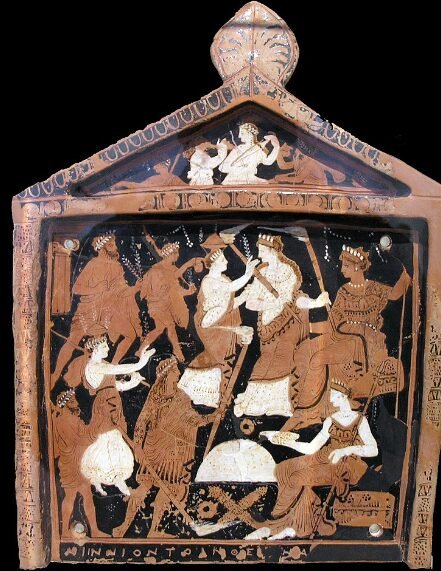
The Eleusinian Mysteries symbolized the myth of Persephone’s descent to the underworld and reunion with her mother, Demeter, representing themes of loss, search, and renewal. For initiates, Persephone’s rebirth symbolized eternal life, offering hope for an afterlife reward. Image: The Ninnion Tablet, a mid-4th century BC votive plaque, depicts scenes from the Eleusinian Mysteries and was discovered in Eleusis’ sanctuary.
The Eleusinian Mysteries were more than just religious ceremonies; they held deep philosophical and spiritual significance for those who participated. At their core, the Mysteries were about the cycle of life, death, and rebirth, symbolized by the changing of the seasons and the growth of crops. The myth of Demeter and Persephone represented the eternal return of life after death, both in the natural world and in the human soul.
For the initiates, the Eleusinian Mysteries offered the promise of a better afterlife. By participating in the rites, they believed they would gain knowledge of the afterlife and be granted a more favorable existence after death. This belief in a blessed afterlife set the Eleusinian Mysteries apart from other religious practices of the time, which often focused more on placating the gods and avoiding their wrath rather than on achieving spiritual enlightenment.
The Eleusinian Mysteries also emphasized the importance of community and shared religious experience. The rites brought together people from all walks of life, regardless of social class or gender, and allowed them to participate in a common spiritual journey. This sense of unity and shared purpose was a key aspect of the Mysteries’ enduring appeal.
Secrecy and Legacy of the Mysteries
One of the most intriguing aspects of the Eleusinian Mysteries was their secrecy. Initiates were sworn to absolute secrecy about the details of the rites, and breaking this oath was considered a grave offense. As a result, very little is known about the exact nature of the ceremonies, and much of what modern scholars understand comes from ancient writings that provide only vague descriptions.
Although details were strictly kept secret, art from the period often illustrates elements of the Eleusinian Mysteries.
Despite this secrecy, the Eleusinian Mysteries had a profound influence on the development of later religious and philosophical traditions. The emphasis on personal salvation, the afterlife, and the idea of spiritual rebirth can be seen in later mystery religions, such as the cult of Isis and Osiris in Egypt and the Mithraic Mysteries in the Roman Empire. Some scholars even argue that early Christianity may have been influenced by the Eleusinian Mysteries, particularly in its concepts of resurrection and eternal life.
READ MORE: Most Revered Ancient Egyptian Gods and Goddesses
The Mysteries continued to be celebrated for nearly two thousand years, from around 1600 BCE until the 4th century CE. They were eventually suppressed by the Christian Roman Emperor Theodosius I, who viewed them as pagan rituals that conflicted with the Christian faith. Despite their suppression, the legacy of the Eleusinian Mysteries lived on, influencing later religious and philosophical thought and continuing to inspire curiosity and fascination.

Theodosius I, also known as Theodosius the Great, was a Roman emperor who reigned from 379 to 395. He is best known for making Christianity the state religion of the Roman Empire and his numerous building projects in the empire’s capital, Constantinople.
Conclusion
The Eleusinian Mysteries were one of the most important and enduring religious rites of ancient Greece. Rooted in the myth of Demeter and Persephone, the Mysteries explored profound themes of life, death, and rebirth, offering initiates the promise of a blessed afterlife and spiritual insight. Although much about the ceremonies remains shrouded in mystery due to the strict secrecy surrounding them, their influence on later religious and philosophical traditions is undeniable.
For the ancient Greeks, the Eleusinian Mysteries were not only a celebration of the agricultural cycle but also a deeply personal and transformative spiritual journey. Through the rites, participants sought to understand the mysteries of existence and to gain a greater sense of connection to the divine forces that governed the universe. Today, the Eleusinian Mysteries continue to be a source of fascination for scholars and spiritual seekers alike, offering a glimpse into the profound religious experiences of the ancient world.
Questions and Answers about the Eleusinian Mysteries

The Great Eleusinian Relief depicts Triptolemus receiving wheat from Demeter and blessings from Persephone, 5th-century BC, National Archaeological Museum, Athens.
What were the Eleusinian Mysteries?
The Eleusinian Mysteries were secret religious ceremonies held in Eleusis, Greece, from around 1600 BCE to 392 CE. These rites celebrated the myth of Demeter and Persephone and offered participants a profound spiritual transformation. The details of the rituals remain unknown due to the secrecy kept by initiates.
Why were the Eleusinian Mysteries significant to the ancient Greeks?
The Eleusinian Mysteries were highly significant because they were believed to offer initiates a deep understanding of life, death, and the afterlife. Participants felt transformed by the experience, claiming they no longer feared death. The Sacred Way, the road connecting Athens to Eleusis, was one of the most important roads in central Greece, showing the importance of these rituals.
What was the myth of Demeter and Persephone, and how did it relate to the Mysteries?
The myth of Demeter and Persephone tells the story of Demeter, the goddess of nature, whose daughter Persephone (formerly Kore) was abducted by Hades, the god of the underworld. Demeter’s grief caused the earth to become barren until Persephone was allowed to return for part of the year, explaining the changing seasons. This myth symbolized the cycle of life, death, and rebirth, forming the foundation of the Eleusinian Mysteries’ teachings.

The rites of the Eleusinian Mysteries spread to Rome and were likely influenced by similar rituals in the Near East and Minoan Crete. Image: A marble statue of Demeter, Greek goddess of the harvest; National Roman Museum
What spiritual insights did initiates gain from the Eleusinian Mysteries?
Initiates gained a vision of the afterlife and came to believe in the immortality of the soul. The rituals taught them that death was not the end but a transition to another state of existence, mirroring Persephone’s annual descent to the underworld and return to the living world.
How were the Eleusinian Mysteries divided, and what were the key events in the rituals?
The Mysteries were divided into the Lesser and Greater Mysteries. The Lesser Mysteries, held in spring, were for purification. The Greater Mysteries, held in September, involved a grand procession from Athens to Eleusis, where initiates re-enacted Demeter’s search for Persephone, drank the special beverage Kykeon, and took part in secret rites in the Telesterion, an underground theater.
What was the purpose of drinking Kykeon during the rituals?
Kykeon, a barley and mint drink, was consumed by initiates as part of the ritual. Some believe it contained a psychotropic substance, which might have heightened the spiritual experience during the ceremonies, aiding in the initiates’ transformation.

The Eleusinian Mysteries Hydria, showing the reunion of Demeter and her daughter Persephone at the start of each spring
What did prominent figures like Plato, Plutarch, and Cicero say about the Eleusinian Mysteries?
Ancient Greek philosopher Plato referenced the Mysteries in his writings, claiming they imparted a deeper understanding of the soul’s immortality. In his Republic, he described the afterlife through the story of Er, possibly influenced by the Mysteries. Plutarch found comfort in the Mysteries after his daughter’s death, expressing belief in the soul’s immortality, while Cicero praised the rites for teaching how to live joyfully and die with hope.
How did Egyptian beliefs influence the Eleusinian Mysteries?
Egyptian religious beliefs, especially the idea of reincarnation and the cyclical nature of life, likely influenced the Mysteries. The Egyptians viewed death as a transition rather than an end, which aligned with the Eleusinian interpretation of the Persephone myth and its emphasis on rebirth.
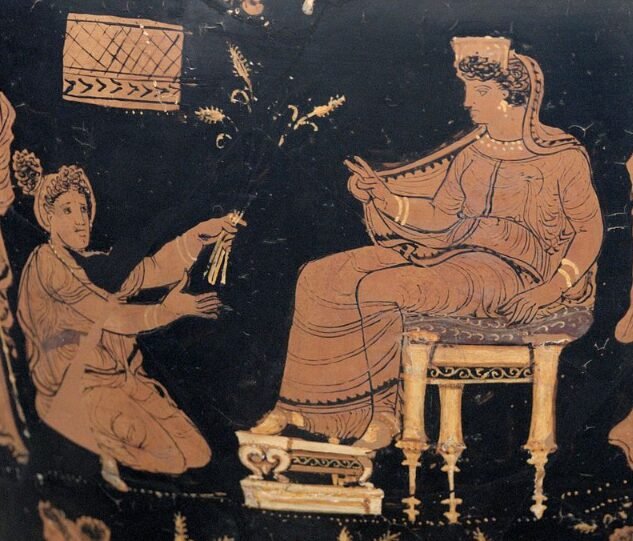
Demeter sits enthroned, blessing the kneeling Metaneira, who presents wheat—a recurring symbol in the mysteries—on a red-figure hydria by the Varrese Painter (c. 340 BC, Apulia).
How and why did the Eleusinian Mysteries come to an end?
The Eleusinian Mysteries were suppressed by the Christian Roman Emperor Theodosius I in 392 CE as part of his effort to eliminate pagan practices. In 396 CE, the sanctuary at Eleusis was destroyed, marking the end of one of the most significant religious rites of the ancient world.
What lasting impact did the Eleusinian Mysteries have on ancient thought?
The Eleusinian Mysteries deeply influenced the spiritual beliefs of ancient Greeks, particularly their views on life, death, and the afterlife. The rituals provided initiates with a sense of peace and a belief in the immortality of the soul, influencing not only religious practices but also philosophical thought, as seen in the writings of Plato and others.





