The First Televised Presidential Address
The first televised presidential address in U.S. history was delivered by President Harry S. Truman on October 5, 1947. This landmark event signaled the beginning of a new era in political communication, where television would eventually become the most powerful medium for reaching the American public.
Truman’s address highlighted not only the increasing importance of television in everyday life but also marked a turning point in how political leaders would engage with citizens.
The Context Leading to the First Televised Address
In the years following World War II, the United States found itself grappling with several economic challenges. The war had spurred tremendous economic growth, and industries that were once geared toward military production now needed to transition to a peacetime economy. This shift created significant dislocations in labor and industry, leading to inflation, labor strikes, and shortages of consumer goods. The Truman administration was at the forefront of these challenges, trying to maintain economic stability while ensuring that the prosperity of the war years was not lost.
In 1947, the U.S. faced a looming economic crisis: inflation was rising at an alarming rate, and the nation’s coal and steel industries were experiencing severe shortages due to ongoing labor strikes. These shortages were especially problematic for heating homes and for industries dependent on steel production, such as the automotive and construction sectors.
It was in this context that President Truman decided to address the American people directly, using a medium that had, until then, been reserved primarily for radio broadcasts and movie theaters: television. While radio had been the dominant form of mass communication, television sets were quickly gaining popularity in American homes.
By 1947, there were around 44,000 television sets in the United States, mostly concentrated in large cities like New York and Philadelphia. Though the audience was relatively small compared to radio listeners, television offered an unprecedented opportunity for the president to speak to the American people in a more direct and personal manner.
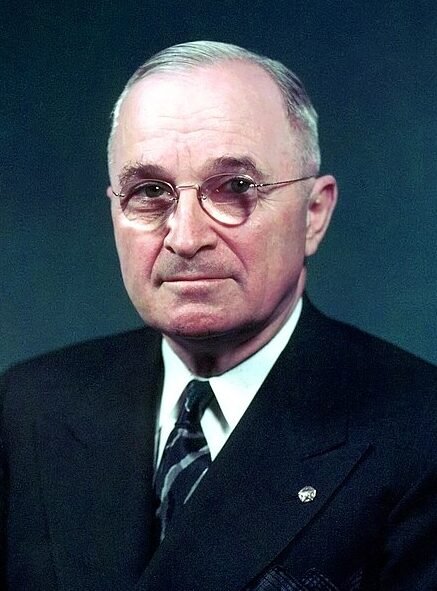
Harry S. Truman was the 33rd president of the United States, serving from 1945 to 1953. He assumed the presidency after Franklin D. Roosevelt’s death and is known for his leadership during the post-World War II period. Image: A 1947 image of President Truman.
The Content of Truman’s Address
On the evening of October 5, 1947, Truman delivered his historic televised address from the White House. The speech was primarily focused on the nation’s economic difficulties and the need for emergency measures to avert a crisis. At the time, there were major concerns about the ongoing strikes in the coal and steel industries, which were vital to the country’s economic health. If the strikes were not resolved soon, the country risked further inflation, shortages of essential goods, and a slowdown in industrial production.
In his address, Truman urged Americans to conserve fuel and cut down on unnecessary spending. He outlined his proposal to extend wartime controls on prices, wages, and rents to curb inflation. The speech was a call to action for both Congress and the American people to work together to stabilize the economy.
He specifically asked Congress to pass legislation that would allow the government to take control of coal mines and railroads if necessary, a bold request aimed at breaking the impasse between labor unions and industrial leaders. Truman also made a direct appeal to labor unions to cease their strikes for the good of the country, emphasizing the importance of national unity in the face of economic hardship.
The Significance of the Televised Format
While Truman’s message was important, the medium through which he delivered it was even more so. The decision to broadcast the speech on television was strategic. Though most Americans still relied on radio for news and entertainment, the Truman administration recognized the potential of television as an emerging medium. Television offered the ability to not only hear but also see the president as he addressed the nation. This visual connection made the speech more personal and allowed Truman to convey a sense of urgency and sincerity that was harder to achieve through radio alone.
The visual component of the address also allowed viewers to observe Truman’s body language, facial expressions, and overall demeanor, adding a layer of emotional appeal to his words. For many Americans, this was the first time they had seen a president deliver a speech in real-time, in the comfort of their living rooms. It was a groundbreaking moment that demonstrated the potential of television to bring political leaders closer to the public.
Although the television audience was small at the time, the impact of this broadcast was immense. The White House’s embrace of television set a precedent that future presidents would follow. Over the next two decades, television would surpass radio as the primary medium through which the American people engaged with their government and political leaders.
The Immediate Aftermath
In the short term, Truman’s televised address did not immediately solve the country’s economic problems. Labor disputes continued, and the inflation crisis persisted for some time. However, the speech did succeed in raising awareness about the urgency of the situation and galvanizing public support for some of Truman’s proposed policies.
Moreover, the address set the stage for future presidential communications. Over time, television became an essential tool for presidents to speak directly to the American people. This new format gave presidents the ability to bypass traditional media gatekeepers, such as newspaper editors and radio hosts, and connect with the public on a more personal level. Presidents could now appeal directly to voters, making their case for policy decisions and influencing public opinion in ways that had never before been possible.
The Evolution of Television and Presidential Communication
Television’s role in politics continued to grow rapidly after Truman’s 1947 address. By the 1950s, more and more American households owned television sets, and political leaders adapted their communication strategies to fit the visual and emotional nature of the medium. The 1952 presidential campaign of Dwight D. Eisenhower, for instance, featured the first use of televised campaign commercials, and by 1960, the televised debates between John F. Kennedy and Richard Nixon marked a turning point in how elections were conducted.
The visual nature of television brought a new dynamic to political communication. Presidents could no longer rely solely on the power of their words; they also had to consider their appearance, tone, and on-camera presence. A successful television appearance required a combination of eloquence, charisma, and relatability.
Truman’s 1947 address can be seen as the precursor to the “fireside chats” of the television age. While Franklin D. Roosevelt had famously used radio to deliver his fireside chats during the Great Depression and World War II, Truman’s televised address demonstrated that television would soon replace radio as the dominant medium for political communication.
Did you know…?
Within five years of Truman’s 1947 address, more than 16 million households, or about three out of every five families, owned a television set, making TV an increasingly important medium for presidential speeches and political communication.
Legacy of Truman’s Televised Address
The first televised presidential address had a lasting impact on how political leaders communicated with the public. Truman’s use of television showed that the medium had the potential to shape public opinion and influence political discourse in powerful ways. Future presidents, including John F. Kennedy, Ronald Reagan, and Barack Obama, would all become masters of television, using it to craft their public image and deliver their messages to millions of Americans.
Conclusion
Truman’s October 5, 1947, televised address was more than just a speech about the economy; it was a historic moment that forever changed the relationship between the president and the public. By embracing television, Truman paved the way for a new era of political communication, one that continues to evolve in the digital age. The use of television to address the nation remains a cornerstone of modern presidential leadership, with its roots tracing back to Truman’s pioneering broadcast in the post-World War II era.
Questions and Answers
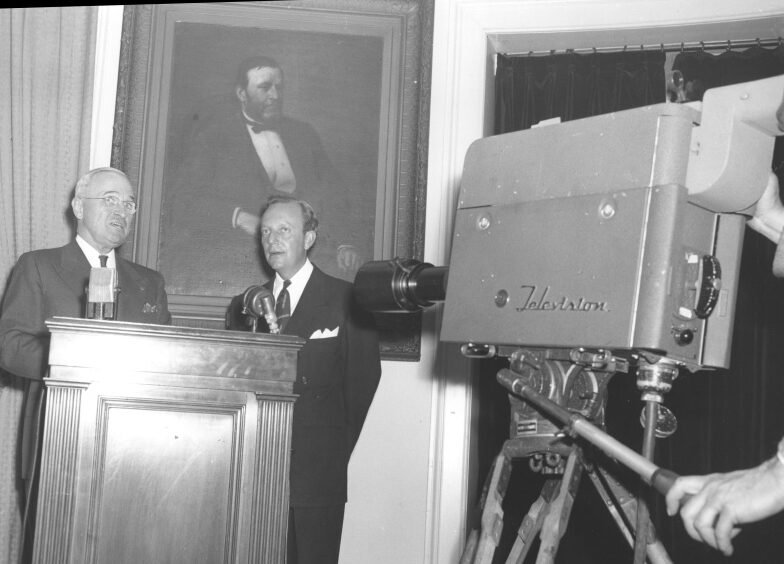
The first televised presidential address marked a significant moment in American political history, as it was the first time a sitting president used television to address the nation, making the medium an important tool for political communication. Image: Truman (left) during the first televised presidential address. Photo credit: 99-755.
When did the first televised presidential address in the United States take place?
The first televised presidential address was delivered by President Harry S. Truman on October 5, 1947.
What was the main focus of President Truman’s televised address?
Truman’s address focused on the issue of food conservation. He urged Americans to reduce their consumption of grain, meat, and poultry to help support war-ravaged European nations that were facing food shortages after World War II.
Why did Truman ask Americans to cut back on certain foods during his televised speech?
Truman requested Americans to voluntarily cut back on food to support European recovery efforts as part of the broader post-war relief strategy, particularly under the Marshall Plan, which aimed to rebuild Europe and promote stability.
How long was Truman’s first televised address?
The speech was approximately 10 minutes long.
What role did television play in Truman’s address, and how many Americans had access to television at the time?
Television was a relatively new medium, and only about 44,000 U.S. households owned a TV at the time. The address was more of an experiment in using television as a communication tool, as most Americans still relied on radio and newspapers. However, this broadcast marked a significant shift toward the use of television for political communication.
How did Truman’s televised address differ from previous presidential addresses, such as Franklin D. Roosevelt’s “fireside chats”?
Truman’s address marked a departure from Roosevelt’s “fireside chats,” which were delivered over the radio. Truman’s use of television provided a visual element, allowing the president to communicate directly with Americans in their homes, showcasing the shift in how political leaders engaged with the public.
What was the broader significance of Truman’s use of television for his presidential address?
Truman’s televised speech represented the growing intersection of politics and mass media. While radio had been the primary medium for reaching the public, television was emerging as a powerful tool that would soon dominate political communication, influencing how future presidents connected with voters.
How did the public perceive television as a medium for political communication after Truman’s address?
Although the initial reach of Truman’s address was limited, the growing popularity of television in the years following his speech cemented its role as a crucial medium for presidential communication. By the early 1950s, television had become an essential platform for presidential speeches, debates, and campaigns.
What impact did the first televised presidential address have on American media and politics?
Truman’s televised address set the stage for the future use of television in politics. It demonstrated the power of visual media in shaping public perception and allowed future presidents to speak directly to American citizens, bypassing traditional media intermediaries like newspapers.