The Lancelot-Grail Cycle, also called the Vulgate Cycle or Pseudo-Map Cycle, is a 13th-century Old French literary masterpiece that profoundly shaped the legend of King Arthur. Written anonymously, the cycle interweaves chivalric romance, Christian mysticism, and rich character narratives, making it a cornerstone of medieval Arthurian literature. Its episodes are connected yet sprawling, focusing on major themes such as the love affair between Lancelot and Guinevere, the spiritual pursuit of the Holy Grail, and the rise and fall of King Arthur.
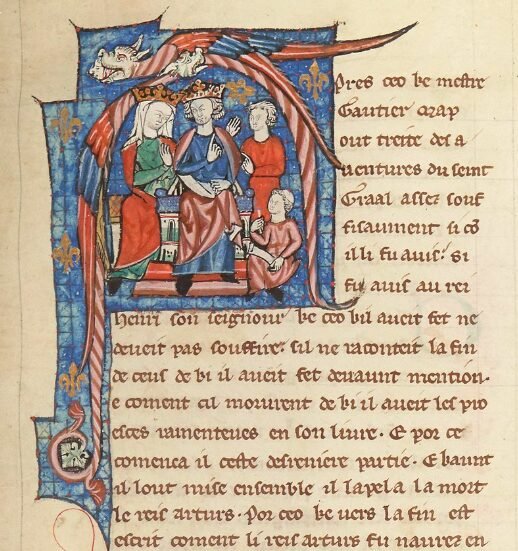
The Lancelot-Grail Cycle draws heavily from earlier Arthurian texts, including Chrétien de Troyes’ romances and French poet Robert de Boron’s works. Image: “Gautier” supposedly narrating Lancelot’s tales to Henry II of England and Eleanor of Aquitaine in a 14th-century Lancelot-Grail manuscript (BnF Français 123).
Historical Context and Inspiration
The Lancelot-Grail Cycle draws heavily from earlier Arthurian texts, including Chrétien de Troyes’ romances and French poet Robert de Boron’s works. By consolidating and expanding these sources, it creates a cohesive and complex narrative. It situates King Arthur’s court in Logres, encompassing stories of individual knights of the Round Table, their personal journeys, and the collective ethos of chivalry. This cycle reflects a blend of secular and spiritual ideologies, appealing to both aristocratic audiences and religious communities.
Key Themes and Motifs
At the heart of the cycle is the forbidden love between Lancelot, Arthur’s most loyal knight, and Guinevere, Arthur’s queen. Their tragic relationship symbolizes the conflict between personal desires and social or moral obligations, contributing to the kingdom’s eventual downfall.
The Holy Grail and Spirituality
The quest for the Holy Grail, a vessel tied to Christ’s blood, is a central narrative thread. It represents a spiritual journey of faith, testing knights’ virtues. Galahad, Lancelot’s pure and pious son, ultimately succeeds where others fail, achieving divine grace and becoming the ultimate hero of the quest.
The Fall of Camelot
The cycle portrays the inevitable collapse of Arthur’s reign, precipitated by internal betrayal, the moral failings of its knights, and external conflicts. This narrative arc explores the fragility of idealism in the face of human flaws.
Composition and Authorship
The authorship of the Lancelot-Grail Cycle remains a mystery. Though some manuscripts attribute it to Walter Map, a 12th-century cleric, modern scholarship dismisses this claim due to chronological inconsistencies. Most scholars believe the cycle was composed collaboratively by multiple anonymous authors or possibly directed by a single “master architect” overseeing the entire project.
The cycle integrates secular and Christian elements, leading some to speculate that its authorship may have involved Cistercian monks or clerical writers familiar with religious allegory. Regardless of its origins, the cycle’s Christian undertones, especially in the Queste del Saint Graal, emphasize repentance and spiritual redemption.
Structure of the Cycle
The Lancelot-Grail Cycle is traditionally divided into five main sections, each serving as a building block for the overarching narrative:
The History of the Holy Grail
This segment, derived from Robert de Boron’s works, recounts the origins of the Grail. It follows Joseph of Arimathea, who brings the sacred vessel to Britain. This prequel establishes the Grail’s spiritual significance and its connection to Britain’s destiny.
The History of Merlin
This section explores Merlin’s miraculous birth, his role in shaping Arthur’s early reign, and his eventual betrayal by Viviane, the Lady of the Lake. It provides vital backstory to Arthur’s ascension and the establishment of the Round Table.
The Prose Lancelot
The cycle’s longest and most intricate section, the Prose Lancelot, chronicles the life of Lancelot. It delves into his exploits, his deep friendship with Galehaut, and his ill-fated romance with Guinevere. This section also introduces Lancelot’s son, Galahad, who will later become central to the Grail Quest.
The Quest for the Holy Grail
The Queste del Saint Graal shifts the narrative’s tone from romance to mysticism. Galahad, Percival, and Bors undertake the Grail Quest, facing spiritual trials. Galahad’s success represents the triumph of divine purity over worldly chivalry, contrasting his father Lancelot’s failure due to his sins.
The Death of King Arthur
In the Mort Artu, the cycle reaches its tragic conclusion. Arthur’s kingdom disintegrates due to betrayal and moral decay. Lancelot and Guinevere’s affair, Mordred’s treachery, and internal strife lead to the fall of Camelot. Arthur’s final battle with Mordred is both a literal and symbolic end to an era.
Narrative Techniques and Innovations
The cycle employs interlacing, a narrative method where multiple storylines unfold simultaneously and intersect. This technique creates a rich, layered tapestry of events, reflecting the interconnected fates of characters.
The Lancelot-Grail Cycle is a monumental achievement in medieval literature, blending romance, spirituality, and tragedy into a cohesive epic.
Unlike earlier Arthurian romances, the Lancelot-Grail Cycle delves deeply into character psychology. Lancelot’s internal conflict, Galahad’s spiritual resolve, and Arthur’s struggles as a king lend complexity to the narrative.
The cycle balances chivalric adventure with Christian allegory, appealing to a diverse audience. Secular tales of heroism coexist with moral lessons, making it both entertaining and edifying.
Cultural and Historical Impact
The Lancelot-Grail Cycle became a dominant form of Arthurian literature in the medieval period. It was widely disseminated across Europe, translated into multiple languages, and adapted into verse and prose. Notably, its themes and characters influenced later works, including Sir Thomas Malory’s Le Morte d’Arthur.
Malory’s work, derived from the Lancelot-Grail Cycle, cemented the modern Arthurian legend. Key elements like the Round Table, the Grail Quest, and Lancelot’s romance became integral to the mythos.
The Lancelot-Grail was widely influential, shaping late medieval Arthurian literature, inspiring Le Morte d’Arthur, and establishing many enduring elements of the Arthurian canon.
The cycle inspired medieval illuminations, Renaissance poetry, and modern adaptations. Its narrative techniques and archetypes influenced storytelling traditions beyond Arthurian literature.
Challenges and Revisions
The Post-Vulgate Cycle emerged in the 13th century as a streamlined revision of the Lancelot-Grail. It reduced the prominence of Lancelot and focused more on the Grail Quest. This revision addressed criticisms of the cycle’s sprawling nature while preserving its core themes.
Surviving manuscripts reveal significant textual differences, reflecting regional adaptations and audience preferences. Some manuscripts emphasize religious aspects, while others highlight chivalric adventures.
Modern Interpretations and Scholarship
Contemporary scholars continue to explore the Lancelot-Grail Cycle’s themes, authorship, and historical context. Modern translations, such as those by American scholar Norris J. Lacy, have made the cycle accessible to wider audiences. The cycle’s exploration of human frailty, divine grace, and the complexities of leadership remains relevant today.
Frequently Asked Questions
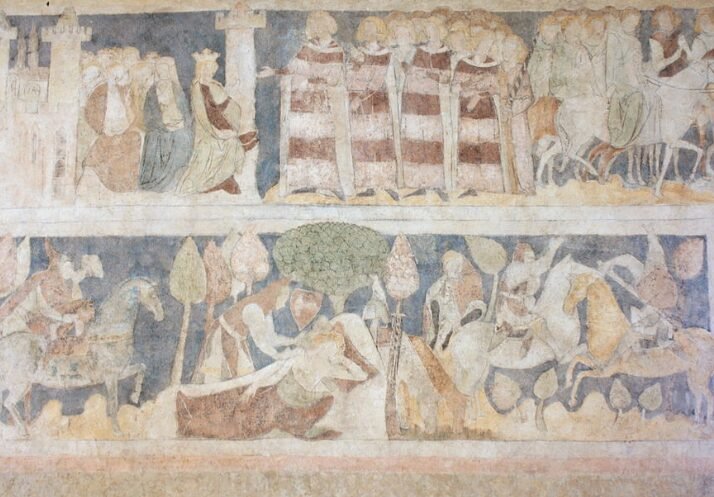
The Lancelot-Grail Cycle is a 13th-century French prose narrative retelling Arthurian legends, focusing on Lancelot and Guinevere’s romance, the quest for the Holy Grail, and Arthur’s rise and fall. Image: Scenes from the Lancelot Proper illustrated in a 14th-century Polish fresco at Siedlęcin Tower, Karkonosze County, western Poland
Who are the key characters?
Key figures include King Arthur, Queen Guinevere, Lancelot, Galahad, Merlin, and members of the Knights of the Round Table, with Galahad achieving the Holy Grail quest.
How does it expand earlier Arthurian works?
The cycle incorporates and elaborates on Robert de Boron’s and Chrétien de Troyes’ works, creating a cohesive narrative with new episodes and interwoven storylines.
What themes dominate the narrative?
Chivalry, courtly love, Christian mysticism, and the conflict between earthly desires and spiritual quests are central themes.
What is its narrative structure?
It uses an “interlace” technique, presenting overlapping, parallel plotlines, particularly evident in the Grail Quest.
Who wrote the Lancelot-Grail Cycle?
The authorship remains unknown; it may have been written by multiple authors or influenced by Cistercian monks for its Christian elements.
What are its major sections?
Key parts include The History of the Holy Grail, The Story of Merlin, Lancelot Proper, The Quest for the Holy Grail, and The Death of King Arthur.





