The Negative Confession holds a profound place in ancient Egyptian religious and funerary practices, functioning as a moral declaration made by the deceased during the crucial judgment process in the afterlife.
Also known as the Declaration of Innocence, the Negative Confession was a list of 42 sins that the soul of the deceased would recite, asserting that it had not committed any of these transgressions during its life on Earth.
This confession took place in the presence of a divine tribunal, which included Osiris, the god of the dead, and 42 divine judges who presided over the soul’s final assessment. If the soul successfully passed this test of moral purity, it would be granted access to paradise. However, failure to prove its innocence would result in dire consequences, potentially leading to annihilation.
This ritual was part of a larger religious and cultural framework within ancient Egypt, where the afterlife and the moral integrity of individuals were viewed as critical components of existence. The Negative Confession was more than just a list of sins; it was a reflection of deeply held Egyptian values and beliefs about the importance of living a life in accordance with ma’at, the principle of truth, justice, balance, and cosmic order.
READ MORE: How the world was created in ancient Egyptian mythology

Winged Maat
The Role of Ma’at in Egyptian Religion
To fully understand the significance of the Negative Confession, it is essential to grasp the concept of ma’at in ancient Egyptian religion. The goddess Ma’at was not just an abstract principle but a central force that governed both the cosmos and human society. She represented harmony, balance, truth, and justice.
Egyptians believed that the universe operated under the principle of ma’at, and maintaining it was essential for the continuity of life, order, and prosperity. The king or pharaoh was the earthly embodiment of this cosmic order, responsible for upholding ma’at in the kingdom through righteous governance and rituals.
In individual life, Egyptians were expected to live according to ma’at by engaging in honest, fair, and just behavior. Any action that disrupted this balance was considered a sin or a transgression against the gods and the natural order. Thus, adherence to ma’at was not only a societal duty but also a religious imperative. In death, the soul of the deceased would have to demonstrate its commitment to ma’at by proving that it had lived a righteous life.
The Negative Confession, therefore, was a formal statement in which the deceased soul claimed that it had adhered to ma’at throughout its earthly existence. Each of the 42 declarations in the confession was addressed to one of the 42 divine judges, who were believed to represent the spiritual aspects of the 42 nomes (districts) of Egypt. The soul’s ability to truthfully recite these statements determined whether it was worthy of entering the afterlife.
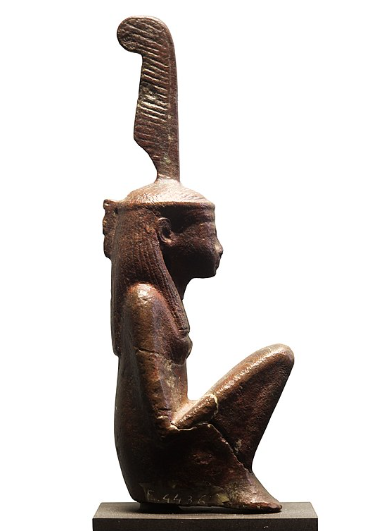
While the specific sins listed in the confession varied depending on the individual’s life and social role, the overarching theme remained the same: the importance of living in harmony with ma’at. Image: Statue of Maat, adorned with the ostrich feather of truth
The Book of the Dead and the Negative Confession
The Negative Confession is most famously associated with the Egyptian Book of the Dead, a collection of funerary texts that guided the deceased through the various stages of the afterlife. The actual title of the text is The Book of Coming Forth by Day, which highlights its purpose: to help the deceased navigate the challenges of the afterlife and emerge victorious in the final judgment.
While the Book of the Dead is often compared to religious scriptures like the Bible, it was not a doctrinal text but a practical guidebook.
The Papyrus of Ani, one of the most famous versions of the Book of the Dead, contains a well-preserved version of the Negative Confession. Written around 1250 BCE for a priest named Ani from Thebes, the papyrus was a personalized guide intended to help Ani’s soul in the afterlife. The Negative Confession included in this papyrus reflects the moral and religious beliefs of the time, as well as Ani’s specific life circumstances.
Funerary texts like the Papyrus of Ani were highly individualized, as scribes would tailor them to the person for whom they were created. Wealthy individuals could afford to commission these texts, while those of lower status often had to rely on simpler or more rudimentary versions. In the case of Ani, the Negative Confession was a deeply personal document that reflected his role as a priest, his moral responsibilities, and his need to prove his worthiness before the gods.
The Judgment Scene and the Weighing of the Heart
The Negative Confession plays a pivotal role in the most famous and dramatic scene of the Egyptian afterlife—the weighing of the heart. This scene is depicted in Spell 125 of the Book of the Dead, where the heart of the deceased is weighed on a scale against a white feather, the symbol of ma’at. The weighing of the heart was a crucial test that determined whether the soul would be admitted to paradise or face destruction.
The ancient Egyptians believed that the heart was the seat of a person’s character, intellect, and emotions. It was the most important organ for determining one’s moral worth, and it was left inside the body during the mummification process for this very reason. In contrast, the brain was considered unimportant and was often discarded during mummification.
If the heart was found to be lighter than the feather of ma’at, the soul was declared pure and allowed to proceed to paradise. If the heart was heavier, indicating a life burdened by sin, it was devoured by Amut (Ammit).
In the judgment scene, the soul of the deceased was led by Anubis, the god of mummification and protector of the dead, into the Hall of Two Truths, where the judgment took place. The soul would stand before Osiris, the ruler of the underworld, along with Thoth, the god of wisdom and writing, who recorded the proceedings. The 42 judges, representing the divine powers of Egypt’s nomes, were also present.

Thoth is portrayed holding a book and stylus, adorned with a crown resembling the moon.
Before the heart was weighed, the deceased recited the Negative Confession, addressing each sin to a specific judge. The sins ranged from moral transgressions like theft and murder to more personal offenses, such as deceit and causing suffering to others.

As the god of the afterlife and resurrection, Osiris represented the cycle of life, death, and rebirth, which was intricately tied to the process of mummification.
If the heart was found to be lighter than the feather of ma’at, the soul was declared pure and allowed to proceed to paradise. If the heart was heavier, indicating a life burdened by sin, it was devoured by Amut (Ammit), a fearsome creature with the head of a crocodile, the body of a lion, and the hindquarters of a hippopotamus. In this case, the soul was condemned to oblivion, ceasing to exist—a fate worse than death itself.

Through the confession and the subsequent weighing of the heart, the Egyptians hoped that the soul would continue its journey into paradise, an eternal reflection of the best aspects of life on earth. Image: A Book of the Dead scene depicts the Weighing of the Heart using Maat’s feather for balance.
The Structure and Purpose of the Negative Confession
The structure of the Negative Confession is significant because it reflects the Egyptians’ understanding of morality and the afterlife. The confession consists of 42 statements, each of which is a denial of a specific sin. The individual making the confession claims innocence of these sins, addressing each statement to one of the 42 divine judges. The sins listed in the confession vary depending on the individual, as the confession was tailored to the person’s life circumstances and social role.
Customization ensured that the confession was sincere and that the deceased would not inadvertently condemn themselves by lying before the gods.
For example, a soldier might not be able to truthfully claim that they had never killed anyone, as killing could have been part of their duties. In such a case, the scribe would omit that sin from the confession or replace it with another that better suited the individual’s life. This customization ensured that the confession was sincere and that the deceased would not inadvertently condemn themselves by lying before the gods.
While the specific sins varied, the overarching theme of the Negative Confession was adherence to ma’at. The confessions generally included offenses such as theft, murder, deceit, and the causing of suffering, all of which were seen as violations of ma’at. The purpose of the confession was not to list every possible sin but to demonstrate that the individual had lived a morally upright life, in accordance with the principles of truth and justice.

The Negative Confession served as a key part of ancient Egyptian afterlife beliefs, reflecting both the individual’s moral integrity and their relationship with the universal principle of ma’at. Image: Several of Maat’s 42 Judges are seated, with the feather of truth shown below.
The Evolution of Funerary Texts
The Negative Confession did not emerge in isolation but was part of a broader tradition of funerary texts in ancient Egypt. The earliest such texts, known as the Pyramid Texts, date back to the Old Kingdom (c. 2613-2181 BCE) and were inscribed on the walls of royal tombs. These texts were intended to help the pharaoh navigate the afterlife and ensure their safe passage to the realm of the gods.
Later, during the First Intermediate Period (2181-2040 BCE), the Coffin Texts appeared. These were written on the coffins of wealthy individuals and provided similar guidance to the deceased. By the time of the New Kingdom (c. 1570-1069 BCE), the Pyramid Texts and Coffin Texts had evolved into the Book of the Dead, a more comprehensive and widely available guide for navigating the afterlife. Unlike the earlier texts, the Book of the Dead could be customized for individuals who could afford to commission a personalized version.
The Negative Confession, as found in the Papyrus of Ani, is a direct descendant of these earlier texts. Its inclusion in the Book of the Dead reflects the growing importance of individual moral accountability in Egyptian religious thought. Whereas earlier funerary texts were more concerned with ritual purity and the proper performance of religious rites, the Book of the Dead and the Negative Confession placed a greater emphasis on personal ethics and the individual’s adherence to ma’at.
The 42 Judges and the Personalized Nature of the Confession
The presence of the 42 divine judges in the judgment scene is another critical aspect of the Negative Confession. These judges, who represented the spiritual aspects of Egypt’s 42 nomes, were responsible for assessing the deceased’s moral character. Each judge was associated with a specific region of Egypt, and the sins addressed in the Negative Confession were thought to reflect the values and customs of these regions.
The personalized nature of the confession is evident in the way the sins were tailored to the individual’s life circumstances. As mentioned earlier, a soldier might not be expected to claim innocence of killing, while a scribe or priest might have different sins included or omitted. This personalization ensured that the deceased could truthfully recite the confession without fear of self-condemnation. The heart, after all, would still be weighed against ma’at, and any deception would be detected by the gods.
In addition to the customization of sins, the Negative Confession also reflected the Egyptians’ belief in the importance of intention. Many of the confessions implied that the individual had not intentionally committed a particular sin, even if they may have inadvertently caused harm. For example, the confession “I have not caused anyone to weep” likely meant that the individual had not intentionally caused suffering, rather than that they had never caused anyone to cry at all. This focus on intention is consistent with the Egyptians’ emphasis on sincerity and moral responsibility.

Tailored to the individual, the Negative Confession allowed the deceased to face judgment with a clear conscience, knowing they had lived in accordance with the principles of truth and harmony. Image: Ptolemy XII before Isis and Osiris, at the Hathor Temple, Dendera
Did you know…?
The earliest funerary texts were the Pyramid Texts from the Old Kingdom, followed by the Coffin Texts during the First Intermediate Period. These evolved into the Egyptian Book of the Dead by the New Kingdom, which included the Negative Confession.
The Legacy and Interpretation of the Negative Confession
The Negative Confession has provided modern scholars with valuable insights into ancient Egyptian morality and religious beliefs. By studying the confessions, Egyptologists have been able to reconstruct the values and social norms that were important to the Egyptians, particularly during the New Kingdom period.
However, the Negative Confession has also been subject to misinterpretation, particularly in modern discussions of ancient Egyptian attitudes toward certain behaviors. For example, some scholars have argued that the Negative Confession reflects a condemnation of homosexuality, based on certain lines that mention sexual transgressions. However, this interpretation ignores the individualized nature of the confession. The sins listed in the confession were tailored to the individual’s life and social role, and what might have been a sin for one person could have been acceptable for another.
Similarly, the Negative Confession should not be understood as a blanket condemnation of behaviors such as premarital sex or drinking. The Egyptians had a more nuanced view of these behaviors, and their acceptability depended on the context.
For example, premarital sex was not necessarily frowned upon, as long as it did not involve a married person. Likewise, drinking was acceptable in certain social situations, such as festivals, but not during work or other important activities. The Negative Confession reflects these distinctions, focusing on the individual’s relationship with ma’at rather than enforcing a rigid moral code.

The Negative Confession, also known as the Declaration of Innocence, is a list of 42 sins that a deceased soul claims never to have committed. Image: The 42 Ideals of Ma’at
Questions and Answers
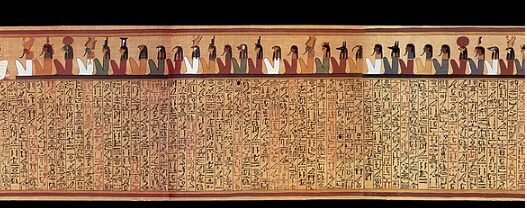
The recitation takes place in the afterlife, during judgment, and plays a key role in determining whether the soul is allowed to proceed to paradise or is condemned. Image: A section from the Papyrus of Ani
Where does the most famous version of the Negative Confession come from?
The most well-known version of the Negative Confession comes from the Papyrus of Ani, a manuscript of the Egyptian Book of the Dead dating to around 1250 BCE, created for a priest named Ani from Thebes.
What happens during the weighing of the heart in the judgment scene of the afterlife?
In the judgment scene, the heart of the deceased is weighed on a scale against a white feather, symbolizing ma’at (truth, balance, and cosmic order). If the heart is lighter than the feather, the soul proceeds to paradise. If heavier, it is devoured by Amut, and the soul ceases to exist.

The actual title of the Egyptian Book of the Dead is The Book of Coming Forth by Day. Its purpose is to guide the soul through the afterlife, providing instructions for the challenges it may face after death.
What cultural values does the Negative Confession reveal about ancient Egypt?
The Negative Confession highlights ancient Egyptian values such as honesty, fairness, and adherence to ma’at. It shows how the Egyptians placed importance on living a virtuous life, reflecting one’s character and moral integrity.
How does the Negative Confession relate to Osiris and the judgment process?
Osiris, the god of the dead and ruler of the underworld, is a central figure in the judgment process. The Negative Confession was developed during the New Kingdom when the cult of Osiris was prominent, as a way for the deceased to justify their worthiness for paradise.

The gods Osiris, Anubis, and Horus. Wall painting in the tomb of Horemheb (KV57)
How was the Negative Confession personalized for different individuals?
The specific sins listed in the Negative Confession varied depending on the individual’s role in life. For example, a soldier could not claim, “I have not commanded to kill,” while a judge or ruler might omit confessions that conflicted with their duties. This personalization allowed the deceased to speak truthfully before the gods.
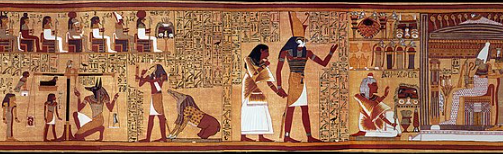
Wealthy individuals, like Ani, could afford personalized versions of the text, tailored specifically to their life experiences. Scribes crafted these texts to reflect the individual’s moral accountability, ensuring that the deceased could truthfully recite the confession without lying. Image: A section from the Papyrus of Ani
Were there any universal sins found in all Negative Confessions?
Yes, certain universal sins, such as “I have not stolen” and “I have not caused pain,” were found in nearly every version of the Negative Confession. These reflect common moral principles that applied to everyone.
What was the significance of intent in the Negative Confession?
Many of the confessions implied the importance of intent. For example, “I have not caused anyone to weep” likely meant that the soul had not intentionally caused suffering. This focus on intent underscores the Egyptians’ emphasis on sincerity and personal responsibility.
Did ancient Egyptians have strict taboos against behaviors like premarital sex or drinking?
No, the ancient Egyptians did not have strict taboos against behaviors like premarital sex or drinking. These actions were acceptable under specific conditions, such as getting drunk at a festival or engaging in premarital sex with someone who wasn’t married to someone else.





