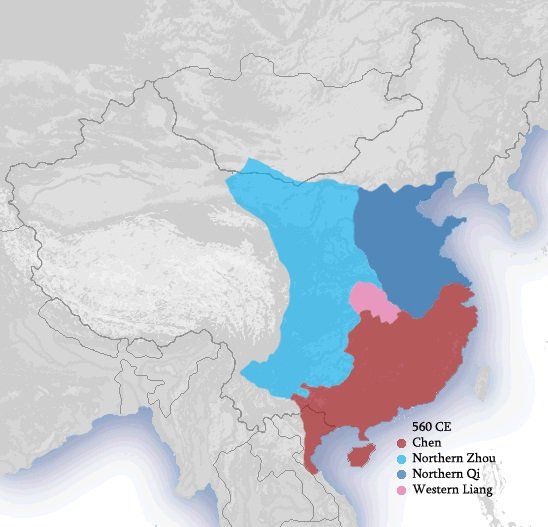
Map showing the approximate territories in 560: Northern Qi (dark blue), Northern Zhou (light blue), Chen (red), and Western Liang (pink).
The Northern and Southern Dynasties (420–589) was a period of political fragmentation in Chinese history that followed the fall of the Eastern Jin dynasty and the chaotic era of the Sixteen Kingdoms. Although it was a time of civil war and division, this period also saw significant cultural advancements, including technological progress, literary achievements, and the spread of Buddhism and Daoism. The era ultimately ended with the unification of China under the Sui dynasty in 589.
In the article below, World History Edu explores the historical developments, cultural transformations, and social dynamics that characterized the Northern and Southern Dynasties.
Background and the Collapse of a Unified China
The fall of the Eastern Han dynasty in 220 led to the formation of the Three Kingdoms: Wei, Shu, and Wu. After a series of military conflicts, the Western Jin dynasty briefly reunited China in 280, but internal power struggles and invasions by non-Han nomadic groups, collectively known as the Five Barbarians, led to its downfall. These invasions resulted in the establishment of numerous short-lived states during the Sixteen Kingdoms period, which preceded the Northern and Southern Dynasties.
Political Division: The Northern and Southern Dynasties
The Northern and Southern Dynasties emerged after the fall of the Eastern Jin dynasty. The north was ruled by various non-Han regimes, particularly the Northern Wei, while the south was governed by a succession of Han-led dynasties, including Liu Song, Southern Qi, Liang, and Chen.
The Northern Dynasties
The Northern dynasties were established primarily by the Xianbei, a nomadic people from the north. The Northern Wei (386–535) was the most prominent of these dynasties. Under Emperor Xiaowen, a sinicization policy was implemented, leading to significant cultural integration. However, internal strife eventually led to the split into Eastern Wei and Western Wei, followed by the rise of Northern Qi and Northern Zhou. The Northern Zhou eventually reunified northern China before being overthrown by the Sui dynasty.
The Southern Dynasties
The southern dynasties were Han Chinese regimes that ruled from Jiankang (modern-day Nanjing). The Liu Song dynasty (420–479) was the first of these, followed by the Southern Qi (479–502), Liang (502–557), and Chen (557–589). These dynasties struggled with internal power struggles but preserved Han traditions and culture. The last of the southern dynasties, the Chen dynasty, was ultimately conquered by the Sui dynasty in 589, marking the reunification of China.
Cultural and Technological Advancements
Despite political turmoil, the Northern and Southern Dynasties period witnessed remarkable cultural progress. The era was marked by literary achievements, technological innovations, and the expansion of Buddhism and Daoism.
Literature and Art
The period saw the development of refined poetry and prose. The works of figures such as Tao Yuanming and Xie Lingyun became highly regarded. The influence of Buddhism introduced new themes and artistic expressions, particularly in sculpture and painting. The Yungang and Longmen Grottoes, which house magnificent Buddhist statues and murals, were constructed during this time.
Technological Innovations
Significant advancements occurred in science and technology. Mathematician and astronomer Zu Chongzhi made precise calculations of pi and improved the Chinese calendar. The development of the stirrup revolutionized cavalry warfare, making mounted soldiers more effective in battle. Cartography, medicine, and metallurgy also saw notable progress.
Spread of Buddhism and Daoism
Buddhism, introduced to China earlier, flourished during this period. Many emperors and aristocrats became patrons of Buddhism, leading to the construction of monasteries and translation of Buddhist scriptures. Daoism also gained prominence, with the compilation of essential Daoist texts. Both religions had a profound impact on Chinese philosophy, art, and governance.
Social Changes and Migration
One of the most significant demographic changes of this period was the large-scale migration of Han Chinese to southern China. The northern invasions and conflicts led to the movement of aristocrats, scholars, and commoners southward, contributing to the development of the Yangtze River region. This migration resulted in cultural exchanges between northern and southern populations, shaping future Chinese civilization.
The reunification under the Sui dynasty marked the beginning of a new era, setting the stage for the golden age of China in the Tang dynasty.
Military Conflicts and the Path to Unification
The Northern and Southern Dynasties were characterized by constant warfare, with both sides attempting to assert dominance. The Northern Wei launched several military campaigns against the southern dynasties but failed to achieve a decisive victory. Similarly, the southern dynasties occasionally launched northern expeditions with limited success. The eventual weakening of the northern states allowed the Northern Zhou to consolidate power before being replaced by the Sui dynasty, which reunified China under Emperor Wen.
Emperor Qin Shi Huang (259 BC – 210 BC), the First Emperor of a unified China
Timeline
- 420 – Liu Yu overthrows Eastern Jin, establishing the Liu Song dynasty, marking the start of the Northern and Southern Dynasties.
- 439 – Northern Wei unifies northern China, ending the Sixteen Kingdoms period.
- 450 – Emperor Taiwu of Northern Wei launches a failed invasion of Liu Song.452 – Taiwu is assassinated; internal conflicts follow.
- 464–479 – Liu Song weakens under internal strife; Southern Qi replaces Liu Song in 479.
- 493 – Emperor Xiaowen of Northern Wei moves the capital to Luoyang, implementing sinicization policies.
- 502 – Liang dynasty replaces Southern Qi; Emperor Wu promotes Buddhism and culture.
- 523–534 – Rebellion of the Six Garrisons weakens Northern Wei, leading to its split into Eastern Wei and Western Wei.
- 550 – Eastern Wei general Gao Yang founds Northern Qi.
- 557 – Western Wei general Yuwen Jue establishes Northern Zhou; Chen dynasty replaces Liang in the south.
- 577 – Northern Zhou conquers Northern Qi, unifying the north.
- 581 – Yang Jian seizes power, founding the Sui dynasty.
- 589 – Sui conquers Chen, ending the Northern and Southern Dynasties and reunifying China.
Ancient China: 10 major facts about one of history’s greatest civilizations
Frequently Asked Questions
How did the Northern and Southern Dynasties come to exist?
Following the fall of the Eastern Jin, Liu Yu seized the throne and established the Liu Song dynasty in 420, beginning the Southern Dynasties. In 439, the Northern Wei unified northern China, marking the start of the Northern Dynasties.
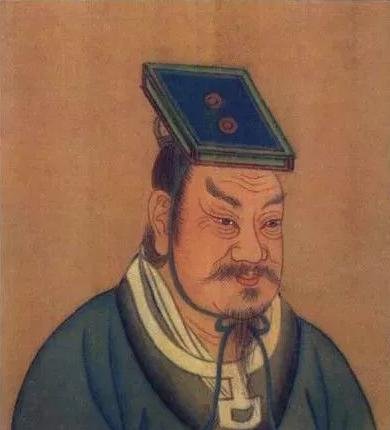
Liu Yu
What role did Buddhism play during this period?
Buddhism became widespread in both the north and south, influencing art, culture, and governance. The Northern Wei supported Buddhist construction projects, such as the Yungang Grottoes.
How did sinicization affect the Northern Dynasties?
Northern rulers, especially the Northern Wei under Emperor Xiaowen, adopted Han customs, language, and administration, integrating steppe nomads into Chinese society.
What were the major technological and scientific advancements?
Innovations included improvements in medicine, astronomy, mathematics, cartography, and military technology, such as the stirrup, which revolutionized cavalry warfare.
The blending of Han and non-Han traditions, the expansion of Buddhism and Daoism, and the development of literature and science laid the foundation for the prosperity of the subsequent Sui and Tang dynasties.
How did the Southern Dynasties differ from the Northern Dynasties?
The south, ruled by Han Chinese elites, focused on literature, arts, and Confucian traditions, while the north, ruled by Xianbei and other non-Han groups, had a strong military culture and was more open to foreign influences.
What led to the reunification of China?
The Northern Zhou conquered the Northern Qi in 577, unifying the north. In 589, the Sui dynasty, founded by Yang Jian, conquered the Chen dynasty in the south, reunifying China.
What was the long-term impact of this period?
The Northern and Southern Dynasties set the foundation for the Sui and Tang dynasties, fostering cultural integration, administrative reforms, and military strategies that shaped China’s future.
The Northern and Southern Dynasties ended with the unification of China by the Sui dynasty.





