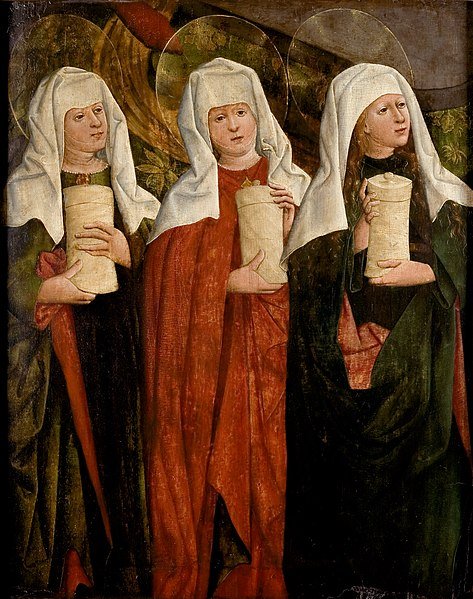
A 15th-century painting “The Three Marys at the Tomb” by Mikołaj Haberschrack.
The Three Marys, mentioned in the canonical Gospels, hold a significant place in the narratives of Jesus’ crucifixion and resurrection. These women represent various roles and connections in the life and ministry of Jesus. As “Mary” was a common name for Jewish women in the period, the Gospels often distinguish them based on their relationships or roles. Over time, Christian tradition has identified and interpreted these women in various ways. Below is an exploration of their roles, interpretations, and cultural impact.
The Gospels’ Mentions of the Marys
The Gospels reference several women named Mary, including:
- Mary, the mother of Jesus: The most renowned figure in Christian theology, she is central to the nativity and life of Christ but is not always present in the narratives of the crucifixion and resurrection.
- Mary Magdalene: Often associated with devotion and as the first to witness the resurrection, Mary Magdalene is a key figure in all resurrection accounts.
- Mary of Jacob (mother of James the Less): Referred to in Matthew 27:56, Mark 15:40, and Luke 24:10, she is sometimes identified as Mary of Clopas.
- Mary of Clopas: Mentioned in John 19:25, she is thought to be related to Jesus’ mother or part of his extended family.
- Mary of Bethany: Known for her devotion to Jesus, she is not explicitly mentioned in crucifixion or resurrection narratives but features in significant events like the anointing of Jesus (John 12:1–3).
Another figure, Salome, is occasionally included in the Marys’ group as “Mary Salome.” Other women, such as Joanna and the mother of Zebedee’s sons, appear in these narratives but are not named Mary.
The Three Marys at the Crucifixion
At the crucifixion of Jesus, the presence of a group of women is recorded in all four Gospels. While variations exist among the accounts, tradition often identifies the Three Marys at the cross as:
- Mary, the mother of Jesus: Present in John’s Gospel (19:25).
- Mary Magdalene: A steadfast disciple of Jesus.
- Mary of Clopas: Sometimes identified as Jesus’ mother’s sister or another relative.
Other Gospels offer differing lists, sometimes including Mary of Jacob and Salome. These differences have led scholars and traditions to reconcile the accounts by combining or interpreting certain figures as the same person under different names.
In art, the Three Marys at the crucifixion are often depicted alongside Jesus, symbolizing loyalty and mourning. Paintings like El Greco’s Disrobing of Christ capture their grief and devotion.
The Three Marys at the Tomb
The Gospels also mention women visiting Jesus’ tomb on Easter morning. These women are traditionally identified as:
- Mary Magdalene.
- Mary of Clopas.
- Mary Salome.
The Gospel accounts differ slightly:
- Mark 16:1 mentions these three explicitly.
- Matthew 28:1 refers to Mary Magdalene and “the other Mary.”
- Luke 24:10 adds Joanna and “the other women.”
- John 20:1–2 only mentions Mary Magdalene but uses the plural “we,” implying others accompanied her.
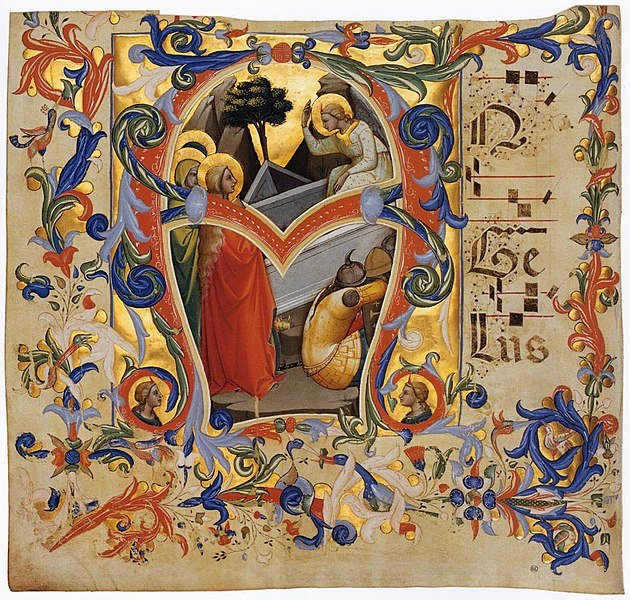
“The Three Marys at the Tomb” (manuscript illumination from a 1396 antiphonary), by Sienese painter Lorenzo Monaco.
Eastern Orthodoxy includes these Marys among the Myrrhbearers, a larger group of followers who prepared Jesus’ body for burial.
Art frequently depicts the Three Marys at the tomb, often with an angel announcing Jesus’ resurrection. This imagery dates back to early Christian frescoes, such as those in Dura-Europos (AD 256), and continues in medieval and modern depictions.
Cultural and Legendary Interpretations
A medieval tradition holds that Mary Magdalene, Mary of Jacob, and Mary Salome, along with others, escaped persecution in the Holy Land and traveled to Provence, France. They supposedly landed in the town of Saintes-Maries-de-la-Mer, where their relics became the focus of a pilgrimage. This legend, though not grounded in historical evidence, is celebrated in French Catholic tradition, with festivals honoring the Three Marys.
In Catholic cultures like Spain, the Philippines, and Latin America, images of the Three Marys are central to Good Friday processions. These representations often include:
- Mary of Clopas: Carrying a broom, symbolizing her role in tending to Jesus’ tomb.
- Mary Salome: Holding a censer or thurible, representing prayer and worship.
- Mary Magdalene: Carrying an alabaster jar, signifying her anointing of Jesus.
The Three Daughters of Saint Anne
A medieval legend claims that Saint Anne, the mother of Mary (mother of Jesus), had three daughters, all named Mary:
- Mary (mother of Jesus).
- Mary of Clopas.
- Mary Salome.
This tradition, popularized in the 9th century by Haymo of Auxerre and later included in Jacobus de Voragine’s Golden Legend (1260), was eventually rejected by the Council of Trent. Nevertheless, it inspired religious art, particularly in Germany and the Low Countries, depicting Saint Anne with her extended family, known as the Holy Kinship.
Symbolism and Parallels in Mythology
The concept of the Three Marys has drawn comparisons to mythological triads, such as the Three Fates (Moirai) in Greek mythology. These goddesses—Clotho (Spinner), Lachesis (Measurer), and Atropos (Cutter)—controlled the thread of human destiny. Similarly, the Marys are present at key moments of Jesus’ life, symbolizing devotion and the unfolding of divine plans.
Other Cultural References
In some Spanish-speaking countries, the Orion’s Belt asterism is called Las Tres Marías (The Three Marys). This celestial naming reflects the broader cultural resonance of the Marys as symbols of unity and faith.
Additionally, Christian theologians and writers, such as Alexander Moody Stuart, have studied the Three Marys, exploring their spiritual significance. His book The Three Marys examines the roles of Mary Magdalene, Mary of Bethany, and Mary of Nazareth, emphasizing their unique contributions to Jesus’ ministry.
Frequently Asked Questions
How do the Gospels depict the women at the crucifixion?
All four Gospels describe women present at the crucifixion, but their identities vary. John mentions Mary (mother of Jesus), Mary Magdalene, and Mary of Clopas, while other Gospels mention Mary of Jacob, Salome, and the mother of the sons of Zebedee.
Who were the Three Marys at the tomb?
The Three Marys at the tomb are often identified as Mary Magdalene, Mary of Clopas, and Mary Salome, based on the Gospel of Mark. Other Gospels mention additional or different women.
What role do the Three Marys play in Christian art?
The Three Marys frequently appear in Christian art, especially scenes of the crucifixion and the resurrection, such as frescoes, manuscript illuminations, and sculptures.
What is the significance of the Three Marys in legend?
A medieval legend recounts that Mary Magdalene, Mary of Jacob, and Mary Salome traveled to Provence, France, bringing early Christianity to the region. Their relics are venerated in Saintes-Maries-de-la-Mer.
Who are the Three Marys as daughters of Saint Anne?
A legend proposes that Saint Anne had three daughters, all named Mary: Mary (mother of Jesus), Mary of Clopas, and Mary Salome. This account was popularized in medieval art and literature but lacks scriptural basis.
What other women are associated with the resurrection narratives?
Besides the Marys, Joanna, Salome, and the mother of the sons of Zebedee are mentioned in the resurrection accounts. Some traditions combine or interchange these identities.
How do cultural interpretations connect the Three Marys to mythology?
Some scholars compare the Three Marys to the Greek Moirai (Fates), as both represent key moments of destiny—symbolized by their presence at Jesus’s life-changing events like the crucifixion and resurrection.





