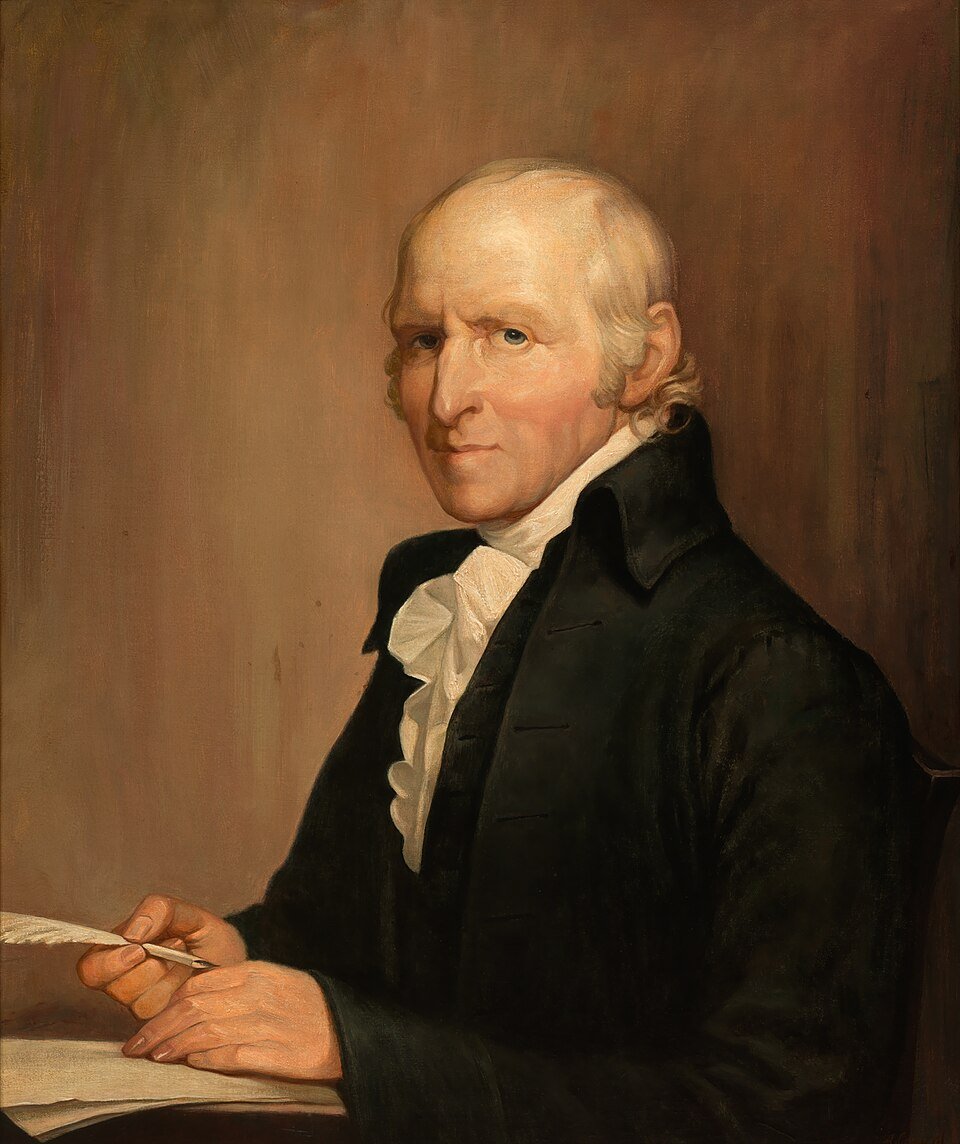
Timothy Pickering
Timothy Pickering was an American politician who served as the third U.S. Secretary of State under Presidents George Washington and John Adams. He was also a member of the Federalist Party and represented Massachusetts in both houses of Congress.
Early Life and Education
Timothy Pickering was born on July 17, 1745, in Salem, Massachusetts, to Deacon Timothy and Mary Wingate Pickering. He was one of nine children and grew up in a family deeply rooted in the community. His older brother, John Pickering, would later serve as the Speaker of the Massachusetts House of Representatives, further adding to the family’s political prominence. Timothy attended local grammar schools in Salem before graduating from Harvard College in 1763. While he was an academic success, Salem minister William Bentley described him as “assuming, turbulent, and headstrong” during his youth, suggesting that he exhibited a strong and independent personality from a young age.
After graduating from Harvard, Pickering began working for John Higginson, the town clerk and Essex County register of deeds. He was admitted to the Massachusetts Bar in 1768 and soon after took over the position of register of deeds when Higginson retired in 1774. This was the beginning of Pickering’s involvement in the legal and political affairs of his community. He was also elected to the Massachusetts General Court, where he served as a representative for Salem. His legal expertise and growing political involvement set the stage for his future career in public service.
Military Service during the American Revolution
Pickering’s military career began in 1766 when he was commissioned as a lieutenant in the Essex County militia. He was promoted to captain in 1769 and soon became involved in the local militia’s efforts to prepare for potential conflicts with British forces. In 1775, when tensions between the colonies and Great Britain escalated, Pickering’s militia was called upon to defend Salem.
On February 26, 1775, Pickering’s troops were involved in what became known as “Leslie’s Retreat,” one of the first military engagements of the Revolutionary War. British troops, under the command of Lieutenant Colonel Alexander Leslie, attempted to seize artillery in Salem, but they were thwarted by Pickering’s militia and local citizens, avoiding an armed conflict that could have sparked the war earlier.
Following this incident, Pickering and his militia joined the Continental Army, participating in the siege of Boston and later in the battles of Lexington and Concord. His leadership and organizational skills caught the attention of General George Washington, who appointed him as the Continental Army’s Adjutant General in 1777. In this role, Pickering oversaw key logistical operations, including the construction of a chain that blocked British naval forces on the Hudson River at West Point. His efforts were integral to the American victory, and he was promoted to Quartermaster General in 1780.
Post-War Career and Rise to Prominence
After the American Revolution, Pickering struggled to achieve financial success. He entered into a mercantile partnership with Samuel Hodgdon, but the venture failed in 1785. He then moved to the Wyoming Valley in Pennsylvania, where he took on various administrative roles, including serving as a commissioner to the Iroquois. During this time, he was involved in the Pennsylvania convention of 1787, which debated the ratification of the United States Constitution. His experiences during this period helped shape his political views, especially regarding the role of government in relations with Native American tribes and his growing support for a strong federal government.
Pickering’s political career took off when President George Washington appointed him as Postmaster General in 1791. His appointment marked the beginning of his long tenure in Washington’s cabinet, where he remained until 1795. During this time, he played a critical role in establishing the nation’s postal system, helping to improve communication and connectivity across the new country. In 1795, after briefly serving as Secretary of War, Pickering was appointed Secretary of State under Washington and continued to serve in this role under President John Adams.
John Adams
Secretary of State and Political Views
As Secretary of State, Pickering was a staunch Federalist and supported policies that favored a strong central government and close ties with Britain. He was an advocate for maintaining American neutrality in European conflicts, though he also supported Britain’s position during the Napoleonic Wars. One of his key moments as Secretary of State came in 1799 when he faced tensions with France during the Quasi-War. In response to French aggression against American shipping, Pickering pushed for a hardline stance against France. His commitment to strengthening ties with Britain made him one of the most influential figures in the Adams administration.
However, his tenure as Secretary of State was marked by growing tensions with President John Adams, particularly over the issue of peace with France. Adams, seeking to avoid a full-scale war, pursued diplomatic negotiations with France in 1799, which angered Pickering and many other Federalists. Pickering believed that a more aggressive approach was needed, and his opposition to Adams’ peace efforts ultimately led to his dismissal in 1800.
Later Political Career and Opposition to the Jeffersonian Republicans
After his dismissal from the Adams administration, Pickering remained active in politics. In 1803, he was elected to the United States Senate from Massachusetts, where he continued to advocate for Federalist principles. His opposition to the policies of President Thomas Jefferson was particularly evident in his strong stance against the Embargo Act of 1807, which sought to prevent American trade with Britain and France in an attempt to avoid conflict. Pickering believed that the Embargo Act would harm the American economy and hurt the Federalist cause.
In 1804, Pickering, along with other Federalists, supported a controversial plan to secede New England and New York from the United States. The plan was fueled by dissatisfaction with Jefferson’s policies and the increasing power of southern states in the federal government. However, the secession movement faltered after Aaron Burr’s defeat in the 1804 New York gubernatorial election. Despite the failure of this plan, Pickering’s pro-British sympathies and his opposition to Jefferson’s policies made him a key figure in the growing political divisions of the early 19th century.
Leadership During the War of 1812 and the Hartford Convention
As the United States entered the War of 1812, Pickering became a vocal critic of the war and a leading figure in the New England secession movement. He saw the war as a disaster for New England, which relied heavily on maritime trade. In 1814, Pickering helped organize the Hartford Convention, a gathering of New England Federalists that sought to address the region’s grievances with the federal government. While some members of the convention advocated for secession, Pickering’s goal was to secure constitutional amendments to protect New England’s interests.
The aftermath of the Hartford Convention was disastrous for the Federalist Party. The convention’s perceived disloyalty to the United States and its failure to achieve any meaningful political reforms led to the collapse of the Federalists as a national political force. Pickering’s involvement in the convention marked the end of his political career, and he was largely sidelined in the years that followed.
Later Life and Legacy
After his political career ended, Pickering retired to his farm in Salem, where he spent the remainder of his life. He lived out his years in relative obscurity, away from the political spotlight, and passed away on January 29, 1829, at the age of 83. His legacy, however, lived on through his contributions to the early years of the United States.
Pickering’s influence is still recognized today. In 1799, Fort Pickering in Salem was named in his honor, and in 1942, a United States Liberty ship named the SS Timothy Pickering was launched. His ancestral home, the Pickering House, was the oldest house in the United States to be continuously owned by the same family until the 1990s.
Despite the controversies and political setbacks that marked his career, Timothy Pickering played a significant role in the early years of the United States. His efforts to shape American foreign policy, especially his advocacy for strong ties with Britain, and his leadership during the formative years of the republic left a lasting imprint on the nation’s history.
Timeline of Timothy Pickering
1745: Timothy Pickering is born in Salem, Massachusetts.
1763: Graduates from Harvard College.
1766: Commissioned as a lieutenant in the Essex County militia.
1775: Participates in “Leslie’s Retreat” and the Siege of Boston.
1777: Appointed Adjutant General of the Continental Army.
1780: Becomes Quartermaster General of the Continental Army.
1791: Appointed Postmaster General by President George Washington.
1795: Appointed Secretary of State under President George Washington.
1799: Opposes peace talks with France and is dismissed from office by President Adams.
1803: Elected to the U.S. Senate as a Federalist.
1814: Participates in the Hartford Convention, advocating for New England secession.
1815: Elected as a Fellow of the American Academy of Arts and Sciences.
1817: Retires from Congress and returns to farming in Salem.





