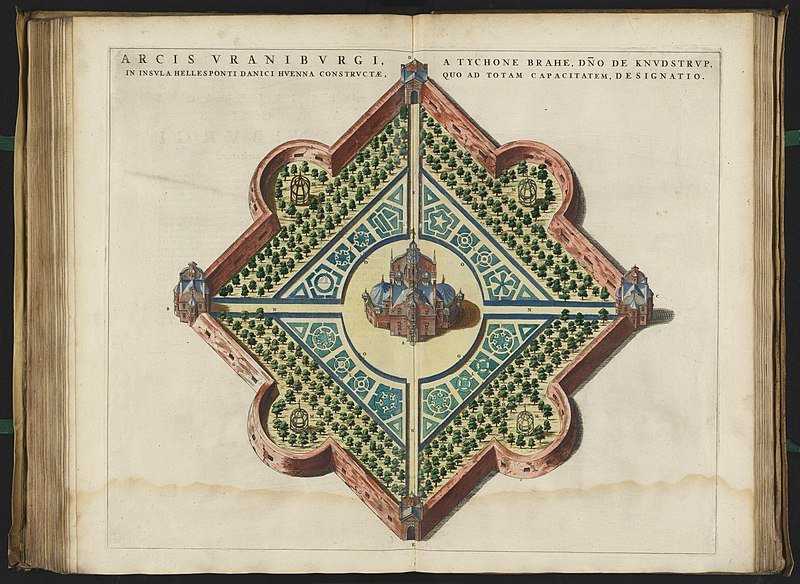
Tycho Brahe’s Uraniborg as depicted in Blaeu’s “Atlas Maior” (1663).
Uraniborg was an influential astronomical observatory and alchemical laboratory established by Danish astronomer Tycho Brahe in the late 16th century. Located on the island of Ven in the Øresund Strait, between modern-day Denmark and Sweden, it was the first custom-built observatory in modern Europe and the last to function without a telescope as its primary instrument. The facility not only advanced astronomical research but also played a key role in alchemy, meteorology, and scientific instrumentation.
Brahe designed Uraniborg as a comprehensive research institution, housing astronomers, students, and artisans who developed precision instruments. Despite its prominence, Brahe was forced to abandon Uraniborg in 1597 after falling out of favor with King Christian IV of Denmark. The observatory was eventually destroyed in 1601, but its legacy influenced later scientific developments, particularly through Brahe’s contributions to celestial mapping and Johannes Kepler’s later refinements in planetary motion. Restoration efforts began in the 1980s, ensuring that Uraniborg’s impact on the history of science remains recognized.
The Construction and Design of Uraniborg
Inspiration and Architectural Style
The observatory was named after Urania, the Muse of Astronomy, reflecting its dedication to celestial studies. Brahe, inspired by Renaissance ideals of geometric harmony and proportion, meticulously designed Uraniborg with a symmetrical layout that integrated astronomy, astrology, and alchemy. He oversaw its construction from 1576 to 1580, employing Danish architect Hans van Emden and sculptor Johan Gregor van der Schardt.
Built primarily of red brick with sandstone and limestone framing, the structure exemplified the Flemish Renaissance style. The main building was square-shaped, measuring about 15 meters on each side. It featured two semi-circular towers on the north and south, giving the overall structure a rectangular footprint.
Interior Layout and Functions
The main floor comprised four rooms—one for Brahe and his family, and the others for visiting scholars. The northern tower housed the kitchens, while the southern tower contained a library, where Brahe inscribed the Latin phrase “Non haberi sed esse” (“What one is, is more important than what one is perceived to be”). The second floor had a royal guest chamber, notably visited by James VI of Scotland (later James I of England) in 1590.
Atop the structure, balconies and rooftop platforms supported astronomical instruments, allowing astronomers to observe celestial phenomena with an unobstructed view. A spiral staircase led to a loft divided into smaller rooms for Brahe’s students. Below ground, an extensive basement housed an alchemical laboratory and storage areas for food, salt, and fuel.
Tycho Brahe’s precise observations revolutionized celestial mapping and paved the way for Kepler’s discoveries.
The Observatory and Instruments
Uraniborg was equipped with some of the most advanced astronomical instruments of its time, including mural quadrants, sextants, and armillary spheres. These tools were mounted on walls or positioned on balconies to maximize stability and accuracy. Unlike earlier observatories, Uraniborg’s instruments were precisely calibrated, allowing for measurements with an unprecedented level of precision—often accurate to within a minute of arc.
One of the most notable instruments was the large mural quadrant, fixed to a north–south wall to measure star altitudes as they passed the meridian. Many of these instruments were later detailed in Brahe’s book Astronomiae instauratae mechanica (1598). To minimize wind disturbances affecting observations, Brahe later built Stjerneborg, an underground extension of Uraniborg, where instruments were housed in more stable conditions.
Scientific Contributions and Research
Uraniborg functioned as an advanced astronomical research center where Brahe and his assistants systematically recorded planetary and stellar positions. Through meticulous observations, he refined celestial cartography and developed the Tychonic system, an alternative model of the cosmos. In this model, Earth remained stationary while the Sun and Moon orbited it, and all other planets revolved around the Sun.
His observations of the 1577 comet led him to reject the Aristotelian belief in crystalline celestial spheres, as the comet’s trajectory proved that planets and celestial bodies moved through space freely. His precise star catalog, completed at Uraniborg, listed over 1,000 stars with unprecedented accuracy.
Brahe’s interests extended beyond astronomy; he also conducted experiments in alchemy and meteorology. His laboratory focused on producing medicines, herbal remedies, and chemical compounds, which he often gifted to patrons and nobility. Meteorological records from Uraniborg provided some of the earliest systematic weather data in Europe.
Uraniborg was the first purpose-built research facility in modern Europe and the last major observatory designed without a telescope, significantly improving celestial measurements.
While Brahe openly shared his astronomical and meteorological findings, his alchemical research remained largely secretive. His underground laboratory was designed to allow natural light while maintaining controlled temperatures for year-round experimentation.
One of Brahe’s greatest legacies was his impact on the German astronomer Johannes Kepler. Before Brahe’s death in 1601, Kepler worked as his assistant and later used Brahe’s precise planetary observations to formulate his laws of planetary motion, which laid the groundwork for modern orbital mechanics.
Uraniborg’s Decline and Aftermath
After the death of King Frederick II, Brahe lost his royal patronage under Christian IV, who was less interested in funding scientific endeavors. In 1597, Brahe abandoned Uraniborg, relocating to Prague, where he continued his work under Emperor Rudolf II.
Following Brahe’s departure, Uraniborg and Stjerneborg fell into disrepair. By 1601, after Brahe’s death, both observatories were largely dismantled. Ven eventually became Swedish territory, and Denmark sought to replace Uraniborg with the Rundetårn (Round Tower) in Copenhagen, which was inaugurated in 1642.
Despite its destruction, Uraniborg’s contributions lived on. French astronomer Jean Picard visited the ruins in 1671 and recorded Uraniborg’s latitude and longitude, helping future astronomers compare Brahe’s findings with later celestial observations.
Restoration and Legacy
Excavations in the 1950s uncovered portions of the original Uraniborg structure and the underground Stjerneborg laboratory. By the 1980s, Swedish authorities initiated restoration efforts, reconstructing parts of the ramparts and replanting the historic gardens based on Brahe’s writings.
Uraniborg was more than an observatory—it was a pioneering scientific institution that bridged astronomy, alchemy, and meteorology.
Today, Uraniborg and Stjerneborg are preserved as part of the Tycho Brahe Museum on Ven. The site features restored gardens, a multimedia exhibition on Brahe’s life, and remains of the observatory’s foundations. The museum attracts researchers and tourists interested in Renaissance science, astronomy, and Brahe’s enduring legacy.
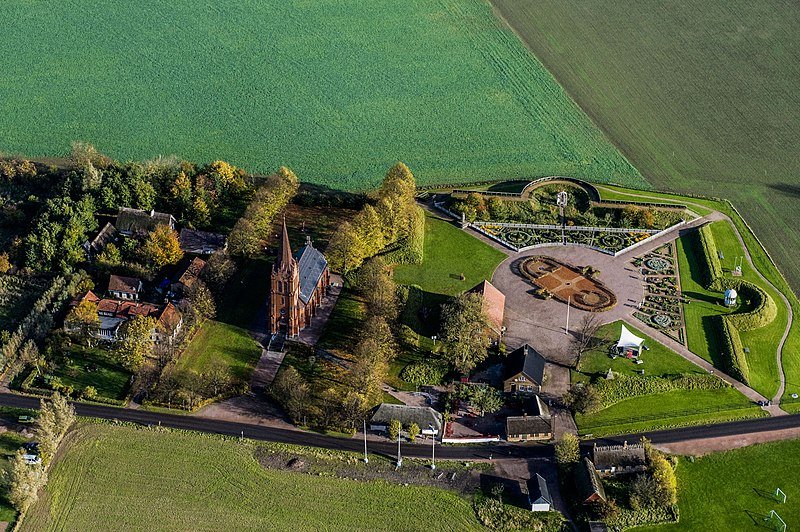
Aerial view (modern)
Frequently Asked Questions
How did Uraniborg contribute to astronomy?
Brahe’s precise observations at Uraniborg led to the creation of the Tychonic system, a hybrid model of the cosmos. His detailed star catalog, accurate to within a minute of arc, later provided essential data for Johannes Kepler’s laws of planetary motion.
What instruments were used at Uraniborg?
Brahe developed and improved instruments such as the mural quadrant, sextants, armillary spheres, and the azimuthal quadrant to enhance measurement accuracy. These innovations allowed for the most precise celestial mapping of the pre-telescope era.
Why did Tycho Brahe abandon Uraniborg?
After the death of his patron, King Frederick II, Brahe lost royal funding under Christian IV and fell out of favor at court. In 1597, he left Denmark and relocated to Prague, where he continued his research under Emperor Rudolf II.
What happened to Uraniborg after Brahe’s departure?
Uraniborg and its underground extension, Stjerneborg, were abandoned and largely destroyed by 1601. Ven was later lost to Sweden, and Denmark replaced Uraniborg’s astronomical functions with the Rundetårn (Round Tower) in Copenhagen, inaugurated in 1642.
What role did Uraniborg play in alchemy and meteorology?
In addition to astronomy, Uraniborg housed an alchemical laboratory where Brahe conducted research on medicine and chemical compounds. He also recorded meteorological data, making some of the earliest systematic weather observations in Europe.
How did Uraniborg influence Johannes Kepler?
Kepler worked as Brahe’s assistant and later used his precise planetary data to develop the laws of planetary motion, fundamentally changing the understanding of celestial mechanics and supporting the heliocentric model.





