
The god Odin battles the wolf Fenrir while other deities and their combatants fight in the background on the field Vígríðr in an illustration (1905) by Emil Doepler.
In Norse mythology, Vígríðr (also known as Óskópnir) is a vast plain destined to be the battleground for the climactic events of Ragnarök, the end of the world. This field is prominently featured in both the Poetic Edda and the Prose Edda, key medieval sources that preserve ancient Norse traditions and beliefs.
Etymology
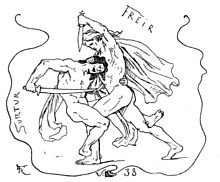
The participants destined to converge on Vigrid are a diverse assembly of gods, giants, and other mythic beings. The Aesir and the Vanir, representing the pantheon of Norse gods, will stand against the forces of chaos, including giants like Surtr and Loki, as well as various monsters and undead warriors. Image: The battle between Surtr and Freyr at Ragnarök, illustration (1895) by Lorenz Frølich
The name Vígríðr originates from Old Norse, meaning “battle-surge” or “place on which battle surges.” It is occasionally anglicized as Vigrid, Vigrith, or Wigrid. The alternative name Óskópnir has a debated origin, with interpretations suggesting meanings like “the not yet created,” “not made,” or “mismade,” reflecting its association with the chaotic end and subsequent renewal of the world.
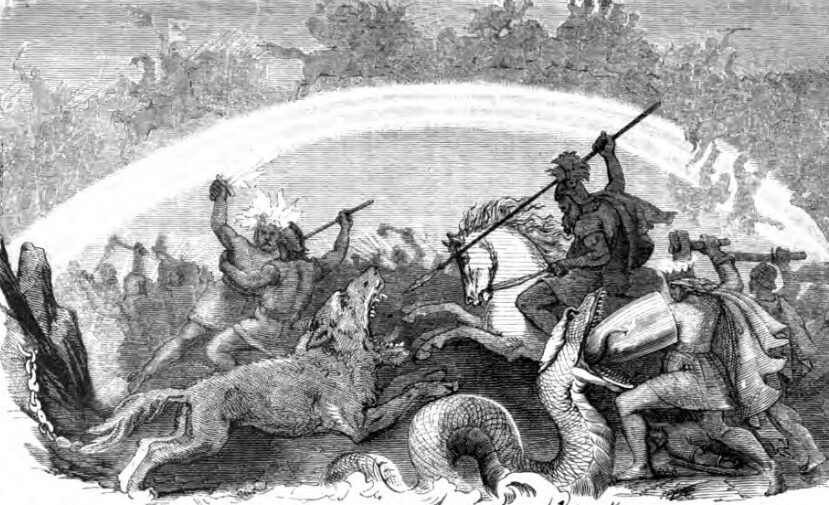
The Norse gods themselves are bound by prophecies that dictate their actions and ultimate demise on this very plain. Image: Battle of the Doomed Gods (by Friedrich Wilhelm Heine, 1882)
Poetic Edda Attestations
In the Poetic Edda, particularly in the poem Vafþrúðnismál, the god Odin, disguised as “Gagnráðr,” engages in a contest of wisdom with the jötunn Vafþrúðnir. When asked about the location where gods and the fire giant Surtr will clash, Odin names the plain as Vígríðr, describing it as extending a hundred leagues in every direction, emphasizing its immense size. Additionally, in Fáfnismál, the wyrm Fáfnir identifies an island named Óskópnir as the site of the forthcoming battle between Surtr and the gods.
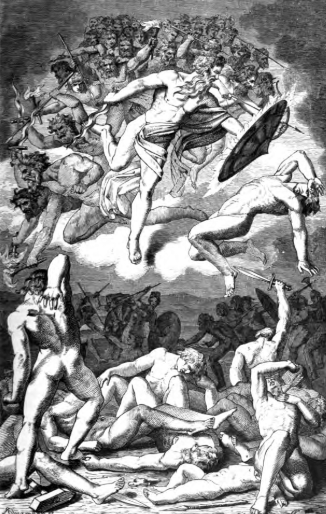
Unlike the familiar landscapes of Midgard or Asgard, Vigrid is portrayed as a liminal space, a threshold between the known worlds and the chaotic forces that threaten their existence. Image: The Downfall of the Æsir by Karl Ehrenberg, 1882
Prose Edda Account
The Prose Edda, authored by Snorri Sturluson, provides a more detailed depiction of Vígríðr in the book Gylfaginning. It describes how the forces of Muspell gather at Vígríðr, bringing forth the monstrous wolf Fenrir, the serpent Jörmungandr, the jötunn Hrym with frost giants, and Loki with Hel’s army. As these adversarial forces assemble, the god Heimdallr sounds the Gjallarhorn, signaling the gods to prepare for battle. The gods, along with the einherjar (fallen warriors), march to Vígríðr, where pivotal confrontations occur:
- Odin confronts and is devoured by Fenrir.
- Thor battles Jörmungandr, ultimately killing the serpent but succumbing to its venom.
- Freyr engages Surtr but falls due to lacking his sword.
- Tyr faces the hound Garmr, resulting in their mutual deaths.
- Loki and Heimdallr kill each other in the final clash.
Following these battles, Surtr ignites the world with fire, leading to its destruction. However, Vígríðr also symbolizes rebirth, as the earth resurfaces renewed, and surviving gods and humans repopulate the world, continuing the eternal cycle of creation and destruction.
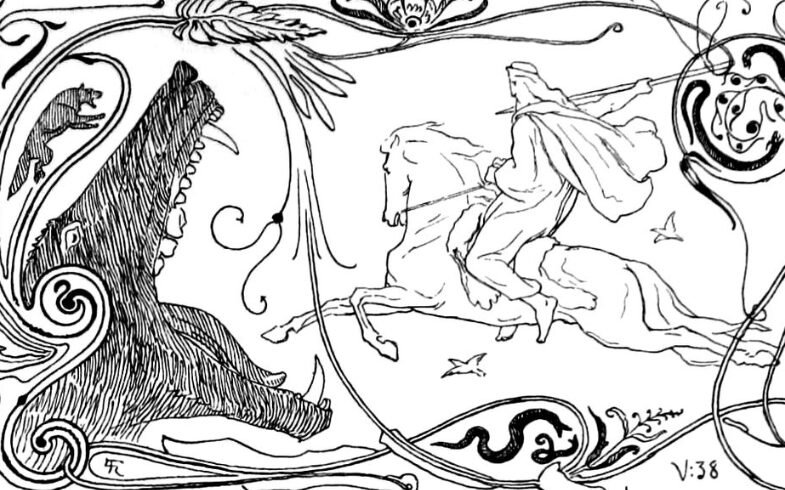
Odin, the Allfather, is destined to face Fenrir, the monstrous wolf, while Thor is fated to battle Jörmungandr, the World Serpent. Image: Fenrir and Odin (1895) by Danish painter Lorenz Frølich
Conclusion
Vígríðr serves as a crucial element in Norse eschatology, representing both the site of ultimate conflict and the foundation for renewal post-Ragnarök. Its portrayal in the Poetic Edda and Prose Edda underscores the themes of fate, destruction, and rebirth that are central to Norse mythology, illustrating the cyclical nature of existence within the cosmic order.

Vigrid is not just a battleground but a catalyst for theological change, facilitating the transition from the old order to the new. Image: “Then the Awful Fight Began” (by George Wright, 1908)





