Virginia Dare, born on August 18, 1587, in the Roanoke Colony (now part of North Carolina), holds a unique place in American history as the first English child born in the New World.
Her story is intertwined with the larger narrative of the “Lost Colony” of Roanoke, one of the greatest unsolved mysteries in early American colonial history.
While her birth is a recorded fact, her life beyond that moment is shrouded in mystery, as she and the rest of the Roanoke settlers disappeared without a trace.
Over time, Virginia Dare has become a symbol of both the promise and the peril of early colonization, with her story evolving into legend and inspiring countless cultural representations.
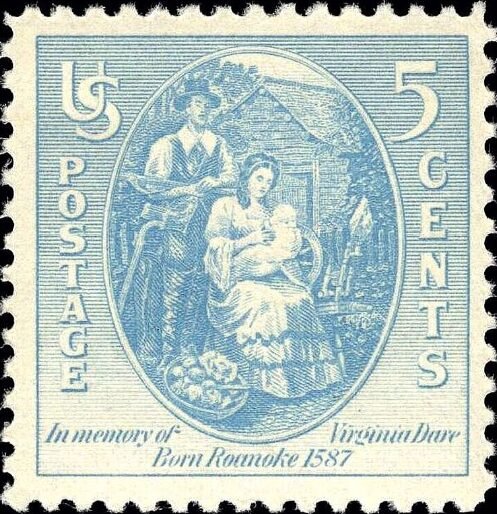
Image: A U.S. postage stamp was issued in 1937 to commemorate the 350th anniversary of Virginia Dare’s birth.
The Birth of Virginia Dare
Virginia Dare was born to English settlers Eleanor and Ananias Dare, members of the Roanoke expedition, which was England’s attempt to establish a permanent settlement in the New World.
Eleanor Dare, Virginia’s mother, was the daughter of John White, the governor of the Roanoke Colony and an accomplished artist and mapmaker. Ananias Dare, Virginia’s father, was a London bricklayer. The family was among the 117 colonists who sailed from England in 1587 under the sponsorship of Sir Walter Raleigh, who had received a charter from Queen Elizabeth I to colonize the region known as Virginia, which at the time encompassed the area from modern-day North Carolina to New York.
The Roanoke expedition was England’s second attempt to settle the area. The first attempt, led by Ralph Lane in 1585, had ended in failure, with the colonists abandoning the settlement after enduring harsh conditions, hostile relations with the native population, and a lack of food.

Sir Walter Raleigh
The second expedition, led by Governor John White, aimed to establish a more permanent and self-sustaining colony. The group included men, women, and children, suggesting that this was meant to be a lasting settlement rather than a temporary outpost.
Virginia Dare’s birth on August 18, 1587, just a few weeks after the colony’s arrival, was a significant event, marking the first time that an English child had been born on American soil. Her birth was recorded in a note by her grandfather, Governor John White, who wrote that “Elenora, daughter to the governor of the city and wife to Ananias Dare, one of the assistants, was delivered of a daughter in Roanoke.”
Virginia’s birth was seen as a symbol of hope for the future of the colony and England’s efforts to establish a foothold in the New World.
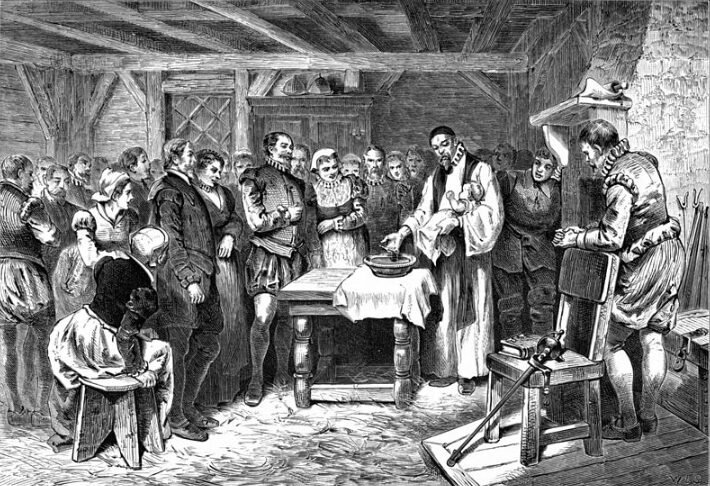
Virginia Dare’s birth is recorded because her grandfather, John White, the colony’s governor, returned to England in 1587 for supplies. When he came back three years later, the colonists had vanished. Image: Baptism of Virginia Dare, wood-engraving, 1880
The Disappearance of the Roanoke Colony
Despite the hopeful beginnings marked by Virginia Dare’s birth, the Roanoke Colony faced significant challenges from the start. The settlers struggled with a lack of supplies and hostile relations with local Native American tribes. Governor White, eager to secure additional provisions and support for the colony, decided to return to England at the end of 1587. Before departing, he left instructions for the colonists to carve a Maltese cross into a tree if they were forced to abandon the settlement due to danger.
White’s return to England was ill-timed. Upon his arrival, he found the country embroiled in preparations to defend against the Spanish Armada, and all available ships were requisitioned for the defense effort. As a result, White was unable to return to Roanoke for nearly three years. It was not until August 18, 1590—Virginia Dare’s third birthday—that White finally returned to the colony, only to find it completely abandoned. The buildings had been dismantled, and there were no signs of a struggle or any of the 117 men, women, and children who had been left behind, including his daughter, granddaughter, and son-in-law.
The only clue to the colonists’ fate was the word “Croatoan” carved into a post of the fort and the letters “Cro” carved into a nearby tree. There was no Maltese cross, which White had instructed the colonists to use if they had been forced to leave under duress, leading him to believe that they had relocated to Croatoan Island, now known as Hatteras Island, about 50 miles south of Roanoke. However, bad weather and other difficulties prevented White from conducting a thorough search, and he was forced to return to England without discovering what had happened to the colonists.
The disappearance of the Roanoke Colony has since become one of the greatest mysteries in American history, earning the settlers the title of the “Lost Colony.” Numerous theories have been proposed over the centuries to explain what happened to the colonists, ranging from integration with local Native American tribes to destruction at the hands of hostile forces or even more far-fetched ideas such as alien abduction. However, no definitive evidence has ever been found to confirm the fate of Virginia Dare or the other settlers.

The return of Governor White to the “Lost Colony”
READ MORE: Early European Colonies in North America that Failed
Theories About the Fate of the Roanoke Colonists
The mystery of what happened to Virginia Dare and the other settlers has fascinated historians, archaeologists, and writers for centuries. Several theories have emerged, with varying degrees of plausibility.
Integration with Native American Tribes
One of the most widely accepted theories is that the colonists sought refuge with local Native American tribes, such as the Croatoan or the Powhatan. The word “Croatoan” carved into the post suggests that the colonists may have moved to Croatoan Island, where they could have joined with the friendly Croatoan tribe. This theory is supported by later reports from English settlers in the Jamestown Colony, founded in 1607, who claimed to have heard stories of Europeans living among the Native Americans in the region.
Some accounts from early 17th-century explorers, such as John Smith of Jamestown, include reports of Native American tribes with members who had European features, such as light skin, blue eyes, or blonde hair, leading to speculation that the Roanoke colonists had intermarried with the indigenous population. William Strachey, a secretary of the Jamestown Colony, wrote in 1612 about seeing European-style houses in Native American villages, which he believed had been built by the Roanoke settlers.
Archaeological evidence supporting this theory has been limited, though some recent discoveries on Hatteras Island have suggested the presence of European artifacts among Native American settlements. However, these findings have not conclusively proven that the Roanoke colonists integrated with the Croatoan or other tribes.
Death at the Hands of Hostile Tribes
Another theory is that the Roanoke settlers were killed by hostile Native American tribes. In 1607, the Jamestown colonists, led by John Smith, sought information about the fate of the Roanoke colonists. Chief Powhatan, leader of the Powhatan Confederacy, claimed that his tribe had attacked and killed the Roanoke settlers. Powhatan reportedly showed Smith European artifacts, including a musket barrel and a brass mortar, as evidence that he had raided their settlement.
However, there is no concrete archaeological evidence to support this claim, and some historians believe that Powhatan may have exaggerated or fabricated the story to intimidate the English settlers. While it is possible that some of the Roanoke colonists met violent ends at the hands of hostile tribes, it is unlikely that this accounts for the entire colony’s disappearance.
Relocation and Starvation
Another possibility is that the Roanoke colonists attempted to relocate to a more favorable location, either further inland or along the coast, but were ultimately unsuccessful. The harsh conditions of the region, including food shortages, lack of fresh water, and disease, could have led to the settlers’ deaths from starvation or exposure. The fact that the colony’s buildings had been carefully dismantled suggests that the departure was not rushed, which supports the idea that the settlers tried to move to a new location.
Some researchers have suggested that the colonists may have split into smaller groups in an attempt to survive, which would explain why no large remains of the colony have been found. However, without definitive archaeological evidence, this theory remains speculative.
Natural Disasters or Disease
Another possibility is that the Roanoke Colony was wiped out by a natural disaster, such as a hurricane, or by an epidemic of disease. The Outer Banks region, where Roanoke Island is located, is known for its frequent hurricanes and tropical storms, which could have devastated the colony. Additionally, diseases brought by European settlers, such as smallpox or influenza, could have decimated the population, particularly if they had limited access to medical care and supplies after White’s departure.
While there is no direct evidence of a natural disaster or epidemic, it is possible that these factors contributed to the colonists’ demise, either alone or in combination with other challenges.
Virginia Dare’s Role in American Folklore
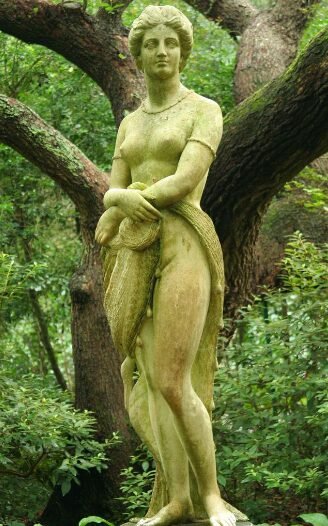
Image: Maria Louisa Lander’s 1859 sculpture of Virginia Dare, in Manteo’s Elizabethan Gardens, depicts her as an adult Indian princess.
Despite the mystery surrounding her life and death, Virginia Dare has become a significant figure in American folklore and mythology. Over the centuries, her story has been reimagined and retold, often with symbolic meanings attached to her identity as the first English child born in the New World.
Symbol of Innocence and Hope
For many Americans, particularly in the 19th and early 20th centuries, Virginia Dare represented the innocence and hope of the early English colonization efforts. Her birth was seen as a symbol of new beginnings in a land full of promise, and her disappearance became a symbol of the struggles and sacrifices made by the early settlers. In this context, Virginia Dare was often depicted as a figure of purity and innocence, embodying the spirit of adventure and bravery that characterized the early English colonists.
The White Doe Legend
One of the most enduring legends surrounding Virginia Dare is the story of the White Doe. According to this tale, Virginia was transformed into a white doe by a Native American shaman after rejecting his romantic advances. The legend goes on to say that Virginia’s true love, a Native American warrior, shot the white doe with a silver arrow, not realizing that it was Virginia. As she lay dying, she transformed back into her human form, revealing her identity just before her death.
This story was popularized in the 19th century by poet Sallie Southall Cotten, whose book The White Doe: The Fate of Virginia Dare (1901) cemented the tale as part of American folklore. The White Doe legend reflects the blending of European and Native American cultures in the mythology of early America, with Virginia Dare representing the tragic loss of innocence and the blending of two worlds.
Appropriation by White Nationalists
In more recent history, Virginia Dare’s story has been appropriated by white nationalist and alt-right groups as a symbol of European purity and heritage. The VDARE website, named after Virginia Dare, promotes anti-immigrant and white nationalist ideologies, using her story as a rallying point for those who seek to preserve a vision of America as a land for people of European descent.
This appropriation of Virginia Dare’s legacy has sparked controversy, as many see her story as a symbol of the diverse and multicultural history of America rather than an emblem of racial purity. The use of Virginia Dare’s name by such groups has been condemned by historians and civil rights organizations, who argue that her legacy should not be co-opted for political purposes.
Virginia Dare in Popular Culture
In addition to her role in American folklore, Virginia Dare has become a popular figure in literature, film, and television. Her story has inspired countless works of fiction, many of which reimagine her fate in creative and imaginative ways.
Literary Adaptations
One of the earliest literary adaptations of Virginia Dare’s story was Cornelia Tuthill’s 1840 novel Virginia Dare, or the Colony of Roanoke, which imagined Virginia growing up and marrying a Jamestown settler. In this romanticized version of her life, Virginia’s disappearance is explained as part of a larger adventure in the New World.
In Sallie Southall Cotten’s The White Doe (1901), Virginia’s transformation into a white doe adds a mythical element to her story, blending Native American folklore with the tale of the Lost Colony. This version of the story has been particularly influential in shaping the popular image of Virginia Dare as a tragic, almost supernatural figure.
Virginia Dare in Modern Fiction
In the 20th and 21st centuries, Virginia Dare has continued to inspire modern writers and filmmakers. In Neil Gaiman’s comic book series 1602, Virginia Dare is depicted as a shape-shifter who can transform into white creatures when she is in danger. This fantastical version of her character blends history with elements of fantasy and adventure.
Margaret Peterson Haddix’s novel Sabotaged (2010), part of her The Missing series, also features Virginia Dare as a central character. In this story, a girl named Andrea discovers that she is actually Virginia Dare, transported through time and struggling to understand her true identity.
Other works, such as Philip José Farmer’s Dare (1965) and Michael Scott’s The Necromancer (2008), explore Virginia’s fate in even more speculative ways, imagining her being abducted by aliens or living as an immortal in a world of magic and mystery.
Memorials and Commemorations

Virginia Dare’s name has been used to market products ranging from vanilla and soft drinks to wine and spirits. Additionally, many places in North Carolina and the Southern United States are named in her honor. Image: Monument to Virginia Dare, Manteo, Roanoke Island, North Carolina
Virginia Dare’s legacy has been commemorated in various ways, both in the United States and in England. In 1937, the U.S. Mint issued a commemorative half-dollar coin featuring Virginia Dare, marking her as the first English child born in the New World. This coin was the first U.S. currency to depict a child and remains a valuable collector’s item today.
In North Carolina, several landmarks bear her name, including Dare County, the Virginia Dare Memorial Bridge, and the Virginia Dare Trail. Each year, residents of Roanoke Island celebrate Virginia Dare’s birthday with an Elizabethan Renaissance fair, honoring her place in the history of the region.
A statue of Virginia Dare, depicted as a grown woman wrapped in a fishnet, stands in the Elizabethan Gardens on Roanoke Island, serving as a physical reminder of her legacy. In London, a bronze sculpture of Virginia Dare is located in St Bride’s Church, where her parents were married before embarking on their journey to the New World.
St. Augustine: The First Permanent European Settlement in America
Questions and Answers about Virginia Dare and the Roanoke Colony

The reverse of the 1937 commemorative US half-dollar coin features Eleanor Dare with her daughter Virginia Dare.
Who was Virginia Dare, and why is she significant in American history?
Virginia Dare was born in August 1587 in the Roanoke Colony, located in present-day North Carolina, making her the first child of English parents to be born in the New World. She is significant as a symbol of early English colonization and the mystery surrounding the “Lost Colony” of Roanoke.
Who were Virginia Dare’s parents, and what is known about them?
Virginia Dare’s parents were Eleanor Dare and Ananias Dare. Eleanor was born in London around 1563 and was the daughter of John White, the governor of Roanoke Colony. Ananias Dare was a London bricklayer. Both were part of the ill-fated Roanoke expedition, but little else is known about their lives.
What happened to the Roanoke Colony, and when did it occur?
The Roanoke Colony mysteriously disappeared by 1590. Governor John White, Virginia Dare’s grandfather, left for England in 1587 to gather supplies. When he returned in 1590, the settlement was abandoned, with no trace of the 108 colonists. The only clue was the word “Croatoan” carved into a post, and there were no signs of violence or struggle.
What is the significance of the word “Croatoan” in the Roanoke mystery?
“Croatoan” was carved into a post at the abandoned Roanoke Colony. Governor John White had instructed the settlers to carve a Maltese cross if they were in danger, but no cross was found. White believed the settlers might have relocated to Croatoan Island (modern-day Hatteras Island), though no search was conducted.
What are the main theories about the fate of the Roanoke colonists?
One popular theory is that the settlers sought refuge with local Native American tribes, either intermarrying or being killed. Chief Powhatan claimed his tribe had attacked and killed the Roanoke settlers, though no solid archaeological evidence supports this. Other theories suggest that some colonists were seen living among Native American tribes or were held as captives.
How did Virginia Dare become a symbol in American folklore?
Virginia Dare became a symbol of innocence, purity, hope, and new beginnings for many Americans. Over time, she has also been associated with women’s rights and used by white nationalist groups as a symbol of European heritage. Her story has become entrenched in American folklore, particularly in the South.
How has Virginia Dare been memorialized over the years?
Virginia Dare has been memorialized in various ways, including a bronze sculpture at St Bride’s Church in London, where her parents were married. The U.S. Mint also issued a commemorative half-dollar coin featuring her in 1937. Many places, such as Dare County in North Carolina, are named in her honor. Additionally, Roanoke Island holds an annual Elizabethan Renaissance fair to celebrate her birthday.
What impact has Virginia Dare had on popular culture?
Virginia Dare’s story has inspired numerous literary works, films, and television shows. Early adaptations include Cornelia Tuthill’s 1840 novel Virginia Dare, or the Colony of Roanoke and Sallie Southall Cotten’s The White Doe: The Fate of Virginia Dare (1901), which portrays her as a mythical figure turned into a white doe. More recent works, such as Neil Gaiman’s 1602 and Margaret Peterson Haddix’s Sabotaged, have also reimagined her story.
What commercial uses have been made of Virginia Dare’s name?
Virginia Dare’s name has been used for various commercial products, including wines and vanilla extract. The Virginia Dare Extract Company uses her name and image to market vanilla products, symbolizing “wholesomeness and purity.” After Prohibition, Virginia Dare was the name of the first commercial wine sold in the U.S.
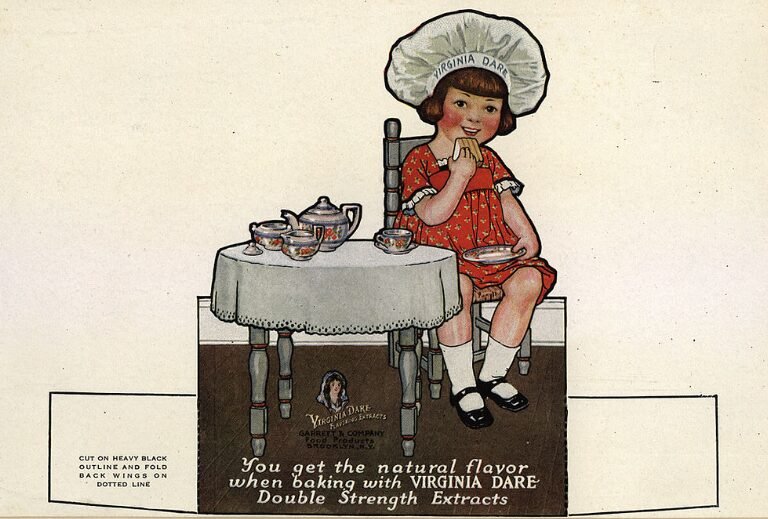
Over the past 400 years, Virginia Dare has become a legendary figure in American folklore, symbolizing various ideals for different groups. She has appeared in numerous works of literature, songs, comic books, television shows, and films. Image: Virginia Dare Flavoring Extracts
How has Virginia Dare’s story been used by different groups in modern times?
Virginia Dare’s legacy has been appropriated by various groups, including feminists who saw her as a symbol of women’s rights in the 1980s. On the other hand, her name has been used by white nationalist and alt-right groups, notably the VDARE website, which promotes ideas of European purity and nationalism.
What are some of the theories presented in literature about Virginia Dare’s fate?
Many creative works have speculated about Virginia Dare’s fate. In some stories, such as The White Doe, she is turned into a doe and later killed by her lover. In Neil Gaiman’s 1602, she transforms into white creatures when in danger. Other stories, like Philip José Farmer’s Dare, imagine her being abducted by aliens. These fictional interpretations have added layers of myth to her story.
What role did Virginia Dare play in speculative fiction and fantasy?
Virginia Dare has appeared in many speculative fiction and fantasy stories, including Michael Scott’s The Necromancer, where she is portrayed as an immortal character. In Mark Chadbourn’s Kingdom of the Serpent trilogy, Virginia and other colonists are taken to a mythological world. These works further blend history and myth, expanding her legacy in imaginative ways.
How has Virginia Dare’s legacy persisted in North Carolina?
In North Carolina, Virginia Dare’s legacy is celebrated annually on Roanoke Island with a Renaissance fair. Numerous landmarks, such as Dare County, the Virginia Dare Memorial Bridge, and the Virginia Dare Trail, honor her name. A statue of her stands in the Elizabethan Gardens on Roanoke Island, serving as a reminder of her place in the region’s history.
What ships and boats have been named after Virginia Dare?
Several ships and boats have been named in her honor. The SS Virginia Dare, a Liberty ship, was built during World War II. Additionally, a schooner named Virginia Dare was constructed in 1883. These vessels carry her name, extending her legacy beyond literature and folklore into the realm of transportation.
FACT CHECK: At World History Edu, we strive for utmost accuracy and objectivity. But if you come across something that doesn’t look right, don’t hesitate to leave a comment below.





