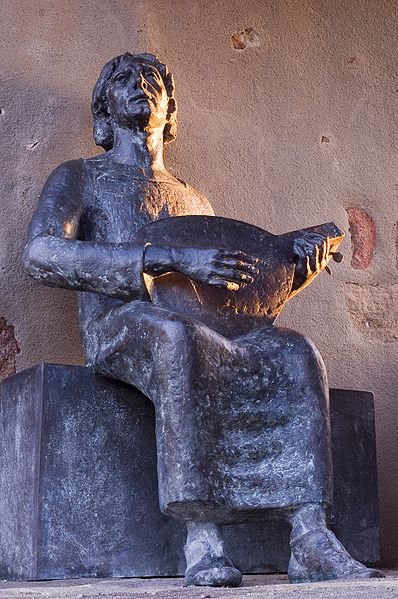
A statue of Wolfram located at Burg Abenberg castle in Abenberg.
Wolfram von Eschenbach (c. 1160/80 – c. 1220) stands as one of the most influential epic poets of medieval German literature. Recognized for his contributions as a knight, poet, and composer, Wolfram’s works encompass epic tales and lyric poetry. His renowned status as a Minnesinger highlights his mastery in weaving lyricism with narrative, a blend that immortalized his legacy in medieval literature.
Life of Wolfram von Eschenbach
Details about Wolfram’s life remain scarce and enigmatic, as no historical records reference him directly. The primary source of insight into his life comes from his own literary works, most notably Parzival. In this epic, Wolfram refers to himself as “wir Beier” (“we Bavarians”), and the East Franconian dialect used in his writing supports this connection. Based on circumstantial evidence, Wolframs-Eschenbach in Bavaria, previously known as Obereschenbach, is considered his birthplace. However, the claim is contentious due to other similarly named locations in the region.
Personal Life and Patrons
Wolfram likely led a modest life, evident from his references to personal poverty in his writing. He is thought to have been a court poet, serving multiple patrons, with Hermann I of Thuringia being a reliable supporter. His humble lifestyle contrasts with his grand literary achievements, suggesting that his work earned him prestige but not wealth.
Claims of Illiteracy
In Parzival, Wolfram declares himself illiterate, a claim that has fueled scholarly debate. While some dismiss this as modesty or rhetorical flourish, others take it as a plausible assertion, emphasizing that medieval poets often dictated their works to scribes. Despite his professed inability to read or write, Wolfram demonstrated remarkable intellectual breadth, showing familiarity with French literature, though his interpretations of French names and phrases were sometimes flawed.
Major Works
Parzival
Wolfram’s Parzival is widely regarded as his magnum opus and a pinnacle of German Arthurian romance. Adapted from Chrétien de Troyes’ unfinished Perceval, le Conte du Graal, Wolfram’s rendition centers on the Holy Grail, which he uniquely depicts as a gemstone. In the narrative, Wolfram criticizes Chrétien’s version, claiming his source was a Provencal poet named Kyot. Parzival explores themes of redemption, spiritual growth, and knightly virtue, resonating deeply with medieval audiences.
Titurel
The fragmented Titurel expands on characters introduced in Parzival, particularly the tragic lovers Schionatulander and Sigune. The first fragment delves into their romantic connection, while the second fragment narrates their ill-fated encounter with a mysterious dog bearing a ruby-etched story. Schionatulander’s quest to retrieve the dog ultimately leads to his demise, a fate prefigured in Parzival.
Willehalm
Willehalm, another incomplete work, draws inspiration from the Old French epic Aliscans. This poem interweaves themes of Christian-Saracen conflict, chivalry, and spiritual redemption. The hero, Willehalm, marries a Saracen princess who converts to Christianity, inciting a religious war. The poignant death of his nephew Vivian underscores the chivalric ideals of courage and sacrifice. Preserved in 78 manuscripts, Willehalm reflects the enduring appeal of Wolfram’s storytelling.
Lyric Poetry
Wolfram’s contribution to lyric poetry is marked by his nine surviving songs, including five Tagelieder (dawn-songs). These poems depict the secret rendezvous of lovers, with the knight departing at dawn. While most feature the lady awakening her lover, some involve a watchman as the intermediary. Although no original melodies have survived, Wolfram’s lyric poetry remains celebrated for its emotional depth and refined artistry.
Influence and Legacy
The widespread admiration for Wolfram’s works is evident in their manuscript tradition. Parzival survives in 84 manuscripts, while Willehalm boasts 78. This extensive preservation highlights the cultural significance of his poetry in medieval Germany.
Wolfram’s unfinished works inspired continuations by later poets. Ulrich von Türheim’s Rennewart extended Willehalm, while Albrecht von Scharfenberg expanded Titurel into the Jüngere Titurel (Younger Titurel), incorporating Wolfram’s narrative voice.
Wolfram’s literary genius gained renewed attention during the Enlightenment, thanks to Johann Jakob Bodmer’s 1753 translation of Parzival. His influence also permeated the works of Richard Wagner, who based his opera Parsifal on Parzival. Wolfram himself is dramatized as a character in Wagner’s Tannhäuser, cementing his place in cultural memory.
Frequently Asked Questions
Where was Wolfram von Eschenbach born?
His birthplace is traditionally identified as Wolframs-Eschenbach in Bavaria, but the evidence is circumstantial, with competing claims from other towns named Eschenbach.
What are Wolfram’s most famous works?
His most renowned works are Parzival, a German Arthurian romance centered on the Holy Grail, the unfinished Willehalm, and the fragmentary Titurel.
What distinguishes Parzival from Chrétien de Troyes’ Perceval?
Parzival offers a distinct interpretation of the Holy Grail as a gemstone and critiques Chrétien’s version, claiming it is based on a superior source, Kyot of Provence.
What themes are explored in Willehalm?
Willehalm depicts religious conflicts between Christians and Saracens, focusing on chivalric courage, spiritual purity, and themes of love, conversion, and war.
What role did Wolfram’s lyric poetry play in Minnesang?
His nine surviving songs, including five dawn-songs, are regarded as masterpieces. These poems depict secretive lovers parting at dawn, often with a watchman or the lady awakening the knight.
What was Wolfram’s influence on later culture?
Wolfram’s Parzival inspired Richard Wagner’s opera Parsifal, and he appears as a character in Wagner’s Tannhäuser. His works remained popular, with many continuations and adaptations in subsequent centuries.





