10 Most Renowned Italian Renaissance Painters and their Masterpieces
The Italian Renaissance, spanning roughly from the 14th to the 17th centuries, was a period of remarkable creativity, exploration, and innovation in art. Artists of this era profoundly influenced Western art and culture through their mastery of perspective, anatomy, and the expressive power of color and composition.
Below, World History Edu takes a closer look at ten of the most exceptional Italian Renaissance painters and their masterpieces, showcasing the depth and impact of their contributions.
Giotto di Bondone (c. 1267–1337)
Giotto is often celebrated as the father of Renaissance painting. His works marked a shift from the stylized forms of medieval art to a more naturalistic approach, characterized by a strong sense of volume and emotional depth.
Masterpiece: Scrovegni Chapel Frescoes (c. 1305) Giotto’s fresco cycle in the Scrovegni Chapel in Padua, depicting the life of Christ and the Virgin Mary, is considered one of his greatest achievements. He introduced lifelike expressions and gestures, creating a sense of humanity in his figures that was unprecedented at the time. His use of composition and narrative power would set the stage for the development of Renaissance art.

Masaccio (1401–1428)
Masaccio was a pioneer of perspective and naturalism, building upon Giotto’s innovations and bringing new realism to his religious paintings. His use of linear perspective was groundbreaking, creating depth and space in his compositions.
Masterpiece: The Holy Trinity (c. 1427) Located in the Church of Santa Maria Novella in Florence, The Holy Trinity is celebrated as the first painting to use fully realized linear perspective, giving viewers an illusion of three-dimensional space. Masaccio’s realistic figures and convincing architectural setting represent a significant advancement in Renaissance art, making this work a pivotal moment in Western painting.
Sandro Botticelli (c. 1445–1510)
Botticelli is renowned for his lyrical and graceful compositions, often blending mythology with elements of beauty and spirituality. His works feature elegant figures with flowing lines, capturing the ethereal qualities of both religious and mythological themes.
Masterpiece: The Birth of Venus (c. 1484–1486) This iconic painting depicts the goddess Venus emerging from the sea, symbolizing beauty and love. Botticelli’s use of soft, flowing lines and delicate color contrasts creates a dreamlike atmosphere, with Venus embodying idealized beauty. The Birth of Venus is one of the most famous works of the Renaissance and a testament to Botticelli’s skill in blending classical mythology with Renaissance ideals.

Image: Self-portrait of Sandro Botticelli
Leonardo da Vinci (1452–1519)
Leonardo is considered one of the most versatile geniuses of the Renaissance, excelling not only in painting but also in science, anatomy, engineering, and more. His meticulous study of human anatomy and natural forms allowed him to create lifelike and emotionally resonant portraits.
Masterpiece: Mona Lisa (c. 1503–1506) The Mona Lisa, housed in the Louvre, is perhaps the most famous painting in the world. Known for its enigmatic smile and the sitter’s lifelike presence, this portrait exemplifies Leonardo’s mastery of sfumato—a technique of blending colors and tones to create soft transitions, giving the face a realistic, almost three-dimensional appearance. The Mona Lisa epitomizes Leonardo’s artistic philosophy, blending detailed observation with profound emotional impact.

Michelangelo Buonarroti (1475–1564)
Michelangelo was a master of both sculpture and painting, known for his powerful and expressive figures. His works often emphasize the beauty of the human form, combining anatomical precision with dynamic, almost sculptural poses.
Masterpiece: The Sistine Chapel Ceiling (1508–1512) Commissioned by Pope Julius II, Michelangelo’s frescoes on the Sistine Chapel ceiling in the Vatican are a monumental achievement. The ceiling’s central panels depict scenes from Genesis, including the famous Creation of Adam, where God reaches out to touch the hand of Adam. Michelangelo’s figures are muscular, dynamic, and imbued with spiritual intensity, showcasing his unparalleled understanding of human anatomy and movement.
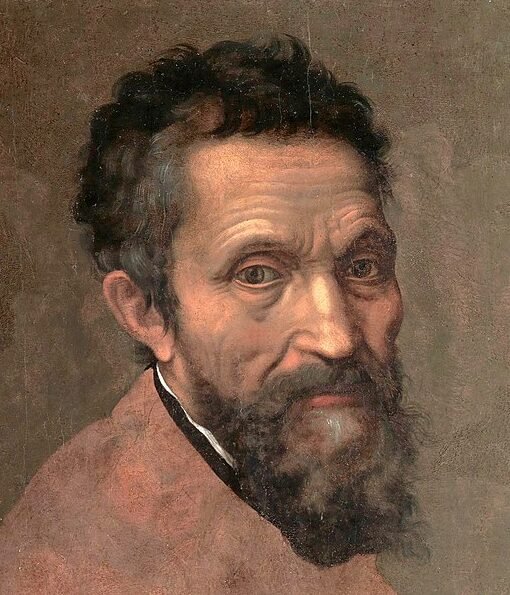
Image: Daniele da Volterr’s painting of Michelangelo.
Raphael (Raffaello Sanzio) (1483–1520)
Raphael was known for his harmonious and balanced compositions, as well as his ability to capture the ideals of beauty and grace. His work reflects a blend of influences from Leonardo and Michelangelo, creating a style that epitomizes the High Renaissance.
Masterpiece: The School of Athens (1509–1511) Painted as part of the decoration of the Vatican’s Apostolic Palace, The School of Athens depicts an imaginary gathering of ancient philosophers, scientists, and mathematicians, including Plato and Aristotle at the center. Raphael’s use of perspective, architectural elements, and idealized figures creates a sense of harmony and intellectual grandeur, making this fresco a quintessential example of Renaissance humanism.

Image: Raphael
Titian (Tiziano Vecellio) (c. 1488–1576)
Titian, a leading figure of the Venetian school, was a master of color and texture. His innovative use of oil paints allowed him to create rich, vibrant hues, giving his paintings an intense emotional and sensory appeal.
Masterpiece: Assumption of the Virgin (1516–1518) This altarpiece in the Basilica di Santa Maria Gloriosa dei Frari in Venice is one of Titian’s most celebrated works. The dramatic composition, with the Virgin Mary ascending to heaven, is filled with energy and movement. Titian’s bold use of color and dynamic forms marks a departure from earlier Renaissance conventions, signaling the beginning of the Venetian emphasis on color over line.

Giorgione (Giorgio da Castelfranco) (c. 1477–1510)
Giorgione is known for his atmospheric and enigmatic paintings, which often blend landscape with mysterious subject matter. His poetic approach influenced many Venetian painters, including Titian.
Masterpiece: The Tempest (c. 1508) One of the first Renaissance paintings to give landscape a central role, The Tempest depicts a soldier and a nursing woman set against a turbulent sky and lush environment. The work’s meaning is still debated, but its mood and use of light create an evocative and introspective atmosphere. Giorgione’s handling of landscape and attention to atmospheric detail set a precedent for later artists.

Image: Giorgione
Correggio (Antonio Allegri da Correggio) (c. 1489–1534)
Correggio was known for his sensual and luminous style, combining elements of High Renaissance with early Mannerism. His mastery of light and perspective gave his works a unique softness and grace.
Masterpiece: Assumption of the Virgin (1526–1530) This fresco on the dome of the Parma Cathedral is celebrated for its illusionistic technique and dramatic foreshortening, which gives viewers the impression of looking up into heaven. Correggio’s figures seem to spiral upwards in a vortex of light and clouds, creating a dynamic sense of movement that was innovative for its time.

Image: Correggio
Tintoretto (Jacopo Robusti) (1518–1594)
Tintoretto was known for his energetic and dramatic compositions, earning him the nickname “Il Furioso” for his bold, rapid painting style. His works are characterized by strong contrasts of light and dark, dynamic poses, and a sense of intense movement.
Masterpiece: The Last Supper (1592–1594) Located in the Basilica di San Giorgio Maggiore in Venice, Tintoretto’s The Last Supper is a highly original interpretation of this classic scene. Rather than arranging the figures in a linear composition, he introduces a diagonal perspective, creating a sense of depth and drama. His use of chiaroscuro (light and shadow) adds a sense of mystery, imbuing the scene with emotional and spiritual intensity.

Image: Tintoretto
Frequently Asked Questions about Italian Renaissance Painting

What was the time frame and geographical context of the Italian Renaissance painting?
Italian Renaissance painting emerged in the late 13th century and flourished from the early 15th to late 16th centuries across the Italian Peninsula, a region divided into various independent and foreign-controlled city-states.
How did Italian painters contribute to the spread of Renaissance ideals despite political fragmentation?
Many Italian painters traveled extensively and served as cultural ambassadors, sharing artistic and philosophical ideas across regions, which helped spread Renaissance ideals throughout Italy.
Which city is considered the birthplace of the Renaissance, and what role did it play?
Florence, in Tuscany, is widely regarded as the birthplace of the Renaissance, particularly in painting. The city nurtured early artistic developments that defined the Renaissance, although Rome and Venice also later became significant centers.
What are the four main periods of Italian Renaissance painting?
Italian Renaissance painting is typically divided into four periods: the Proto-Renaissance (1300–1425), the Early Renaissance (1425–1495), the High Renaissance (1495–1520), and Mannerism (1520–1600).
What defines the Proto-Renaissance period, and who were its key artists?
The Proto-Renaissance (1300–1425) marked the beginning of a new approach to painting, emphasizing naturalism and emotional expression. Key artists included Giotto, Taddeo Gaddi, Orcagna, and Altichiero.
What advancements characterized the Early Renaissance period?
The Early Renaissance (1425–1495) saw significant developments in techniques like linear perspective, chiaroscuro (light and shadow), and anatomical accuracy. Artists like Masaccio, Fra Angelico, and Sandro Botticelli advanced these techniques in Florence.
Who were some notable artists of the High Renaissance, and what were their contributions?
The High Renaissance (1495–1520) is considered the peak of Renaissance art, featuring artists like Leonardo da Vinci, Michelangelo, and Raphael. Their works combined technical skill with creative harmony, setting new standards in human anatomy, perspective, and light.
What marked the Mannerist period, and how did it differ from the High Renaissance?
The Mannerist period (1520–1600) followed the High Renaissance and was characterized by experimentation with distorted proportions, exaggerated poses, and unusual perspectives. Artists like Pontormo, Parmigianino, and Bronzino broke away from the balanced compositions of earlier Renaissance works.





