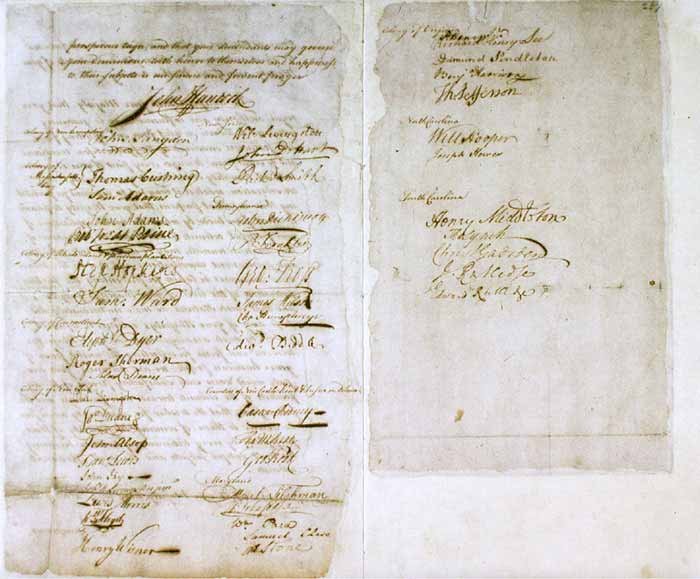
The signature page of the Olive Branch Petition featuring John Hancock’s distinctive signature prominently at the top.
The Olive Branch Petition was a final attempt by the Thirteen Colonies to avoid war with Great Britain, expressing loyalty to King George III and requesting him to intervene to prevent further conflict.
Summary
The Olive Branch Petition was adopted by the Second Continental Congress on July 5, 1775, and signed three days later, on July 8, 1775. It represented a last-ditch effort by the Thirteen Colonies to avoid full-scale war with Great Britain. The petition sought to affirm American loyalty to King George III and requested the British king to intervene in order to prevent further conflict. This effort came at a time when tensions between Britain and its American colonies had already reached a boiling point, and the colonies had begun to prepare for armed resistance. Despite these preparations, the petition aimed to achieve a peaceful resolution by appealing directly to the king.

King George III.
While the petition was intended to prevent an all-out war, it was soon overshadowed by other events. The same day the petition was approved, the Continental Congress also passed the Declaration of the Causes and Necessity of Taking Up Arms. This document outlined the colonies’ reasons for resistance, making the success of the petition unlikely.
By August 1775, the British government officially declared the colonies in rebellion. King George III refused to read the Olive Branch Petition, and within weeks, he labeled the colonists as traitors. This marked the failure of the petition and set the stage for the eventual declaration of independence.
The Drafting Process: Efforts to Reconcile
The Second Continental Congress convened in Philadelphia in May 1775, during a time of growing unrest between the colonies and Britain. The initial atmosphere at the Congress was one of division, with some delegates, led by John Dickinson, advocating for reconciliation with Britain, while others, such as John Adams, believed that conflict was inevitable.
Dickinson, a moderate who sought to maintain colonial ties to Britain, became the primary author of the Olive Branch Petition. He believed that the colonies did not seek full independence but merely desired more equitable trade relations and the repeal of oppressive laws, such as the Intolerable Acts. Dickinson’s position was that if Britain would grant these demands, peace could be restored.
The drafting committee for the petition included notable figures such as Thomas Johnson, Benjamin Franklin, John Jay, and John Rutledge. These men, while supportive of Dickinson’s general aim for reconciliation, contributed their ideas to make the petition a formal, respectful appeal to King George III.
The petition was composed in such a way as to convey loyalty to the British crown, requesting that the king restore peace and protect American rights under British law. The letter called for the repeal of the Intolerable Acts, which had severely restricted the colonies’ autonomy, and proposed negotiations to resolve the issues that had led to the conflict.

The Petition’s Reception in Britain
Once the Olive Branch Petition was finalized, it was sent to Great Britain in the hands of Richard Penn and Arthur Lee, who delivered it to colonial secretary Lord Dartmouth. The petition was formally presented to the British government on August 21, 1775, with the original being delivered on September 1. However, by this time, the political and military landscape had drastically changed.
King George III had already declared the colonies to be in open rebellion in his Proclamation of Rebellion on August 23, 1775. This declaration, issued in response to the Battle of Bunker Hill, marked the British government’s formal decision to treat the colonies as enemies. The proclamation called for all British officials and loyal subjects to take action to suppress the rebellion, effectively nullifying any chance for reconciliation at that moment.
Moreover, the contents of a letter from John Adams to a friend, which criticized the petition as futile and predicted the inevitability of war, had been intercepted by British officials. The letter reached Britain around the same time as the petition, leading British authorities to believe that the petition was insincere. John Adams had argued that war with Britain was unavoidable and that the colonies should prepare for conflict, including raising a navy and capturing British officials. This sentiment further alienated the British from considering the Olive Branch Petition seriously.
King George III’s Rejection
When the petition reached London, King George III refused to read it. This refusal, combined with his prior proclamation of rebellion, made it clear that the British government had no interest in engaging in negotiations or reconciling with the colonies. The king’s refusal to even entertain the petition demonstrated his commitment to suppressing the colonial revolt and pursuing military action against the colonies.
The rejection of the Olive Branch Petition by King George III marked a turning point, leading directly to the Declaration of Independence and the establishment of the United States as an independent nation.
In early September 1775, Penn and Lee were informed that no answer would be given to the petition, as the king had already declared the colonies in rebellion. This refusal was a pivotal moment, as it not only rejected the petition but also confirmed that the colonies’ grievances would not be addressed through peaceful means. The petition’s failure effectively closed the door to reconciliation and set the stage for the intensification of the conflict.
The Fallout: Shifting Sentiment Toward Independence
The rejection of the Olive Branch Petition had profound political consequences. For many in the colonies, the king’s dismissal of their petition confirmed that the only viable option left was independence. John Adams, who had long advocated for independence, saw the rejection as an opportunity to rally the colonies for a more radical course of action. He argued that the colonies could no longer look to Britain for a resolution and that independence was the only way forward.
Adams’ views gained traction among other revolutionary leaders, and the failure of the petition played a critical role in shifting public sentiment. The idea that the colonies had no chance of reconciling with Britain began to take hold, especially after the king’s refusal to even consider the Olive Branch Petition. As a result, many colonists began to see the struggle as one for complete independence rather than a quest for better treatment under British rule.
Thomas Paine’s pamphlet Common Sense, published in January 1776, further fueled this sentiment. Paine argued forcefully for American independence, stating that it was unnatural for the colonies to remain tied to a distant monarchy that was indifferent to their needs. His pamphlet was widely read and contributed to the growing desire for independence, particularly among those who had previously been unsure about breaking ties with Britain.

Thomas Paine
The Path to the Declaration of Independence
The Olive Branch Petition’s failure helped to solidify the case for independence, and by June 1776, the Second Continental Congress began to move toward a formal declaration. On July 2, 1776, the Congress voted to declare independence from Great Britain, and on July 4, 1776, the Declaration of Independence, largely written by Thomas Jefferson, was adopted.
The Declaration of Independence laid out the colonies’ grievances against the British crown and articulated the case for full separation. The rejection of the Olive Branch Petition and the king’s subsequent refusal to consider the colonies’ demands were pivotal in shaping the decision to break away from British rule.
The Legacy of the Olive Branch Petition
While the Olive Branch Petition failed to achieve its intended goal, it remains a significant symbol of the colonists’ initial desire to avoid conflict and preserve their relationship with Britain. It demonstrated the colonies’ commitment to peaceful resolution, even as tensions escalated. The petition is also a reminder of the early efforts to avoid war and the complexities of the decision to declare independence.
The rejection of the petition marked the end of any serious hopes for reconciliation with Britain and led directly to the Declaration of Independence. It also served to unite the colonies in a common cause, with the realization that only through full independence could they secure their future. Although the petition itself did not prevent war, it was an important moment in the path to American independence, reflecting the broader struggle between loyalty to the British crown and the desire for self-determination.
The Olive Branch Petition is a reminder that the road to American independence was not a straightforward one, with early efforts at reconciliation ultimately giving way to the realization that independence was the only path forward.
Most influential intellectuals of the American Revolution Era
FREQUENTLY ASKED QUESTIONS
Who drafted the Olive Branch Petition?
The petition was primarily drafted by John Dickinson, with support from Benjamin Franklin, Thomas Johnson, John Jay, and John Rutledge, all of whom were part of the drafting committee.
What were the goals of the Olive Branch Petition?
The petition sought to reconcile differences between the colonies and Britain by asking for the repeal of the Intolerable Acts and the establishment of a lasting peaceful relationship.
What was King George III’s response to the petition?
King George III refused to read the Olive Branch Petition, having already declared the colonies to be in open rebellion and dismissing any attempts at reconciliation.
How did the British government react to the petition?
The British government rejected the petition, viewing it as insincere due to intercepted letters by John Adams, which suggested that war with Britain was inevitable.
How did the rejection of the petition affect colonial sentiment?
The rejection of the petition solidified the belief among many colonists that reconciliation with Britain was impossible, leading to growing support for complete independence.
What role did Thomas Paine’s Common Sense play after the petition’s rejection?
Paine’s Common Sense helped shift public opinion toward independence, arguing that it was unnatural for the colonies to remain tied to Britain, further solidifying the move toward separation.
What was the result of the petition’s failure?
The failure of the Olive Branch Petition led directly to the Declaration of Independence in 1776, marking the formal break between the colonies and Britain.
Lord North: the British Prime Minister Who Lost the American Colonies





