Major Accomplishments of Founding Father John Dickinson
John Dickinson, born on November 13, 1732, was a lawyer, politician, and prominent Founding Father of the United States, whose writings and actions greatly influenced the American Revolution.
Known as the “Penman of the Revolution,” Dickinson was both a vocal advocate for colonial rights and a proponent of diplomacy, using his legal acumen and eloquent writing to address grievances against British rule while emphasizing the importance of measured action.
His impact on American political thought and early governance has left an enduring legacy, evident in his roles as a state leader, delegate to the Constitutional Convention, and the architect behind significant founding documents.

John Dickinson remains a testament to the ideals of unity, justice, and thoughtful governance that form the bedrock of American democracy. Image: Founding Father John Dickinson
Early Life and Education
John Dickinson was born to a prosperous Quaker family in Talbot County, Maryland, before moving to Delaware, where he grew up on his family’s plantation.
His father, Samuel Dickinson, was a judge and member of Delaware’s government, which influenced Dickinson’s early exposure to civic duty.
After receiving a classical education, Dickinson went on to study law, first in Philadelphia and then at the Middle Temple in London, one of the prestigious Inns of Court. His education in England offered him a deep understanding of British law and politics, grounding him in the principles of English constitutionalism. This background would later inform his critiques of British policies and his contributions to American political theory.
Political Career and Early Involvement in Colonial Grievances
After returning to America in the early 1750s, Dickinson established a successful legal practice and soon became involved in politics. He was elected to the Delaware Assembly in 1759 and later served in the Pennsylvania Assembly.
By the 1760s, Dickinson’s reputation as an articulate lawyer and committed public servant earned him a leading role in colonial politics, particularly as tensions grew between Britain and the colonies over taxation and representation.
In response to the Stamp Act of 1765, which imposed a tax on all printed materials in the colonies, Dickinson joined other colonial leaders in protest, arguing that taxation without representation violated fundamental rights.
While many colonists advocated for economic boycotts and public demonstrations, Dickinson emphasized a legal approach, using his writing to inspire a unified and principled opposition to British policies.
Letters from a Farmer in Pennsylvania
In 1767-1768, Dickinson wrote a series of twelve essays titled Letters from a Farmer in Pennsylvania, which were published in newspapers throughout the colonies. Written under the pseudonym “A Farmer,” these letters became one of the most influential political documents of the pre-Revolutionary period. The letters articulated Dickinson’s belief that while Britain had the right to regulate trade, it did not have the right to impose taxes without the colonies’ consent. By framing his argument in legal and philosophical terms, Dickinson appealed to a broad audience and helped galvanize public opinion against the Townshend Acts, which had imposed taxes on goods like tea, glass, and paper.
Letters from a Farmer in Pennsylvania emphasized restraint and caution, advocating for peaceful resistance rather than immediate rebellion. Dickinson argued that the colonies should seek redress through negotiation, a stance that set him apart from some of his contemporaries, who were moving toward outright defiance. His approach highlighted the importance of law and principle, aiming to show that the colonies were defending longstanding English rights rather than seeking independence.
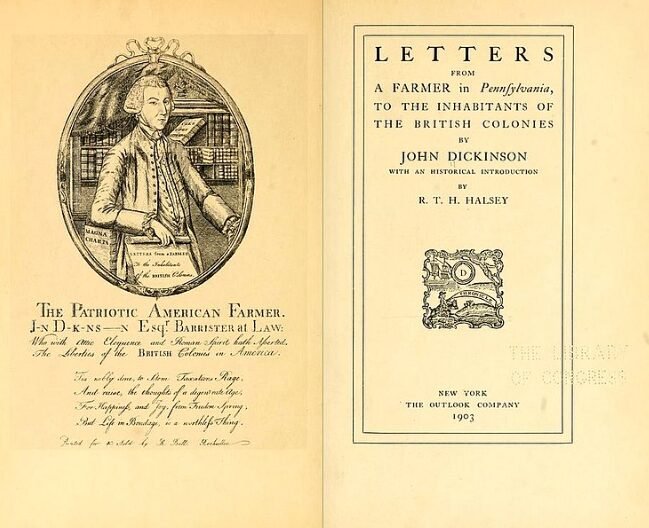
Letters from a Farmer in Pennsylvania is a series of twelve essays by John Dickinson, published under the pseudonym “A Farmer” from 1767 to 1768. Widely read throughout the Thirteen Colonies, these letters united colonists against the Townshend Acts, building momentum toward revolution. Image: Frontispiece and title page of a 1903 reprint of the letters
“The Liberty Song” and Patriot Advocacy
In 1768, Dickinson wrote The Liberty Song, one of the first patriotic songs of the American Revolution. The song’s refrain, “Join hand in hand, brave Americans all; By uniting we stand, by dividing we fall,” became an enduring slogan for colonial unity.
Although a minor work compared to his political writings, The Liberty Song captured the spirit of solidarity and commitment that characterized the early resistance to British rule. Dickinson’s advocacy extended beyond the written word, and his role as a popular writer and speaker made him one of the most influential figures rallying public opinion.
The First and Second Continental Congresses
As the conflict with Britain intensified, Dickinson was elected as a delegate to the First Continental Congress in 1774. He contributed significantly to the proceedings, drafting the Petition to the King, an appeal to King George III that outlined colonial grievances and sought a peaceful solution. Although the petition was ultimately unsuccessful, it demonstrated Dickinson’s commitment to diplomacy as a first resort.
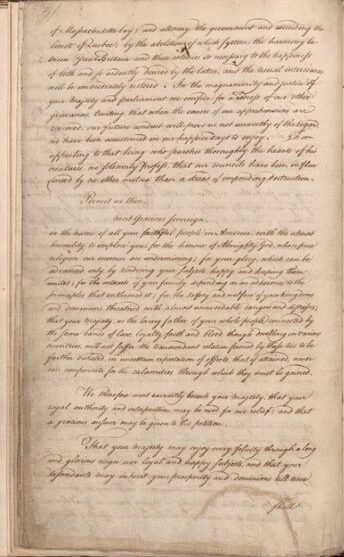
The Petition to the King was sent by the First Continental Congress in 1774, urging King George III to repeal the Intolerable Acts. His rejection of this appeal heightened tensions, leading toward the Declaration of Independence and the Revolutionary War. Image: 1774 Petition to the King
In 1775, as a member of the Second Continental Congress, Dickinson drafted the Olive Branch Petition, another attempt to appeal directly to the king to avoid war. The petition was sent following the outbreak of hostilities at Lexington and Concord, but it was rejected by the British government. Despite this, Dickinson continued to advocate for caution and reasoned discourse, believing that open rebellion should be a last resort. His approach, however, put him at odds with other delegates who believed independence was now inevitable.

As colonists sought greater political control, tensions with the British monarchy grew. The French and Indian War (1754–1763) worsened matters when Britain demanded the colonies help cover war costs, sparking bitter opposition to taxation without representation. Gradually, the Thirteen Colonies united to resist what they viewed as oppressive policies. Image: American painter John Trumbull’s 1819 painting, Declaration of Independence, shows the Committee of Five presenting the Declaration to Congress.
Conflict Over Independence
Despite his contributions to the revolutionary cause, Dickinson took a controversial stance when the issue of independence came to a vote. While he supported colonial rights and had helped prepare for armed defense, he opposed declaring independence in 1776.
Dickinson felt that the colonies were unprepared for war and feared the economic and social upheaval that would result from a break with Britain. He believed that an alliance with France or Spain, which would likely be necessary to secure victory, could compromise the colonies’ autonomy. Consequently, he abstained from the vote on the Declaration of Independence and did not sign the document.
While this position led some to question his commitment, Dickinson’s actions reflected a genuine concern for the long-term welfare of the colonies. He continued to support the war effort, serving as a colonel in the Pennsylvania militia and later joining the Delaware militia. His willingness to defend the colonies militarily demonstrated that his opposition to independence was not based on loyalty to Britain but on a cautious approach to governance.
The Articles of Confederation and Early American Governance
Dickinson’s greatest contribution to early American governance came with his authorship of the first draft of the Articles of Confederation in 1776-1777. The Articles served as the first constitution for the newly independent states, outlining a framework for a “firm league of friendship” among the colonies.
Although the Articles were ultimately replaced by the U.S. Constitution, they represented an essential step in establishing a unified government for the American states.
The Articles of Confederation reflected Dickinson’s vision of a decentralized government, with states retaining significant powers. He believed that a weak central government would protect the liberties of citizens and prevent the concentration of power.
Although the Articles were later criticized for their limitations, Dickinson’s work provided a starting point for American governance and underscored the importance of balancing state and federal interests.

Page I of the Articles of Confederation
The Model Treaty and Foreign Alliances
In addition to the Articles of Confederation, Dickinson contributed to the drafting of the Model Treaty, a guide for establishing alliances with foreign nations. Recognizing the importance of securing international support, particularly from France, Dickinson advocated for a treaty based on mutual interests rather than entangling political alliances. The Model Treaty helped set the tone for American foreign relations, emphasizing commercial over military alliances, and its principles influenced subsequent diplomatic agreements.
President of Delaware and Pennsylvania
After the Revolution, Dickinson continued his political career, serving as the president (similar to governor) of both Delaware (1781–1783) and Pennsylvania (1782–1785).
As state president, Dickinson lived at Joseph Galloway’s confiscated mansion at Sixth and Market Streets, which served as the State Presidential Mansion.
As president, Dickinson managed state affairs during a turbulent period, overseeing transitions from war to peace and addressing post-war economic challenges. His dual leadership positions reflected his standing and trustworthiness in the eyes of the public, as well as his ability to work across state lines.
The Annapolis Convention and Constitutional Convention
In 1786, Dickinson chaired the Annapolis Convention, a meeting called to address problems with the Articles of Confederation, particularly in regulating interstate commerce. Although only a few states attended, the convention concluded with a recommendation to hold a larger meeting to revise the Articles. This led directly to the 1787 Constitutional Convention in Philadelphia, where Dickinson represented Delaware.
At the Constitutional Convention, Dickinson played a moderate role, supporting a stronger federal government while advocating for states’ rights. His experience in drafting the Articles of Confederation helped him contribute valuable insights to the development of the U.S. Constitution.
Ultimately, he signed the Constitution and supported its ratification, recognizing the need for a more effective national government to preserve the union.

Scene at the Signing of the Constitution of the United States is a 1940 painting by Howard Chandler Christy, illustrating the Constitution’s ratification at Independence Hall on June 21, 1788.
Legacy and Recognition by Thomas Jefferson
Fellow Founding Father Thomas Jefferson, reflecting on Dickinson’s legacy, praised him as “one of the great worthies of the revolution” and acknowledged his early and enduring commitment to American rights.
Dickinson’s lifelong dedication to principles of liberty and justice earned him respect among his contemporaries, and his writings, particularly Letters from a Farmer, remained influential in shaping the nation’s political thought.
Institutions and Memorials Honoring John Dickinson
Dickinson’s contributions to American education and governance are commemorated through several institutions named in his honor. Together with his wife, Mary Norris Dickinson, he is the namesake of Dickinson College in Carlisle, Pennsylvania. Founded with a mission to educate future leaders, the college symbolizes Dickinson’s belief in the importance of civic education and public service.
The Penn State Dickinson Law, the Dickinson Complex at the University of Delaware, and John Dickinson High School in Wilmington, Delaware, are also named after him. These institutions reflect his enduring legacy and serve as reminders of his commitment to education, civic responsibility, and the rule of law.
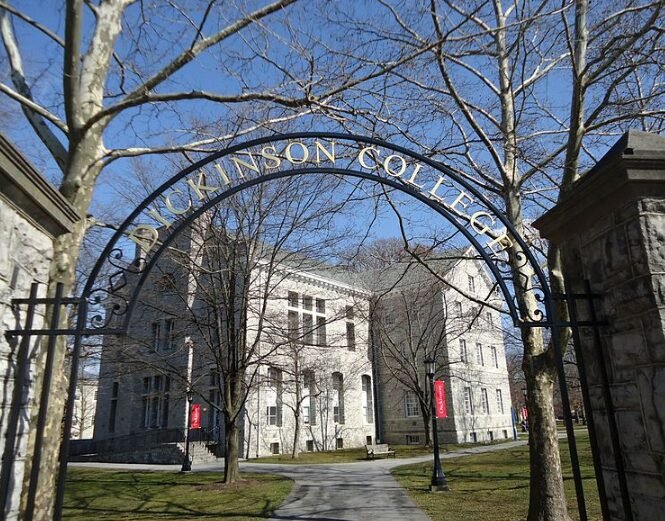
Dickinson College, a private liberal arts institution in Carlisle, Pennsylvania, was founded as Carlisle Grammar School in 1773 and chartered on September 9, 1783, making it the first college established post-Independence. Founded by Benjamin Rush, it honors John Dickinson, a Founding Father, and his wife Mary Norris Dickinson, whose personal libraries were donated to the college. Image: Entrance to the Academic Quad showing Bosler Hall
Did you know…?
Dickinson’s mansion on Chestnut Street was repurposed as a hospital and later became the French ambassador’s residence during his time in Delaware in 1776–77.
Legacy of Moderation and Dedication
John Dickinson’s legacy is defined by his careful balance of advocacy and caution, patriotism and prudence. While his opposition to the Declaration of Independence set him apart from many Founding Fathers, his contributions to American governance and diplomacy underscore his dedication to the cause of liberty. His advocacy for legal resistance over violent rebellion, his commitment to unity among the states, and his dedication to public service highlight his unique role in the founding of the United States.
Dickinson’s writings and political philosophy continue to resonate, serving as a reminder of the importance of measured, principled action in the pursuit of justice.
His legacy, preserved in the institutions named after him and in the words of Jefferson and other admirers, reflects the complexities of the American Revolution and the values that guided the founding of the nation.
Frequently Asked Questions about John Dickinson

John Dickinson, a Founding Father of the United States, was an influential attorney and politician from Philadelphia and Wilmington. Image: A 1780 portrait of Dickinson
Who was Dickinson’s wife, and what was her significance in John Dickinson’s life?
Mary “Polly” Norris was John Dickinson’s wife, a well-educated and influential Philadelphia woman with substantial wealth. She managed her family’s estate, Fair Hill, and owned one of the largest private libraries in the colonies, with 1,500 volumes. She married Dickinson on July 19, 1770.
The couple lived at Fair Hill, Polly’s family estate near today’s Germantown, Philadelphia, which they modernized with their combined wealth.
Polly was the daughter of Isaac Norris, a wealthy Philadelphia Quaker and Speaker of the Pennsylvania General Assembly, and Sarah Logan, granddaughter of prominent figure James Logan. She was also related to the Quaker poet Hannah Griffitts.

Portrait of Mary Norris Dickinson and her daughter Sallie Dickinson, painted by American painter Charles Willson Peale in 1773.
Why was John Dickinson called the “Penman of the Revolution”?
John Dickinson earned the title “Penman of the Revolution” for his widely-read Letters from a Farmer in Pennsylvania (1767–1768), which protested British taxation and helped unify the colonies against British policies.
What significant contributions did Dickinson make to early American governance?
Dickinson was instrumental in shaping early American governance through his writings and political actions. He drafted the Petition to the King and the Olive Branch Petition, seeking peaceful reconciliation with Britain. He also authored the first draft of the Articles of Confederation, creating the initial framework for a union of the colonies.
What was Dickinson’s position on American independence?
Though Dickinson strongly supported American rights, he initially opposed independence. He abstained from voting on and signing the Declaration of Independence, preferring diplomatic solutions over a complete separation from Britain.
How did Dickinson contribute to the Revolutionary War effort despite his reservations about independence?
Despite his reservations, Dickinson served as a military officer during the Revolution and helped draft the Model Treaty, a guide for establishing foreign alliances crucial to the American war strategy.
In what ways did Dickinson’s influence extend beyond the Revolution?
Dickinson served as president of Delaware and Pennsylvania, held a leadership role in the Annapolis Convention of 1786, and signed the U.S. Constitution as a delegate from Delaware. His support for a strong federal government shaped the formation of the United States.
How did Thomas Jefferson describe Dickinson’s contributions to the American cause?
Thomas Jefferson praised Dickinson as “one of the great worthies of the revolution” and a dedicated advocate for American rights, highlighting his long-standing commitment to American principles.
What institutions honor Dickinson’s legacy today?
Dickinson’s legacy lives on through institutions named after him, including Dickinson College, Penn State Dickinson Law, and the Dickinson Complex at the University of Delaware. John Dickinson High School in Wilmington, Delaware, was also dedicated in his honor.
How did Dickinson’s approach to governance differ from that of other Founding Fathers?
Dickinson advocated for unity and negotiation but ultimately supported self-governance. His balanced approach, valuing both diplomatic solutions and the establishment of a stable government, reflects his unique position among the Founding Fathers.
What lasting impact did Dickinson leave on American ideals?
Dickinson’s writings and political contributions helped lay the foundation for American governance, emphasizing liberty, justice, and a balanced government. His legacy continues to influence values of civic responsibility and educational empowerment in the United States.





