History of Ruhollah Khomeini and how he became Supreme Leader of Iran
Ruhollah Khomeini was an influential Iranian political and religious leader who played a critical role in shaping the modern history of Iran. His life journey spanned from a quiet upbringing in rural Iran to becoming the architect of the 1979 Iranian Revolution, which ended millennia of monarchy in the country and established the Islamic Republic.
How did Khomeini influence the revolution from exile? And how do Khomeini’s supporters view him?
Below, World History Edu will explore Khomeini’s life, his rise to power, his political and religious career, and the lasting impact he had on Iran and the wider Islamic world.
Early Life and Family Background
Ruhollah Musavi Khomeini was born on either May 17, 1900, or September 24, 1902, in the small town of Khomein, located in Iran’s Markazi Province. His exact birthdate is uncertain due to discrepancies in various records. Khomeini hailed from a family with religious and intellectual roots. His ancestors were small landowners, clerics, and merchants who originally came from Nishapur in northeastern Iran but had migrated to the Kingdom of Awadh in India during the late 18th century. The rulers of Awadh, who were Twelver Shia Muslims of Persian origin, welcomed many Persian scholars, jurists, and intellectuals.
Khomeini’s paternal grandfather, Seyyed Ahmad Musavi Hindi, was born in Kintoor near Lucknow in India. In the 1830s, he traveled on a pilgrimage to the holy Shia sites in Iraq and then migrated to Iran, settling in Khomein. His descendants, including Ruhollah Khomeini, would inherit a legacy of Shia clerical scholarship and devotion to Twelver Shi’ism, the dominant sect of Shia Islam in Iran.
When Khomeini was only two years old, his father, Seyyed Mostafa Musavi, was murdered, allegedly by local rivals who opposed his clerical activities. Khomeini was thus raised primarily by his mother, Agha Khanum, and his aunt, Sahebeth, who both took on the responsibility of educating and nurturing him. From a young age, Khomeini was immersed in religious education. He began studying the Quran and Persian under the guidance of his relatives, particularly his elder brother Morteza Pasandideh, who played a significant role in his early intellectual development.
Religious Education and Early Career
Khomeini’s formal religious education began after World War I. He was initially drawn to the Islamic seminary in Isfahan, but he eventually chose to attend the seminary in Arak, where he studied under the renowned scholar Ayatollah Abdolkarim Haeri Yazdi. In 1920, Khomeini moved to Arak to begin his studies in earnest, focusing on Islamic law (Sharia), jurisprudence (fiqh), and religious philosophy. His academic curiosity soon extended beyond traditional Islamic studies, and he began to explore philosophy and mysticism.
In 1921, when Ayatollah Haeri Yazdi relocated to the holy city of Qom, Khomeini followed him and became one of his most devoted students. Qom, a center of religious learning in Iran, provided Khomeini with the intellectual environment to deepen his knowledge of Islamic law and philosophy. He developed a particular interest in Islamic mysticism (irfan) and philosophy, studying the works of prominent Islamic scholars such as Avicenna and Mulla Sadra. Khomeini was also influenced by ancient Greek philosophy, including the works of Aristotle and Plato.
Apart from his scholarly endeavors, Khomeini nurtured a lifelong passion for poetry. He began composing mystic and political poetry during his youth, and his poetry later gained recognition for its depth and emotional intensity. His poems were published posthumously in collections such as The Confidant, The Decanter of Love, and Turning Point.
Rising Influence and Opposition to Reza Shah
In the 1940s, Khomeini emerged as a prominent figure within the religious circles of Qom. His early political engagement was marked by his opposition to the secularization and modernization policies of Reza Shah Pahlavi, who sought to reduce the influence of the clergy in Iranian society and transform Iran into a secular, Westernized state. Reza Shah’s reforms included a ban on traditional Islamic dress (including the hijab for women) and the promotion of Western education and values.
In 1942, Khomeini published his first political book, Kashf al-Asrar (Uncovering of Secrets), a refutation of secular criticisms of Islam and a condemnation of the modernization efforts of Reza Shah’s government. In this book, Khomeini laid out his vision for an Islamic society governed by Islamic principles. His opposition to secularism and Westernization would later become a defining feature of his political ideology.
During the 1940s and 1950s, Khomeini became increasingly influential among the Shi’a religious scholars, or ulama, in Iran. His teachings and writings attracted a following, particularly among those who were opposed to the Shah’s modernization efforts. However, it wasn’t until the 1960s that Khomeini’s political career would truly take off.
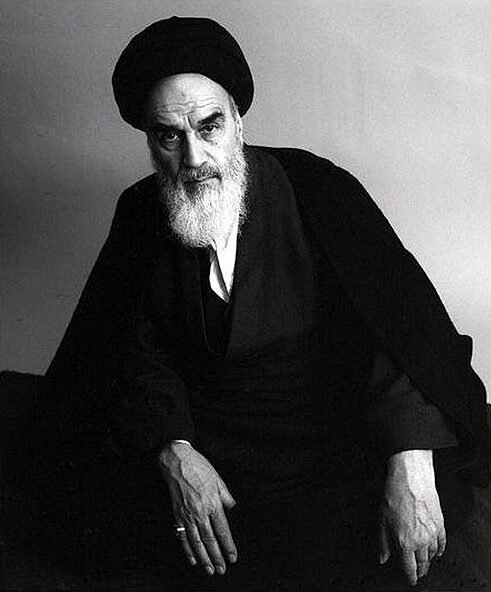
Image: A 1970s image of Khomeini.
Opposition to Mohammad Reza Shah and Exile
Khomeini’s rise to political prominence came in the early 1960s, during the reign of Mohammad Reza Shah Pahlavi, the son of Reza Shah. Mohammad Reza Shah continued many of his father’s policies, including efforts to modernize and secularize Iranian society. His most significant reform program was the White Revolution, a series of economic, social, and political reforms announced in 1963. These reforms included land redistribution, the enfranchisement of women, and the promotion of Western education.
Khomeini viewed the White Revolution as a direct attack on Islam and the traditional values of Iranian society. He saw the Shah’s reforms as an extension of Western imperialism, particularly American influence, in Iran. In June 1963, Khomeini delivered a speech at the Feyziyeh Madrasah in Qom, denouncing the Shah’s policies and calling for resistance against his regime. Khomeini’s speech drew parallels between the Shah and the tyrannical rulers of early Islamic history, which resonated with many Iranians who felt that the Shah was betraying Islamic values.
Khomeini’s public criticism of the Shah’s regime led to his arrest on June 5, 1963. His detention sparked widespread protests across Iran, known as the Movement of 15 Khordad, in which hundreds of demonstrators were killed by government forces. These events marked a turning point in Khomeini’s political career, as he became a symbol of resistance against the Shah’s regime.
In 1964, Khomeini was exiled by the Shah, first to Turkey and later to the holy city of Najaf in Iraq, where he continued his religious and political activities. While in exile, Khomeini developed his theory of velayat-e faqih (Guardianship of the Jurist), which argued that Islamic clerics should hold ultimate political authority in a society governed by Islamic law. This theory would later form the foundation of the Islamic Republic of Iran.
Iranian Revolution: What caused it and what was the outcome?
Leadership of the Iranian Revolution
During his years in exile, Khomeini’s influence continued to grow. His speeches and writings, often smuggled into Iran in the form of cassette tapes, were widely circulated among the Iranian public. These recordings were critical in mobilizing opposition to the Shah’s regime, particularly among the urban middle class, religious scholars, and students.
By the late 1970s, widespread discontent with the Shah’s regime had reached a boiling point. Economic hardships, political repression, and the Shah’s close ties with Western powers, especially the United States, fueled popular anger. Khomeini’s calls for an Islamic revolution gained traction, and in January 1979, after months of protests and strikes, the Shah fled Iran.
On February 1, 1979, Khomeini returned to Iran after 15 years in exile. His return was met with widespread jubilation, as millions of Iranians saw him as the leader of the revolution that would transform their country. Soon after his arrival, Khomeini established a provisional government, which quickly dismantled the remnants of the monarchy.
In April 1979, a national referendum was held in which Iranians overwhelmingly voted to establish an Islamic Republic. Khomeini became the Supreme Leader of the new Islamic state, holding ultimate political and religious authority. His concept of velayat-e faqih was enshrined in the new constitution, making him the most powerful figure in the country.
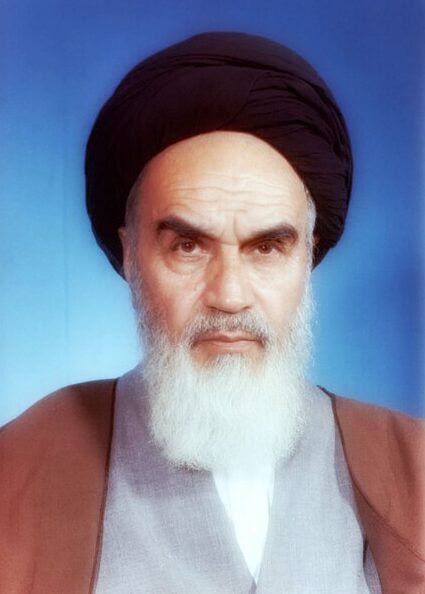
Image: A 1981 photo of Khomeini.
Supreme Leader of the Islamic Republic
As Supreme Leader, Khomeini’s role was to oversee both the political and religious affairs of the Islamic Republic. He exercised significant control over the government, the military, and the judiciary, and his decisions were considered final on matters of state and religion.
Khomeini’s early years as Supreme Leader were marked by several significant events. The most prominent of these was the Iran Hostage Crisis, which began in November 1979 when a group of Iranian students seized the U.S. Embassy in Tehran and held 52 American diplomats and citizens hostage for 444 days. Khomeini supported the hostage-takers and used the crisis to solidify his anti-American rhetoric, referring to the United States as the “Great Satan.” The hostage crisis severely strained U.S.-Iran relations and contributed to Khomeini’s image as a staunch opponent of Western imperialism.
Another defining event of Khomeini’s rule was the Iran-Iraq War, which began in September 1980 when Iraq, led by Saddam Hussein, invaded Iran. The war lasted for eight years and resulted in significant loss of life and economic devastation on both sides. Khomeini viewed the war as a defense of the Islamic Revolution and refused to negotiate peace until 1988, when both sides agreed to a ceasefire brokered by the United Nations. The war left a lasting impact on Iran’s economy and society, but it also helped to consolidate Khomeini’s authority and the power of the Islamic Republic.
Legacy and Controversies
Khomeini’s legacy is deeply controversial. Supporters view him as a champion of Islamic revival, anti-imperialism, and social justice. They credit him with restoring Islamic values to Iranian society and standing up to Western powers, particularly the United States and the Soviet Union.
However, Khomeini’s critics point to widespread human rights abuses during his rule. His government executed thousands of political opponents, including members of leftist groups, intellectuals, and those who opposed the Islamic Republic. Khomeini’s use of child soldiers in human wave attacks during the Iran-Iraq War has also drawn significant criticism. Estimates suggest that up to 100,000 children may have died in these assaults.
In 1989, Khomeini issued a fatwa calling for the assassination of British Indian novelist Salman Rushdie, whose book The Satanic Verses was deemed blasphemous. The fatwa led to widespread protests in the Muslim world and strained relations between Iran and Western countries.
Khomeini’s death on June 3, 1989, was marked by one of the largest funerals in history, with millions of Iranians attending. He was succeeded as Supreme Leader by Ali Khamenei, one of his closest associates.
How did the United States and Iran become such fierce enemies?
Questions and Answers on Ruhollah Khomeini
When and where was Khomeini born?
Khomeini was born either on May 17, 1900, or September 24, 1902, in Khomeyn, located in what is now Iran’s Markazi province.
Where did Khomeini pursue his religious education?
Khomeini began his studies in Khomein but later moved to a seminary in Arak. He eventually continued his education in Qom under Ayatollah Abdolkarim Haeri Yazdi, where he focused on Islamic law, jurisprudence, philosophy, and mysticism.
Also, Khomeini was influenced by Islamic philosophers like Avicenna and Mulla Sadra, as well as ancient Greek philosophers such as Aristotle and Plato. His philosophical interests greatly shaped his later religious and political teachings.
Khomeini had a deep passion for poetry, writing mystic and political poems throughout his life. Some of his works were published in collections and reflected his philosophical and religious views.
How did Khomeini’s political engagement begin?
Khomeini’s political engagement began in the 1940s when he opposed the secular reforms of Reza Shah, particularly the modernization policies that he saw as threats to Islam. His book Kashf al-Asrar (Uncovering of Secrets) published in 1942, criticized these secular reforms.
What was the Movement of 15 Khordad?
The Movement of 15 Khordad refers to the mass protests and riots that erupted in June 1963 after Khomeini’s arrest for his vocal opposition to the Shah’s regime. This marked the beginning of Khomeini’s leadership in the fight against the monarchy.
What led to Khomeini’s exile in 1964?
Khomeini strongly opposed the Shah’s White Revolution, a series of modernization reforms. His opposition to these reforms led to his forced exile to Bursa, Turkey, in 1964. Nearly a year later, he moved to Najaf, Iraq, where he continued his religious and political teachings.
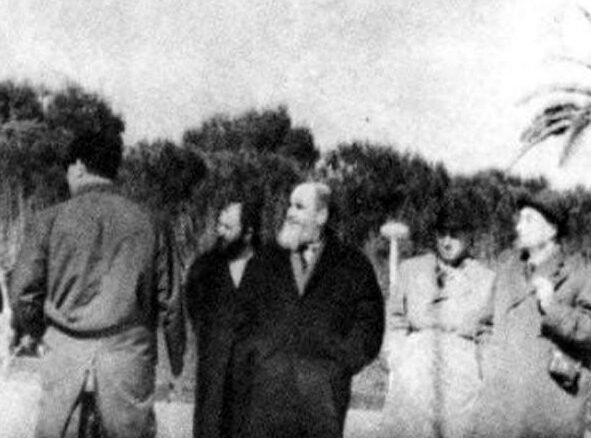
Image: Khomeini during his time in exile in Turkey.
What was the significance of Khomeini’s theory of Guardianship of the Jurist?
Khomeini’s theory of velayat-e faqih (Guardianship of the Jurist) argued that Islamic clerics should hold ultimate political authority. This theory became the foundation of Iran’s theocratic government after the Islamic Revolution and was compiled in his book Islamic Government.
How did Khomeini influence the revolution from exile?
Khomeini’s speeches and writings, particularly his recorded cassette messages, were widely circulated in Iran, contributing to the growing revolutionary movement against the Shah. In 1978, Khomeini moved to France, where he continued directing the revolution from afar.
How did Khomeini gain international attention in 1979?
Khomeini gained global attention during the Iranian Revolution of 1979. Time magazine named him “Man of the Year” for his influence. He became widely known in Western media for his support of the Iran hostage crisis, issuing a fatwa against British Indian novelist Salman Rushdie, and calling the United States the “Great Satan.”
What role did Khomeini play after the Iranian Revolution?
After the revolution, Khomeini became Iran’s first Supreme Leader, the highest-ranking political and religious authority in the country. He held this position until his death in 1989. His rule was marked by the Iran–Iraq War from 1980 to 1988.
How did Khomeini’s leadership during the Iran–Iraq War shape his legacy?
Khomeini’s leadership during the Iran–Iraq War defined much of his tenure. The war consumed significant resources and resulted in a large number of casualties. His use of child soldiers in human wave attacks has been heavily criticized, with estimates suggesting that up to 100,000 children may have died in these assaults.
How is Khomeini viewed in Iran today?
In Iran, Khomeini is officially referred to as “Imam Khomeini” and is legally considered “inviolable.” Those who insult his memory face severe punishment. His image and legacy are deeply intertwined with the fabric of the Islamic Republic.
What do Khomeini’s supporters and critics say about his legacy?
Supporters praise Khomeini as a champion of Islamic revival, anti-imperialism, and anti-racism, crediting him with restoring Islamic values in the face of Western influence. However, critics accuse him of human rights violations, including the suppression of political opposition, ordering attacks on demonstrators, and executing thousands of political prisoners.
How did Khomeini’s fatwa against Salman Rushdie affect his international image?
In 1989, Khomeini issued a fatwa calling for the assassination of British Indian novelist Salman Rushdie, accusing him of blasphemy in his book The Satanic Verses. This fatwa sparked international outrage and solidified Khomeini’s image as a strict enforcer of Islamic law.
What lasting impact did Khomeini have on Iranian society and politics?
Khomeini’s influence continues to shape Iranian society and politics. His leadership established the foundation for Iran’s theocratic system, and his principles of Islamic governance still guide the country’s political framework today. His legacy remains highly controversial due to his policies and actions during his rule.





