Saraswati in Hinduism: Origin Story and Significance
Saraswati is one of the most revered deities in Hinduism, embodying knowledge, wisdom, learning, speech, and the arts. Her significance transcends her role as a goddess of academic pursuits—she represents the flow of knowledge and culture, and her influence extends to all forms of creativity and intellectual growth. As one of the central goddesses of Hinduism, Saraswati is integral to the way Hindus understand and engage with the world intellectually and artistically.
In this comprehensive exploration of Saraswati, WHE delves into her origin story, her evolution over time, and the profound significance she holds in Hinduism and beyond.
Saraswati’s Vedic Origins
Saraswati’s earliest roots are found in the Vedic period, where she was originally worshipped as a river goddess. The Sarasvati River, named after the goddess, was one of the most important rivers mentioned in the Rigveda, the oldest of the four Vedas (composed around 1500 BCE). The river was seen as the source of nourishment and fertility, and Saraswati was initially venerated for her life-sustaining powers. Her association with water linked her to purification, fertility, and prosperity, as rivers were vital for agriculture and the sustenance of early civilizations.
In the Rigveda, Saraswati is praised not only as a river but also as a deity of knowledge and wisdom. She is described as “She who possesses knowledge” (Vac), and her role in this context begins to shift from a river deity to a goddess of eloquence, speech, and the arts. This duality—Saraswati as both a river goddess and a goddess of learning—suggests that the ancient Vedic people saw knowledge as something that flowed, like a river, nurturing the mind just as water nourishes the land.
As the Sarasvati River dried up over time and became less central to the lives of the people, the goddess’s role evolved. By the later Vedic period and in subsequent Hindu traditions, Saraswati’s connection to the river diminished, and her identity as the goddess of wisdom, learning, and the arts came to the forefront.
The Merging of Saraswati and Vac: The Goddess of Speech
Saraswati’s transition from a river goddess to a goddess of knowledge is closely tied to her identification with Vac, the Vedic goddess of speech. In Hindu philosophy, speech is not merely a tool for communication; it is the manifestation of thought, creativity, and intellectual expression. The power of Vac is the power to create through words, whether that creation is in the form of a poem, a piece of music, or a philosophical discourse.
In the Brahmanas, a collection of Vedic commentaries written after the Rigveda, Saraswati is increasingly identified with Vac, and the two figures eventually merge into one deity. This consolidation marks the transition of Saraswati from a deity associated with physical sustenance (as a river goddess) to one who nurtures the intellectual and artistic life. Saraswati, now firmly established as the goddess of speech, becomes the source of all verbal and intellectual creativity in the world.
The merging of Saraswati with Vac also reflects Hinduism’s recognition of the power of sound. In the Hindu tradition, sound is seen as a fundamental force of creation. The universe itself is believed to have been brought into being through sound, specifically the sacred syllable Om. In this sense, Saraswati, as the goddess of speech, embodies the creative power of sound.
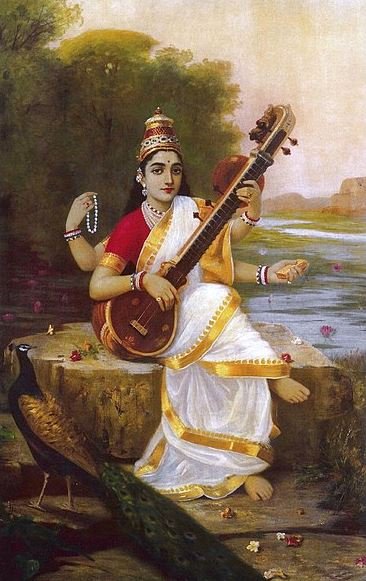
Image: Saraswati. Illustration by Indian artist Raja Ravi Varma.
Saraswati in Classical and Medieval Hinduism
By the time of classical and medieval Hinduism, Saraswati had fully developed into the goddess of learning, arts, and culture. In this period, Saraswati was primarily worshipped as the goddess of intellectual and artistic pursuits. She was credited as the inventor of the Sanskrit language, the ancient language of the Hindu scriptures, and the protector of sacred knowledge.
In this role, Saraswati became the consort or Shakti (creative power) of the god Brahma, the creator god in the Hindu pantheon. In Hindu cosmology, Brahma represents the mind and intellectual creation, and Saraswati symbolizes the creative energy that makes such intellectual and artistic pursuits possible. Through Saraswati, the abstract ideas and concepts in Brahma’s mind are transformed into language, poetry, music, and art, thus making the divine process of creation accessible to humans.
Saraswati’s relationship with Brahma is not just one of a consort; she represents the very power of creation through knowledge and learning. This association with Brahma further solidified her role as the goddess who fosters intellectual clarity, wisdom, and the ordered structure of knowledge.
The Symbolism and Iconography of Saraswati
Saraswati’s visual representation is filled with deep symbolism that reflects her attributes as a goddess of knowledge and culture. In Hindu iconography, she is typically depicted as a serene and radiant woman, dressed in pure white, symbolizing the Sattva quality, which represents purity, truth, and wisdom.
Her four arms hold significant items:
- A book, representing knowledge and the Vedas.
- A rosary (or mala), symbolizing meditation and spiritual wisdom.
- A water pot, representing purity and the power of purification.
- A veena, a musical instrument, symbolizing her mastery of the arts and the harmony of knowledge and creativity.
The white hamsa (swan or goose) that accompanies Saraswati is another symbol of wisdom and discernment, as the hamsa is believed to have the ability to separate milk from water, signifying the ability to discern truth from falsehood. In some depictions, Saraswati is also shown riding a peacock, representing beauty, creativity, and art.
The choice of white in her attire and the presence of a swan reinforce the themes of purity, focus, and intellectual clarity, essential qualities for anyone seeking knowledge.
Saraswati’s Significance in Different Hindu Traditions
Shaktism
In the Shaktism tradition, which emphasizes the worship of the goddess as the supreme force of the universe, Saraswati is venerated as an essential aspect of the Divine Mother. As a part of the Tridevi (the triple goddess alongside Lakshmi and Parvati), Saraswati represents the creative aspect of the Supreme Goddess. In this tradition, she is not only the consort of Brahma but also an independent source of creative power and wisdom.
Vaishnavism
In some Vaishnava traditions, Saraswati is viewed as a consort of Vishnu, assisting him in his divine functions. While this view is not as widespread, it highlights her flexibility in being linked to various gods within the Hindu pantheon. Saraswati’s role here underscores her status as the goddess who supports the work of maintaining cosmic order through knowledge and creativity.
Shaivism
Though Saraswati is not a central figure in Shaivism, she is sometimes invoked in her role as the goddess of speech and wisdom, particularly in contexts where the focus is on the use of sound and language in meditation and chanting.
Saraswati and the Festival of Vasant Panchami
One of the most important festivals dedicated to Saraswati is Vasant Panchami, celebrated on the fifth day of the Hindu month of Magha (January–February). This festival marks the arrival of spring and is also known as Saraswati Puja or Saraswati Jayanti in many regions of India. Vasant Panchami is particularly significant for students, teachers, and artists, as Saraswati is honored as the patron goddess of knowledge, learning, and the arts.
On this day, devotees offer prayers to Saraswati, seeking her blessings for success in their academic, intellectual, and artistic endeavors. Temples and educational institutions across India host special ceremonies, and children are often encouraged to begin writing the letters of the alphabet for the first time, symbolizing their initiation into learning. The festival highlights Saraswati’s role as a nurturing force behind human intellectual and cultural development.
Saraswati’s Influence Beyond Hinduism
Saraswati’s influence is not limited to Hinduism. She is also an important deity in Jainism and Buddhism, where she continues to represent wisdom, learning, and the arts.
Buddhism
In East Asian Buddhism, Saraswati is known as Benzaiten (or Benzai-ten) and is venerated as the goddess of eloquence, knowledge, and music. Benzaiten’s origins can be traced directly to the Hindu Saraswati, and her worship spread from India to China, Korea, and Japan through the transmission of Buddhist ideas. In Japan, Benzaiten is one of the Seven Lucky Gods, and her association with wisdom and eloquence makes her a significant figure in Japanese culture, particularly in artistic and scholarly pursuits.
Jainism
In Jainism, Saraswati plays a vital role as the goddess who helps propagate the teachings of the Tirthankaras (spiritual teachers). She is revered as the embodiment of wisdom and learning, responsible for spreading the sacred knowledge contained in Jain scriptures. Saraswati’s role in Jainism reflects her broader influence as a universal symbol of intellectual and spiritual growth.
Saraswati’s Connection to Knowledge and Liberation
Saraswati’s association with knowledge goes beyond intellectual and artistic learning—she is also connected to spiritual wisdom and liberation (moksha). In Hindu philosophy, particularly in the Advaita Vedanta school, the pursuit of knowledge is seen as a path to understanding the ultimate reality, Brahman. Saraswati, as the goddess of wisdom, is therefore not only the patron of academic learning but also a guide for those seeking self-realization and spiritual enlightenment.
The knowledge Saraswati represents is not limited to worldly understanding; it includes spiritual insight into the nature of the self and the cosmos. As such, Saraswati plays a critical role in helping devotees transcend ignorance and illusion, leading them toward ultimate liberation.
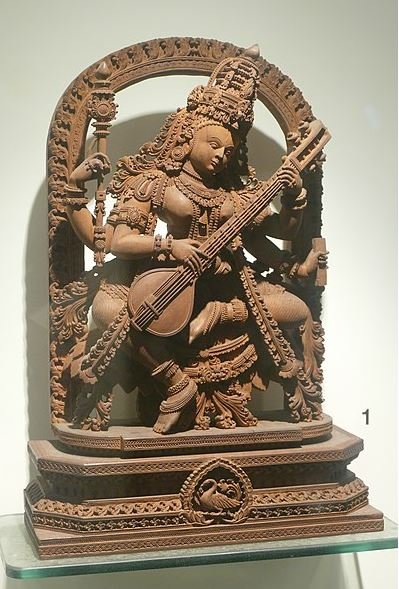
Image: Saraswati seated on a lotus throne, playing veena at the Indian Museum, Kolkata.
Temples and Worship
Although Saraswati has fewer temples dedicated solely to her compared to other Hindu deities like Vishnu and Shiva, she is still widely worshipped across India and beyond. One of the earliest known shrines to Saraswati is the Sharada Peeth in Kashmir, which dates back to the 6th–12th centuries CE. Saraswati is also worshipped in educational institutions, schools, and music academies, where devotees seek her blessings for success in their studies and artistic endeavors.
In homes and temples, Saraswati is often worshipped during special occasions such as Vasant Panchami, when her image or icon is adorned with yellow flowers, and prayers are offered to invoke her grace.
Questions and Answers: Saraswati, the Goddess of Knowledge and Arts
What is the Tridevi, and how does Saraswati fit into it?
The Tridevi is a trinity of major goddesses in Hinduism, consisting of Saraswati, Lakshmi, and Parvati. Saraswati represents knowledge and learning, Lakshmi symbolizes wealth and prosperity, and Parvati embodies love and power.
In which other religions is Saraswati venerated, apart from Hinduism?
Saraswati is also venerated in Jainism and Buddhism. In Buddhism, she is known as Benzaiten in East Asia, where she is regarded as the goddess of eloquence and talent.
What was Saraswati’s original association in the Vedic tradition?
In the Vedic tradition, Saraswati was initially associated with the Sarasvati River, worshipped as a river goddess. Her role was connected with purifying and nurturing fertility through water.
How did Saraswati’s significance evolve in later Hinduism?
Over time, Saraswati’s association with the river diminished, and she became more closely identified with Vac, the goddess of speech. Eventually, Saraswati evolved into the goddess of learning, arts, and creativity, emphasizing knowledge and intellectual pursuits.
What does Saraswati represent in classical Hinduism?
In classical and medieval Hinduism, Saraswati represents learning, poetic inspiration, and the arts. She is also credited as the inventor of the Sanskrit language and is linked to the creative power of sound, embodying intellectual and creative energy.
What role does Saraswati play in relation to Brahma?
Saraswati is often depicted as the consort or creative energy (Shakti) of the god Brahma. She represents his intellectual and creative abilities, symbolizing clarity, order, and the creation of knowledge through language.
How is Saraswati significant in the Shaktism and Vaishnava traditions?
In Shaktism, Saraswati is venerated as a creative aspect of the Supreme Goddess. In Vaishnava traditions, she is sometimes recognized as a consort of Vishnu, assisting him in his divine functions.
What are the main symbols associated with Saraswati’s iconography?
Saraswati is typically depicted as a serene figure dressed in white, symbolizing purity. She has four arms, holding a book (knowledge), a rosary (meditation), a water pot (purity), and a veena (a musical instrument representing the arts). Her mount is often a swan (hamsa), symbolizing wisdom, or a peacock, representing beauty.
Where are temples dedicated to Saraswati found, and what is a historically significant shrine?
Temples dedicated to Saraswati can be found across India and worldwide. One of the most historically significant shrines is Sharada Peeth, located in Kashmir, which dates back to the 6th–12th centuries CE.
What is Vasant Panchami, and how is it related to Saraswati?
Vasant Panchami, also known as Saraswati Puja or Saraswati Jayanti, is a festival celebrated on the fifth day of spring. It honors Saraswati as the goddess of knowledge and learning. On this day, students and scholars pay tribute to her, and young children are traditionally taught to write their first letters of the alphabet.
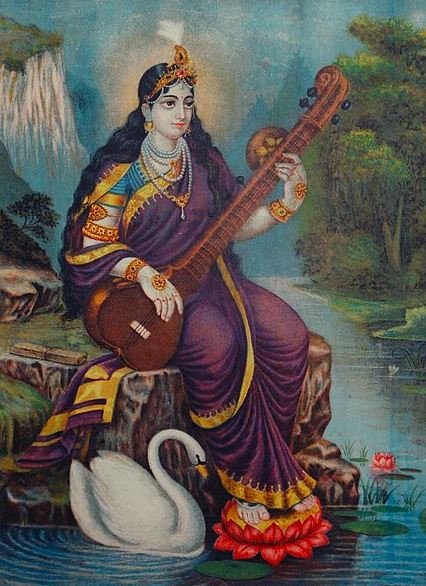
Image: Sarasvati is the Hindu deity representing knowledge and arts.
How is Saraswati revered in Buddhism and Jainism?
In Buddhism, Saraswati is revered as Benzaiten, the goddess of eloquence and talent, particularly in East Asia. In Jainism, she is honored as the deity responsible for spreading the teachings of the Tirthankaras, the spiritual teachers of Jainism.
What does Saraswati symbolize in all the religious traditions where she is worshipped?
Saraswati symbolizes wisdom, learning, intellectual growth, and artistic creativity. Her presence across Hinduism, Jainism, and Buddhism highlights her universal significance as a goddess of knowledge and culture.
Why is Saraswati’s influence enduring across multiple traditions?
Saraswati’s influence endures because she embodies the pursuit of wisdom, education, and creativity—values that transcend religious boundaries. She continues to inspire devotion from those seeking knowledge, artistic expression, and higher learning across Hinduism, Jainism, and Buddhism.