Louis XIV of France: History and Major Facts about the Sun King
Louis XIV of France (1638–1715), also known as the “Sun King,” remains one of the most famous monarchs in European history. His reign, which spanned 72 years, is the longest in recorded European history, and it marked a pivotal era in French culture, politics, and the development of absolute monarchy. Through his ambitious military campaigns, monumental contributions to art and architecture, and centralized political power, Louis XIV left an indelible mark on France and the broader European landscape.
World History Edu takes an in-depth look at Louis XIV’s life and reign, including how he rose to power, his numerous wars and political maneuvers, and his lasting cultural and political legacies.

Louis XIV, known as Louis the Great or the Sun King, was King of France from 1643 until his death in 1715, with a reign of 72 years—the longest of any sovereign. His reign saw significant influence both within France and across Europe. Image: A portrait of Louis XIV
Early Life and Childhood of Louis XIV
Louis XIV was born on September 5, 1638, after 23 years of marriage between King Louis XIII of France and Queen Anne of Austria. Louis XIII and Anne had suffered several stillbirths, and the birth of their son, named Louis-Dieudonné (meaning “God-given”), was seen as a divine blessing. As the long-awaited heir to the French throne, the young Louis became known as the Dauphin of France and carried the hopes of the French monarchy.
Louis spent his earliest years in relative isolation at the court of his mother, Queen Anne, to whom he was deeply attached. His father, King Louis XIII, died when Louis was only four years old, on May 14, 1643. Following Louis XIII’s death, the young Louis XIV automatically became king, though due to his age, the real power lay with his mother, who assumed the role of regent.
Queen Anne’s Regency and the Influence of Cardinal Mazarin
Queen Anne quickly took control of the regency, despite Louis XIII’s will stating that the regency should be shared among several nobles. She appointed Cardinal Jules Mazarin, a skilled diplomat and politician, as her chief minister. Mazarin had already served under Louis XIII and now became a mentor and guide to the young Louis XIV.
During Anne’s regency, France was heavily involved in the Thirty Years’ War (1618–1648), a European conflict that devastated the continent. Mazarin played a critical role in navigating France’s involvement, and his diplomatic skills were instrumental in securing favorable terms for France at the Peace of Westphalia in 1648, which ended the war. The treaties expanded French influence in Europe by securing Alsace and other strategic territories.
Mazarin also ensured that Louis XIV received a robust education, focusing on history, military tactics, governance, and the nature of absolute monarchy. This education, combined with Mazarin’s example, shaped Louis XIV’s worldview and approach to kingship.
The Fronde Rebellions (1648–1653)
The regency of Queen Anne and the rule of Mazarin were not without challenges. In 1648, a series of revolts known as the Fronde erupted, driven by opposition to Mazarin’s centralizing policies and heavy taxation. The Fronde consisted of two phases: the Fronde of the Parlements, involving judicial and political elites, and the Fronde of the Princes, which involved powerful nobles.
The Fronde deeply affected young Louis. At one point, the royal family was forced to flee Paris, and Mazarin went into temporary exile. The rebellion weakened the authority of the monarchy for a time, but by 1653, Mazarin had restored control, and the rebellious nobles were defeated. Nevertheless, the Fronde left a lasting impression on Louis XIV. It fueled his deep mistrust of the nobility and reinforced his desire for a centralized, absolute monarchy in which royal authority would never again be so openly challenged.
Louis XIV’s Ascension to Power
When Mazarin died in 1661, the 22-year-old Louis XIV took full control of the French state, famously declaring that he would rule alone without a first minister, saying, “L’État, c’est moi” (I am the state). This declaration reflected his belief in absolute monarchy, where all power resided in the king. Louis sought to control every aspect of government, from diplomacy to military affairs and the economy.
Louis XIV moved quickly to centralize power and neutralize any potential threats from the nobility. He restricted their influence at court and implemented policies that reduced the autonomy of regional governors. To consolidate his power, he expanded the role of intendants, royal officials who represented the king’s interests in the provinces, ensuring that local governance was aligned with royal directives.
One of Louis’s key goals was to make France the most powerful nation in Europe. His reign was marked by significant territorial expansion, aggressive foreign policies, and the development of a professional military that was unrivaled on the continent.
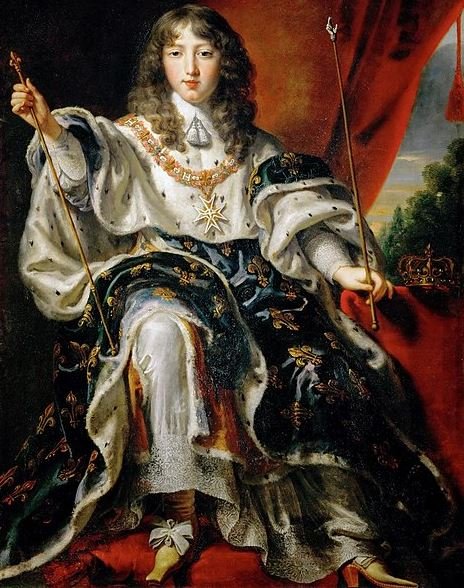
Portrait of Louis XIV by Justus van Egmont.
The Role of Jean-Baptiste Colbert
Upon assuming direct control, Louis appointed Jean-Baptiste Colbert as his minister of finance. Colbert, a brilliant administrator, was tasked with reforming France’s economy and consolidating royal finances, which had been strained by war and mismanagement.
Colbert was a proponent of mercantilism, an economic policy that aimed to strengthen the nation by increasing exports and reducing imports. He sought to expand France’s colonial holdings, improve trade, and build a strong navy to protect French interests abroad. Under Colbert’s direction, the merchant marine and military navy were expanded, and significant infrastructure improvements, such as new roads, canals, and bridges, were made across France.
Colbert also had a deep interest in culture and intellectual pursuits. He played a key role in founding the Academies of Fine Arts, Music, and Science, as well as establishing the Paris Observatory. His patronage of the arts helped make France a cultural powerhouse in Europe.
The Palace of Versailles: A Symbol of Power
One of Louis XIV’s most significant and enduring legacies was the construction of the Palace of Versailles. Originally a hunting lodge, Louis transformed Versailles into a monumental palace that became the seat of his court and government.
Construction on Versailles began in 1661 and spanned several decades. The palace became a symbol of Louis XIV’s absolute power and his vision of France as the center of European culture and influence. The Hall of Mirrors, the King’s Grand Apartments, and the vast gardens of Versailles were all designed to impress and showcase the wealth and prestige of the French monarchy. The lavish court life at Versailles allowed Louis to keep the nobility close, thereby neutralizing their political power by involving them in elaborate rituals and ceremonies.
Versailles also became a hub for the arts, where musicians, writers, and artists flourished under royal patronage. Louis XIV’s support of the arts contributed to the Baroque style becoming synonymous with French culture during his reign. The splendor of Versailles attracted visitors from across Europe, and it was widely regarded as the eighth wonder of the world.
Louis XIV’s Foreign Wars and Military Ambitions
Louis XIV’s reign was characterized by nearly constant military conflict. His ambitious foreign policy sought to expand French territory and influence, making France the dominant power in Europe. Several key wars defined his reign, starting with the War of Devolution (1667–1668).
War of Devolution (1667–1668)
After the death of his father-in-law, Philip IV of Spain, in 1665, Louis claimed that his wife, Maria Theresa, had a right to inherit parts of the Spanish Netherlands. This claim led to the War of Devolution, in which France initially enjoyed military success. However, the war ended when the Triple Alliance of England, Sweden, and the Netherlands intervened, leading to the Treaty of Aix-la-Chapelle in 1668, which halted French expansion.
Franco-Dutch War (1672–1678)
Undeterred, Louis sought to weaken the Netherlands in the Franco-Dutch War (1672–1678). The war, which pitted France against a coalition of European powers, ultimately resulted in the Treaties of Nijmegen, in which France gained the province of Franche-Comté and several fortresses in the Spanish Netherlands.
The War of the Reunions and Other Conflicts
In the 1680s, Louis waged the War of the Reunions against Spain, further expanding France’s territory through a series of small-scale conflicts. He also launched naval campaigns against Algiers, Tripoli, and Genoa, seeking to extend French influence in the Mediterranean.
The Nine Years’ War (1688–1697)
The most significant conflict of this period was the Nine Years’ War (1688–1697), in which France fought against the Grand Alliance—a coalition that included England, Spain, the Dutch Republic, and the Holy Roman Empire. This wide-reaching European conflict saw French forces score early victories, including at the Battle of Fleurus (1690) and the Battle of Landen (1693). However, by the end of the war, France was weakened by years of fighting, and the Treaty of Ryswick (1697) forced Louis to return some of his territorial gains.
War of the Spanish Succession (1701–1714)
The final major conflict of Louis XIV’s reign was the War of the Spanish Succession (1701–1714), triggered by the death of King Charles II of Spain. Louis sought to place his grandson, Philip of Anjou, on the Spanish throne, which alarmed other European powers. The war involved several major powers, including England, the Dutch Republic, and the Holy Roman Empire, who feared that a Bourbon monarch in Spain would upset the balance of power.
The war ended with the Treaty of Utrecht in 1713, which allowed Philip to remain on the Spanish throne but required that Spain and France remain separate entities. This treaty marked the end of Louis XIV’s ambitions for European dominance.
Absolutism and Domestic Reforms
Louis XIV is often considered the epitome of absolutism, a form of governance in which the monarch holds supreme power over the state. Throughout his reign, Louis centralized authority and reduced the power of the nobility and regional governors, bringing all aspects of governance under the control of the crown.
Centralization of Power
One of the key tools in Louis’s absolutist regime was the expanded use of intendants, royal agents who administered justice, taxation, and local governance on behalf of the king. Intendants were crucial in ensuring that Louis’s policies were implemented consistently across France.
Legal and Administrative Reforms
In 1667 and 1670, Louis introduced reforms aimed at making legal procedures more uniform across France. He reopened the Paris Law School, formalized the inspection of prisons, and required that prisoners be questioned within 24 hours of their arrest. These measures improved the administration of justice and reduced corruption in the legal system.
Religious Policy and the Revocation of the Edict of Nantes
One of the most controversial aspects of Louis XIV’s reign was his religious policy. In 1685, Louis revoked the Edict of Nantes, a law that had granted civil rights to French Protestants (known as Huguenots). The Edict of Nantes, originally passed by Henry IV in 1598, had allowed Huguenots to practice their faith without persecution, but Louis sought to impose religious uniformity by promoting Catholicism as the state religion.
The revocation of the Edict of Nantes led to widespread persecution of Protestants. Many Huguenots were forced to convert to Catholicism, while others fled the country. It is estimated that around 200,000 Huguenots left France, settling in places like England, the Dutch Republic, and Prussia. This mass exodus deprived France of many skilled workers and artisans, damaging the country’s economy.

Louis XIV’s Death and Legacy
Louis XIV died on September 1, 1715, just four days before his 77th birthday, after ruling for 72 years, the longest reign of any European monarch in recorded history. He outlived both his son and his grandson, leaving the throne to his great-grandson, Louis XV, who was just five years old at the time.
Louis XIV’s reign is often viewed as the epitome of absolutist rule. While his aggressive foreign policies and military campaigns expanded French influence, they also left France deeply indebted and war-weary by the end of his reign. His religious intolerance, particularly the persecution of the Huguenots, is widely condemned by historians.
Despite these criticisms, Louis XIV’s contributions to French culture, architecture, and governance are undeniable. The Palace of Versailles remains one of the most iconic symbols of royal power and artistic achievement. His centralization of power laid the groundwork for the modern French state, and his reign continues to be a subject of fascination for historians and scholars.
Conclusion
The life and reign of Louis XIV of France were marked by unparalleled ambition, grandeur, and controversy.
Known as the Sun King, Louis XIV sought to make France the most powerful nation in Europe, expanding its influence through war, diplomacy, and cultural patronage. His reign saw the rise of absolute monarchy, the construction of Versailles, and significant legal and economic reforms.
However, his military ambitions and religious policies left a mixed legacy, with France deeply in debt and divided by the time of his death. Nonetheless, Louis XIV’s reign represents one of the most transformative periods in French and European history, a time of both remarkable achievements and lasting consequences.
Frequently Asked Questions about Louis XIV

Known as the “Sun King,” Louis XIV is remembered for his absolute rule, military ambitions, and the creation of the magnificent Palace of Versailles. His era remains a key point of interest in European history, showcasing the height of French cultural and political power during the 17th and early 18th centuries.
When was Louis XIV born, and why was his birth significant?
Louis XIV was born on September 5, 1638, after two decades of marriage between King Louis XIII and Queen Anne of Austria. His birth was significant because the kingdom had long awaited an heir to the French throne, making him a symbol of hope for the continuation of the royal line.
At what age did Louis XIV become king, and who ruled in his place initially?
Louis XIV became king at the age of four when his father, Louis XIII, died in 1643. His mother, Queen Anne, served as regent, ruling on his behalf with Cardinal Mazarin as her chief advisor until Louis took full control at age 22.

Image: Coinage of Louis XIV.
Who was Cardinal Mazarin, and what role did he play during Louis XIV’s early reign?
Cardinal Mazarin was the chief minister to both Louis XIII and Louis XIV. He played a critical role in France’s diplomacy during the Thirty Years’ War and helped negotiate the Peace of Westphalia in 1648, which expanded French territory. Mazarin also provided Louis with a well-rounded education and governed effectively during Louis’s early reign.
What was the Fronde, and how did it impact Louis XIV’s early reign?
The Fronde was a civil rebellion (1648–1653) in France, sparked by discontent over high taxes and Mazarin’s policies. Nobles and commoners revolted, but the rebellion failed to weaken royal authority. Louis XIV and his family took refuge during the Fronde, but Mazarin eventually regained control, consolidating the monarchy’s power.
When was Louis XIV crowned king, and what symbolic items did he carry during his coronation?
Louis XIV was crowned king on June 7, 1654, at Reims Cathedral. He wore the crown of Charlemagne, carried the scepter, and held the Hand of Justice during the ceremony, symbolizing his authority as king.
What was the Treaty of the Pyrenees, and why was it significant?
The Treaty of the Pyrenees was signed in 1659 following France’s victory in the Franco-Spanish War. It expanded French territory and secured peace between France and Spain. The treaty also resulted in Louis XIV’s marriage to Maria Theresa, the daughter of the Spanish king, further solidifying peace and alliances.
What were Jean-Baptiste Colbert’s contributions to France during Louis XIV’s reign?
Jean-Baptiste Colbert, appointed as Louis XIV’s minister of finance, helped stabilize the French economy through reforms. His contributions included expanding the merchant and military navy, improving infrastructure (roads, bridges, canals), and fostering the arts and sciences by establishing various academies, such as those of Fine Arts, Music, and Science.
What were Louis XIV’s major military ambitions, and how did they shape his reign?
Louis XIV sought to expand French influence across Europe, leading to several wars, including the War of Devolution (1667–1668) and the Franco-Dutch War (1672–1678). These wars initially expanded French territory, but they also strained France’s resources, especially after the Nine Years’ War and the War of the Spanish Succession.
What was the War of the Spanish Succession, and how did it end?
The War of the Spanish Succession (1701–1714) was triggered by the death of King Charles II of Spain and Louis XIV’s attempt to place his grandson, Philip of Anjou, on the Spanish throne. The war involved multiple European powers but ended with the Peace of Utrecht in 1713, limiting Louis’s ambitions for dominance in Europe.

What religious policy did Louis XIV implement, and what were its consequences?
In 1685, Louis XIV revoked the Edict of Nantes, which had granted civil rights to Huguenots (French Protestants). This led to the persecution of Protestants, with many choosing to flee France. The revocation damaged France’s economy by causing skilled Protestant workers to emigrate.
What is Louis XIV’s most enduring legacy, and why is it significant?
The Palace of Versailles is Louis XIV’s most enduring legacy. It became a symbol of royal power and luxury, showcasing French art and architecture. Versailles was the center of Louis’s court, influencing royal courts across Europe and symbolizing France’s cultural dominance.
When did Louis XIV die, and how long did he reign?
Louis XIV died on September 1, 1715, just four days before his 77th birthday. He reigned for 72 years, the longest of any monarch in European history, leaving the throne to his great-grandson, Louis XV.
What are the key critiques of Louis XIV’s reign?
While Louis XIV expanded French territory and influence, his military ambitions left France heavily indebted and war-weary. His revocation of the Edict of Nantes is also widely criticized for its religious intolerance and long-term social and economic consequences.





