Lost Colony of Roanoke
The Lost Colony of Roanoke is one of the most enduring mysteries in American history. It represents one of the first attempts by England to establish a permanent settlement in North America, and its disappearance has sparked centuries of speculation, theories, and investigations.
The colony, founded in the late 16th century, is most famous for the unexplained vanishing of its settlers. Despite numerous efforts to uncover the truth, the fate of the Roanoke colonists remains unsolved. This long-lasting enigma has captured the imaginations of historians, archaeologists, and the general public.
Early Background: English Ambitions and Colonial Beginnings
In the late 16th century, England, under the reign of Queen Elizabeth I, sought to expand its influence and claim territories in the New World. Inspired by the wealth and success of Spain’s colonies, England aspired to establish its own foothold in North America. Sir Walter Raleigh, a close advisor to Queen Elizabeth, took the lead in organizing these efforts. Raleigh received a royal charter in 1584, granting him the authority to explore and colonize unclaimed lands in North America. His primary goal was to establish a permanent English settlement that could serve as a base for privateering, allow access to new resources, and prevent Spanish expansion in the region.
Raleigh’s initial explorations led to the discovery of Roanoke Island, located in present-day Dare County, North Carolina. Roanoke was chosen as the site for the colony due to its strategic location, offering a defensible position and access to the mainland, as well as its relative isolation, which Raleigh believed would protect it from Spanish forces and hostile Native American tribes.

Image: A map depicting present-day Roanoke Colony, within North Carolina.
The First Attempt: Ralph Lane’s Colony of 1585-1586
In 1585, Sir Walter Raleigh organized his first expedition to establish an English settlement on Roanoke Island. Ralph Lane, a military officer, was appointed as governor of the colony. Lane, along with a group of around 100 men, arrived on Roanoke Island in August 1585.
The early months of the settlement were marked by challenges and difficulties. The colony was underprepared for the realities of life in the New World, and the settlers soon faced shortages of food and supplies.
Their relations with the local Native American tribes were also strained. Although some initial interactions were friendly, tensions grew over time, particularly with the Secotan tribe, as the English settlers relied heavily on the indigenous people for food.
The colony’s dire situation was worsened by delays in resupply missions. Sir Richard Grenville, who was responsible for delivering supplies to the fledgling colony, was delayed due to unforeseen circumstances. This left Ralph Lane and his men struggling to survive. In June 1586, Sir Francis Drake, an English naval commander, visited Roanoke Island after a successful raid on Spanish ships in the Caribbean. Lane, seeing no other option, decided to abandon the colony and return to England with Drake’s fleet.
Shortly after Lane’s departure, Grenville arrived at Roanoke with supplies. Finding the colony deserted, Grenville left a small detachment of men to hold England’s claim to the land before also returning to England.

Image: A portrait of Walter Raleigh.
The Second Attempt: John White’s Colony of 1587
Despite the failure of the first settlement, Sir Walter Raleigh was undeterred. He organized a second expedition in 1587, this time with a more ambitious plan to establish a permanent colony.
John White, an artist and cartographer who had participated in the first Roanoke expedition, was chosen to lead the new group of settlers. White’s mission was to establish the “Cittie of Raleigh,” a new settlement further north in the Chesapeake Bay area. However, after making a stop at Roanoke Island to check on the men left behind by Grenville, White and his colonists found no trace of them.
Despite this troubling discovery, White and his settlers—115 men, women, and children—decided to remain on Roanoke Island and build their colony there. Among the settlers was White’s own daughter, Eleanor Dare, who gave birth to a daughter, Virginia Dare, shortly after their arrival. Virginia Dare is notable as the first English child born in the Americas, and her name would become an iconic part of American folklore.
Challenges and Tensions at the Roanoke Colony
Like the previous attempt, the new colony faced numerous challenges. The settlers struggled to grow crops and secure enough food, as they had arrived too late in the season to plant. Relations with the local Native American tribes were again fraught with tension. Some tribes, particularly the Croatoan, were friendly and supportive, while others remained hostile, partly due to lingering distrust from the earlier colony’s conflicts.
By the end of 1587, it became clear that the colony needed more supplies and assistance to survive. John White, as the colony’s governor, decided to return to England to organize a resupply mission. White departed for England in late 1587, leaving behind the settlers, including his daughter and granddaughter. His intention was to return within a few months with the necessary supplies to sustain the colony.
Delays in White’s Return: The Anglo-Spanish War
Unfortunately, White’s plans to return to Roanoke were disrupted by the outbreak of the Anglo-Spanish War in 1588. The war between England and Spain, which culminated in the defeat of the Spanish Armada, monopolized English resources and ships. As a result, John White was unable to secure vessels to return to Roanoke for nearly three years. During this time, he was frustrated by repeated delays and the difficulty of obtaining support for the resupply mission.
It wasn’t until 1590 that White was finally able to make the journey back to Roanoke Island. By then, much time had passed, and White feared what he might find upon his return.
The Mysterious Disappearance of the Roanoke Colony
When John White arrived at Roanoke Island in August 1590, he was met with an unsettling sight: the colony was deserted. There were no signs of the settlers, no bodies, and no evidence of a struggle or attack. The only clue left behind was the word “CROATOAN” carved into a palisade post, and the letters “CRO” carved into a nearby tree. White interpreted this as a message indicating that the colonists had relocated to Croatoan Island (now known as Hatteras Island), where a friendly Native American tribe, the Croatoans, lived.
Eager to follow this lead, White attempted to sail to Croatoan Island to search for the settlers. However, bad weather and the loss of an anchor forced him to abandon the search and return to England. He never made another attempt to find the colonists, and the fate of the Roanoke settlers remained a mystery.

Theories About the Fate of the Roanoke Colonists
The disappearance of the Roanoke colonists has sparked numerous theories, ranging from plausible to far-fetched. The following are some of the most widely discussed explanations:
Assimilation with Native American Tribes
One of the most popular theories is that the Roanoke settlers assimilated with local Native American tribes, such as the Croatoans or the more inland tribes. This theory is supported by reports from later English settlers, including those from Jamestown, who heard stories of European-looking people living among Native American communities. Some Native American oral histories also mention the presence of light-skinned people with European features. The colonists may have sought refuge with friendly tribes after struggling to survive on their own.
Relocation to Another Site
It is possible that the colonists attempted to relocate to another area, either further inland or to a more favorable location for survival. They may have planned to move to the Chesapeake Bay area, as originally intended, or to Croatoan Island, as suggested by the “CROATOAN” carving. However, no definitive evidence of such a relocation has been found, and the lack of any documented traces of the colony at another site leaves this theory inconclusive.
Massacre by Hostile Tribes
Another theory is that the settlers were attacked and killed by hostile Native American tribes, such as the Secotan, who had previously clashed with the English during the Lane colony. Although reports from Jamestown settlers mentioned rumors of a massacre, no concrete evidence of such an event has ever been discovered. It is also possible that the settlers could have been captured or enslaved by a hostile group.
Starvation or Disease
The harsh conditions faced by the Roanoke colonists, including food shortages and exposure to disease, may have led to their deaths. Starvation or disease outbreaks could have decimated the population, leaving no survivors to record their fate. However, the absence of any human remains or clear evidence of mass deaths casts doubt on this explanation.
Spanish Attack
Some historians have speculated that the Roanoke settlers may have been victims of a Spanish attack. Spain was England’s primary rival in the New World, and the Spanish had a vested interest in preventing the establishment of English colonies in North America. Spanish forces were active in the region during this time, and it is conceivable that they could have destroyed the colony. However, no Spanish records or evidence suggest that such an attack occurred.
Later Investigations and Archaeological Efforts
In the centuries following the disappearance of the Roanoke colonists, there have been numerous attempts to solve the mystery. Archaeologists, historians, and researchers have conducted investigations, digs, and analyses in search of clues about what happened to the settlers.
Early interest in the fate of the Roanoke colonists was rekindled by the establishment of the Jamestown colony in 1607. The Jamestown settlers, aware of the Roanoke mystery, made inquiries and collected reports from local Native Americans about the fate of the Roanoke colonists. Some accounts suggested that the settlers had been killed or absorbed into Native American tribes, but no definitive proof was found.
Some Native American oral histories mention the presence of individuals with European features, possibly suggesting that some Roanoke colonists intermarried with Native Americans and were assimilated into their communities. Researchers have explored this theory by studying the genealogies and DNA of present-day Native American descendants in the region, though conclusive evidence of European ancestry linked to Roanoke remains elusive.
Numerous archaeological excavations have been conducted on Roanoke Island and nearby sites in the hope of uncovering physical evidence of the colonists’ fate. In the early 20th century, excavations on Roanoke Island unearthed artifacts from the original colony, including tools, pottery, and other remnants. However, these discoveries provided no definitive answers about the disappearance.
More recent digs, including those on Hatteras Island (the site of Croatoan Island), have yielded artifacts that suggest contact between the Roanoke settlers and Native Americans. However, these findings remain circumstantial and have not conclusively proven what became of the colonists.
In the 1930s, a series of stones known as the “Dare Stones” were discovered, purportedly inscribed by Eleanor Dare, John White’s daughter, recounting the tragic fate of the Roanoke colonists. The stones were initially hailed as a breakthrough in solving the mystery, but they were later debunked as a hoax. Despite this, the stones briefly reignited public interest in the Lost Colony.

Image: An illustration depicting the discovery of Colony of Roanoke.
The Legacy of the Lost Colony of Roanoke
The story of the Lost Colony of Roanoke has left a lasting legacy in American history and culture. It represents one of the first major mysteries of European colonization in the New World and serves as a reminder of the challenges faced by early settlers. The disappearance of the colonists has inspired countless works of fiction, folklore, and historical narratives. Virginia Dare, in particular, has become a symbol of American innocence and pioneering spirit, often featured in literature and art.
The mystery of Roanoke continues to captivate the imaginations of historians, archaeologists, and amateur sleuths alike. Despite extensive research and investigation, the fate of the Roanoke colonists remains one of the greatest unsolved mysteries in American history. Whether they assimilated with Native Americans, were massacred, or succumbed to starvation or disease, the colonists’ story stands as a testament to the difficulties and uncertainties faced by those who sought to establish a new life in the Americas.
Frequently Asked Questions

What was the Roanoke Colony?
The Roanoke Colony was an English settlement attempt founded in 1585 by Sir Walter Raleigh on Roanoke Island, which is in present-day Dare County, North Carolina. It is most famous for the mysterious disappearance of its settlers, leading it to be known as the “Lost Colony.”
Who led the first group of settlers to Roanoke Island, and when did they arrive?
Governor Ralph Lane led the first group of settlers to Roanoke Island in 1585 as part of Sir Walter Raleigh’s efforts to establish a permanent English settlement in North America.
What challenges did the Roanoke Colony face?
The Roanoke Colony faced significant challenges, including shortages of supplies and difficult relations with local Native American tribes. These issues made it difficult for the colony to thrive.
Why did Ralph Lane abandon the Roanoke Colony in 1586?
Ralph Lane abandoned the Roanoke Colony in 1586 due to the lack of supplies and the colony’s increasingly dire situation. When Sir Francis Drake visited the island, Lane chose to return to England with Drake’s fleet.
What happened when Sir Richard Grenville arrived after Lane’s departure?
Sir Richard Grenville arrived shortly after Ralph Lane and his settlers had left. He found the colony deserted, but still left a small group of men behind to maintain England’s claim to the land.

Who led the second expedition to Roanoke Island, and when did it occur?
The second expedition to Roanoke Island was led by John White in 1587. Sir Walter Raleigh had sent White to re-establish the settlement and attempt to create a new colony.
What was the significance of Virginia Dare?
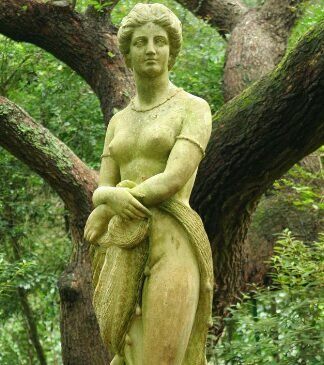
Virginia Dare, the granddaughter of John White, was the first English child born in the Americas. Image: Statue of Virginia Dare.
Virginia Dare, as the first English child born in the Americas, became an iconic figure in American folklore. She symbolizes innocence and the hope of the New World, making her a central figure in the legend of the Lost Colony.
Why was John White unable to return to Roanoke quickly after leaving for supplies?
John White’s return to Roanoke was delayed for several years due to the outbreak of the Anglo-Spanish War, which made sea travel difficult and prevented him from securing ships to return until 1590.
What did John White find when he returned to Roanoke in 1590?
When John White returned to Roanoke in 1590, he found the colony completely abandoned. The only clue left was the word “CROATOAN” carved into a palisade, which White interpreted as a sign that the colonists had relocated to Croatoan Island.
What are some theories about the fate of the Roanoke colonists?
Several theories exist about the fate of the Roanoke colonists. These include assimilation with local Native American tribes, such as the Croatoans, or that the settlers were killed by hostile tribes. Other theories suggest they may have died due to disease, starvation, or relocation to another area, but no conclusive evidence has been found.