Who were the ten Attic Orators?
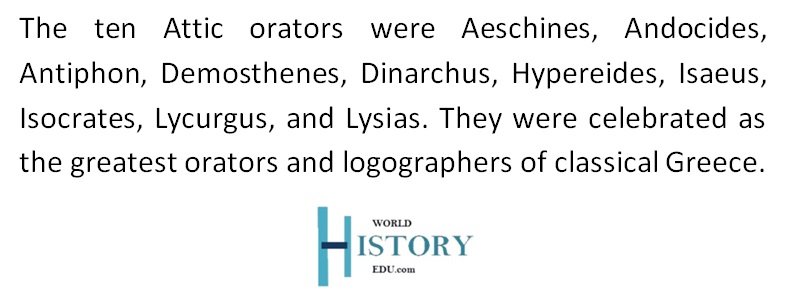
The ten Attic orators were celebrated figures of ancient Greece, renowned for their mastery of rhetoric and their significant roles in shaping classical Greek oratory. Known collectively as the “Canon of Ten,” their works have been studied for centuries as models of persuasive speaking and legal argumentation. Each orator brought a unique style and focus to their craft, reflecting the diverse political and cultural dynamics of classical Athens.

The contributions of the ten Attic Orators not only defined the art of oratory in their time but also established a lasting legacy in the Western tradition of public speaking and persuasion. Image: Depiction of Demosthenes practicing his craft
Aeschines (389–314 BC)
Aeschines was a statesman and rival of Demosthenes, known for his compelling oratory and political career. Born into a modest family, Aeschines initially worked as an actor and clerk before entering politics. His military service included participation in significant campaigns such as the Battle of Mantinea.
Aeschines’ career as an orator gained prominence during his diplomatic missions to Philip II of Macedon, where he advocated for peace between Athens and Macedonia. His rivalry with Demosthenes, another prominent orator, defined much of his career. Their disputes culminated in the famous case On the Crown, in which Demosthenes triumphed, leading Aeschines to retire and establish a school of rhetoric in Rhodes.
His surviving speeches—Against Timarchus, On the False Embassy, and Against Ctesiphon—remain essential for understanding Athenian law and political rhetoric.

Statue of Aeschines, Villa of the Papyri, Herculaneum. Displayed at Naples Archaeological Museum, photographed 1969.
Andocides (440–390 BC)
Andocides was an Athenian orator and logographer best known for his involvement in the religious scandal of the mutilation of the Hermae during the Peloponnesian War. This incident forced him into exile, shaping much of his later life and rhetoric.
Upon his return to Athens, Andocides defended himself in the speech On the Mysteries, arguing his innocence and advocating for reconciliation. His other works, including Against Alcibiades and On the Peace with Sparta, showcase his ability to navigate the complexities of Athenian politics and religion. Despite his controversial reputation, Andocides’ speeches provide valuable insights into the legal and social issues of his time.
Antiphon (480–411 BC)
Antiphon was a pioneer of Greek oratory and is often credited as one of the first professional speechwriters (logographers). Born into an aristocratic family, he was deeply involved in Athenian politics and played a significant role in the oligarchic revolution of 411 BC.
Antiphon’s speeches, primarily written for courtroom defenses, demonstrate his skill in crafting persuasive arguments. His works, including On the Murder of Herodes and Against the Stepmother for Poisoning, are notable for their logical structure and emotional appeal. His involvement in the failed oligarchic coup led to his execution, but his contributions to the art of rhetoric set the foundation for subsequent generations of orators.
Demosthenes (384–322 BC)
Demosthenes is arguably the most famous of the Attic orators, celebrated for his eloquence and unwavering opposition to Macedonian expansion under Philip II and Alexander the Great. Born into a wealthy family, Demosthenes overcame a speech impediment through rigorous training to become a master orator.
His speeches, such as the Philippics and Olynthiacs, rallied Athenians to resist Macedonian influence. In the courtroom, his skill in presenting complex legal arguments is evident in works like Against Meidias. His rivalry with Aeschines, particularly in the case On the Crown, showcased his rhetorical brilliance and cemented his legacy as a defender of Athenian democracy.

Image: Bust of Demosthenes.
Dinarchus (360–290 BC)
Dinarchus was a metic (resident foreigner) in Athens and the last of the ten Attic orators. His career flourished during the decline of Athenian independence following the rise of Macedon. As a logographer, he wrote speeches for others, often focusing on legal and political matters.
His surviving works—Against Demosthenes, Against Aristogiton, and Against Philocles—highlight his criticism of corruption and mismanagement among Athenian leaders. While his style is less celebrated than that of Demosthenes or Lysias, Dinarchus’ speeches are valuable for understanding the political turmoil of late classical Athens.
Hypereides (390–322 BC)
Hypereides was an influential Athenian orator and politician, renowned for his wit and elegance. He was a staunch opponent of Macedonian influence and a supporter of Athenian democracy. As a contemporary of Demosthenes, Hypereides often collaborated with him in political efforts.
His speeches, including Against Philippides and For Lycophron, combine legal precision with rhetorical flair. Hypereides’ ability to adapt his style to different audiences made him a versatile orator. His opposition to Alexander the Great’s policies ultimately led to his execution, but his works continue to inspire admiration for their sophistication and artistry.

Image: Hypereides.
Isaeus (420–350 BC)
Isaeus specialized in inheritance cases, making significant contributions to the development of legal rhetoric in Athens. His speeches, such as On the Estate of Menecles and On the Estate of Apollodorus, are distinguished by their clarity and logical rigor.
As a mentor to Demosthenes, Isaeus influenced the next generation of orators, emphasizing the importance of tailoring arguments to specific legal contexts. His works provide valuable insights into Athenian family law and the social dynamics of wealth and inheritance.
Isocrates (436–338 BC)
Isocrates was not only an orator but also a prominent educator and rhetorician. Unlike his contemporaries, he avoided courtroom disputes, focusing instead on political and philosophical discourse. His school of rhetoric attracted students from across Greece, including future leaders like Philip II of Macedon.
Isocrates’ works, such as Panegyricus and On the Peace, advocate for Greek unity and ethical governance. His emphasis on style and moral persuasion influenced the development of rhetoric as an intellectual discipline. Isocrates’ legacy extends beyond his speeches, shaping the broader traditions of Greek and Roman oratory.

Image: Bust of Isocrates.
Lycurgus (396–323 BC)
Lycurgus was a prominent statesman and financier, known for his administrative reforms and dedication to Athenian cultural heritage. He managed Athens’ finances during a period of recovery, funding public works and military preparations.
Lycurgus’ surviving speech, Against Leocrates, reflects his commitment to civic duty and moral integrity. He emphasized the importance of loyalty to Athens and the preservation of its traditions. As a leader, Lycurgus embodied the ideals of service and responsibility, leaving a lasting impact on Athenian governance.
Lysias (445–380 BC)
Lysias was a metic and professional speechwriter whose works are celebrated for their simplicity and charm. His speeches, often written for private individuals, address a wide range of topics, from personal disputes to political controversies.
Notable examples include Against Eratosthenes, which denounces the actions of the Thirty Tyrants, and On the Murder of Eratosthenes, a compelling legal argument in a murder case. Lysias’ ability to capture the voice of his clients made his speeches highly effective and influential.

Image: Statue of ancient Greek speechwriter Lysias; artwork by French sculptor Jean Dedieu (Gardens of Versailles)
Contributions of the Attic Orators to Rhetoric and Society
The ten Attic orators collectively shaped the art of rhetoric, setting standards that influenced subsequent generations of speakers in Greece and Rome. Their contributions extended beyond oratory, reflecting the democratic, legal, and cultural complexities of classical Athens.
Many of the orators, including Antiphon, Lysias, and Isaeus, specialized in courtroom speeches. Their works demonstrate how rhetoric could be used to navigate complex legal disputes, emphasizing clarity, logical argumentation, and emotional appeal.
Figures like Demosthenes and Hypereides used their oratory to influence public opinion and rally support for democratic ideals. Their speeches highlight the power of persuasion in shaping policy and resisting external threats.
Orators such as Lycurgus emphasized the importance of Athenian traditions and values. Their works reflect a commitment to preserving cultural heritage during times of political and social upheaval.
Isocrates elevated rhetoric to an intellectual discipline, integrating it with philosophy and ethics. His teachings inspired generations of students and established rhetoric as a central component of classical education.
Each orator brought a distinctive style to their craft, from the clarity and simplicity of Lysias to the fiery passion of Demosthenes. Their innovations enriched the art of rhetoric, demonstrating its versatility across different contexts.
The work of the Attic orators laid the foundation for Atticism, a rhetorical movement favoring simplicity and precision. This approach influenced Roman orators like Cicero and Quintilian, ensuring the enduring relevance of the Attic orators’ principles.
Conclusion
The ten Attic orators represent the pinnacle of classical Greek oratory, each contributing uniquely to the art of rhetoric and the cultural fabric of Athens. Their speeches not only address the political and legal challenges of their time but also offer timeless lessons in persuasion, leadership, and civic responsibility. As a group, they embody the intellectual and artistic achievements of classical Greece, leaving a legacy that continues to inspire and educate.
Frequently Asked Questions
What is the “Canon of Ten”?
The “Canon of Ten” is a selection of the most preeminent orators and logographers of classical Greece. It was likely established during the Hellenistic period in Alexandria and became fully recognized by the 2nd century AD.
What role did oratory play in Greek society?
Oratory was highly valued in Greek society, as seen as early as the era of Homer. Effective speaking was essential for leadership, persuasion in public and private matters, and participation in democratic and judicial processes.
How did Homer’s works highlight the importance of eloquence?
In Homer’s Iliad, Achilles is described as “a speaker of words and a doer of deeds,” emphasizing that eloquence was as crucial as physical strength for leadership.
When did formal training in oratory begin in Greece?
Formal training in oratory began in the 5th century BC, led by pioneers like Corax of Syracuse and his student Tisias, who developed the first systematic study of rhetoric.
Who was Gorgias of Leontini, and what was his contribution to oratory?
Gorgias of Leontini was a Sicilian orator who visited Athens in 427 BC. His innovative speech style, incorporating new forms of expression and logical argumentation, significantly influenced Greek oratory and inspired figures like Isocrates.
What role did Isocrates play in the development of rhetoric?
Isocrates, a prominent 4th-century BC educator and rhetorician, formalized rhetoric as a core subject in Greek education, emphasizing its importance in moral and intellectual development.
What were the main contributions of the Attic orators?
The Attic orators excelled in persuasive speech for legal, political, and ceremonial purposes. They developed unique styles and techniques that reflected the democratic and judicial systems of Athens.
Which two Attic orators were known for their rivalry, and what was a key example of it?
Demosthenes and Aeschines were famous for their rivalry. Their speeches during the case On the Crown are key examples of their rhetorical brilliance and competitive relationship.
What was Lysias known for in his oratory?
Lysias was known for his clarity and elegance, particularly in courtroom speeches.
What is Atticism, and how did it relate to the Attic orators?
Atticism was a rhetorical movement inspired by the Attic orators, advocating for clear, simple expression over ornate styles. This approach influenced later Greek and Roman oratory, including Cicero’s speeches.
How did the Attic orators impact later rhetorical traditions?
The Attic orators shaped the evolution of rhetoric, promoting clarity and simplicity. Their work inspired Atticism and served as models for Greek and Roman orators, leaving a lasting legacy in the history of persuasive speech.





