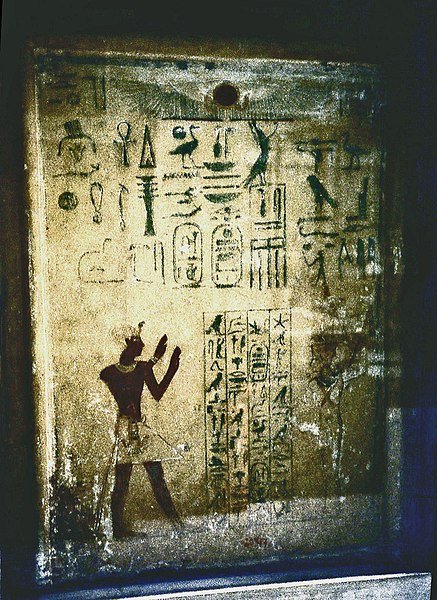
Stele of Snaaib, displayed at the Egyptian Museum in Cairo.
Menkhaure Snaaib was a lesser-known Egyptian pharaoh who ruled during the turbulent Second Intermediate Period, a transitional phase between the Middle Kingdom and the New Kingdom at the end of the Middle Bronze Age. Despite the scarcity of evidence, his reign has intrigued historians due to its connection with significant political and cultural shifts in ancient Egypt.
Painted limestone stela depicting Pharaoh Snaaib
The primary evidence of Menkhaure Snaaib’s existence comes from a painted limestone stela (CG 20517) found at Abydos, specifically at Kom es-Sultan. This stela is of crude craftsmanship, indicating limited resources or hurried production during his reign. The stela is significant for several reasons:
- It depicts the king wearing the Khepresh crown, also known as the “Blue Crown,” which became prominent in later periods. This depiction marks the earliest known use of the Khepresh in Egyptian art.
- The inscriptions on the stela provide his nomen (birth name), prenomen (throne name), and Horus name, vital clues for historians about his identity and reign.
- The stela shows Snaaib worshipping the god Min-Horus-nakht, a deity associated with fertility and strength, reflecting the religious practices of the time.
Khepresh Crown Usage
While Snaaib’s stela presents the earliest evidence of the Khepresh crown, another ruler of this period, Neferhotep III, is also depicted wearing this crown. This parallel indicates the growing symbolic importance of the Khepresh among Egyptian rulers during the Second Intermediate Period.
Theories on Snaaib’s Reign
Egyptologists Kim Ryholt and Darrell Baker theorize that Snaaib was a member of the Abydos Dynasty, a short-lived group of local rulers who controlled central Egypt after the collapse of the 13th Dynasty. This hypothesis is based on:
- The geographical location of the stela at Abydos, suggesting Snaaib’s reign was centered in this region.
- The political fragmentation of Egypt during this era, characterized by multiple competing rulers.
The Abydos Dynasty emerged as an independent power following the conquest of Memphis by the Hyksos, who dominated northern Egypt. Abydos, with its rich religious and cultural significance, served as the capital of this dynasty, which maintained control over Middle Egypt for a brief period.
Alternative Placement: End of the 13th Dynasty
In contrast to Ryholt and Baker, Jürgen von Beckerath places Menkhaure Snaaib’s reign near the end of the 13th Dynasty, a period marked by increasing instability. According to this theory:
- Snaaib was not part of the Abydos Dynasty but rather one of the last rulers of the declining 13th Dynasty.
- The stela’s crude quality might reflect the economic and political difficulties of this late phase of the 13th Dynasty.
The Collapse of Central Authority
Ryholt’s study expands on the ideas of Detlef Franke, proposing that the collapse of the centralized 13th Dynasty government allowed regional powers like Abydos to emerge. The division of Egypt into smaller, competing kingdoms created a mosaic of rule where figures like Snaaib held limited but significant authority in their respective regions.
Frequently Asked Questions about Pharaoh Snaaib
What artifact attests to his reign?
A painted limestone stela (CG 20517) found at Abydos, dedicated to the god Min-Horus-nakht.
Why is this stela significant?
It provides Menkhaure Snaaib’s nomen, prenomen, and Horus names, and shows him wearing the Khepresh crown in one of its earliest known depictions.
What is the broader context of the Abydos Dynasty theory?
Following the collapse of the 13th Dynasty and the Hyksos conquest of Memphis, an independent kingdom may have emerged in Middle Egypt, centered on Abydos, ruled by short-lived local kings. Snaaib is possibly among them.





