Who were the Hyksos?

As rulers of Egypt’s Fifteenth Dynasty (c. 1650–1550 BCE), the Hyksos’s legacy lies in their governance of the Nile Delta from Avaris and their interactions with the native Egyptian population and neighboring cultures. Image: “Four Foreign Chieftains” depicted in tomb TT39, ca. 1479–1458 BC, housed at the Metropolitan Museum.
The Hyksos, derived from the Egyptian term ḥqꜣw-ḫꜣswt meaning “rulers of foreign lands,” marked a significant chapter in Egypt’s history as the Fifteenth Dynasty (c. 1650–1550 BCE). They ruled primarily from Avaris in the Nile Delta, extending their control over Lower and Middle Egypt. Despite being foreign rulers, the Hyksos blended Egyptian customs with Levantine practices, leaving a lasting impact on the cultural and technological landscape of ancient Egypt.
Origins and Arrival: Settlers or Invaders?
The Hyksos are often described as people of West Semitic or Levantine origin. Manetho, the Greco-Egyptian historian, characterized them as violent invaders in his Aegyptiaca, written in the 3rd century BCE. However, modern Egyptology challenges this narrative, suggesting that the Hyksos’ rise to power followed centuries of gradual settlement by Canaanite communities in the Nile Delta. These settlers may have capitalized on Egypt’s political instability during the Thirteenth Dynasty, eventually establishing their own rule.
The Hyksos brought Levantine customs, while also adopting Egyptian traditions. They introduced innovations such as the horse and chariot, the khopesh sword, and possibly the composite bow—though these claims remain debated among scholars.

The Hyksos, a term derived from the Egyptian phrase heqau khasut (“rulers of foreign lands”), represent a fascinating yet enigmatic chapter in Egyptian history. Image: A man described as “Abisha the Hyksos”
Hyksos Rule: A Fragmented Egypt
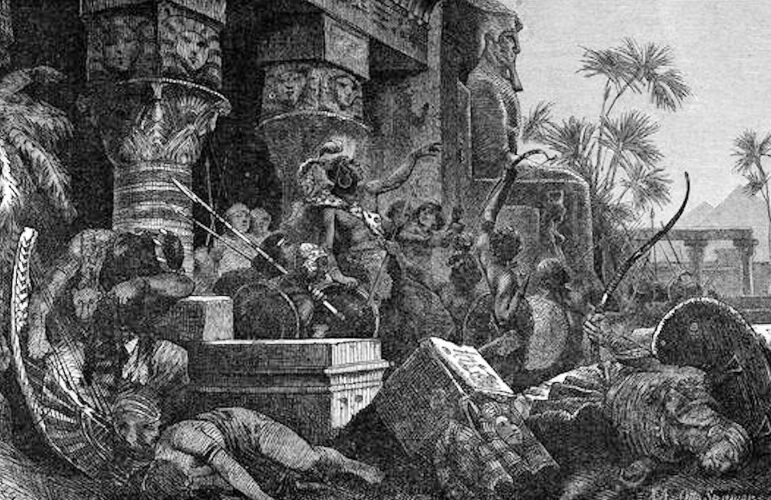
The Hyksos established their capital at Avaris in the Nile Delta, ruling Lower and Middle Egypt. They adopted Egyptian royal titles and practices, blending them with Canaanite customs. Their society was marked by administrative efficiency and multicultural influences, reflecting their origins as migrants who gradually gained power. Image: Hyksos invasion as imagined in the 19th century by Hermann Vogel (19th century)
The Hyksos did not rule all of Egypt. While they controlled the northern regions, Thebes remained independent, governed by the Seventeenth Dynasty. This coexistence eventually led to conflicts that culminated in their downfall.
Administration and Influence
Hyksos rulers adopted Egyptian royal titles and bureaucracy, blending their Levantine heritage with local practices. Scarabs bearing their names indicate their influence over trade and administration. However, they were often labeled as ꜥꜣmw (“Asiatics”) in Egyptian texts, reflecting their foreign origins.
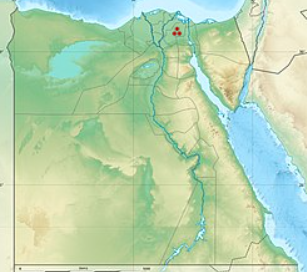
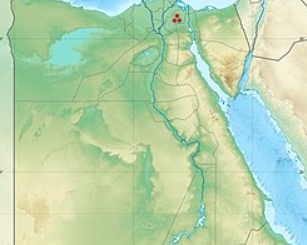
The Hyksos transformed Avaris into a major trading hub, facilitating commerce between Egypt, the Levant, and Cyprus. Imported goods, such as Canaanite pottery and Cypriot wares, attest to these connections. Image: Location of Avaris – the capital of the Hyksos
Technological and Economic Contributions
The Hyksos are credited with introducing:
- Horse-drawn chariots, which revolutionized Egyptian warfare.
- Advanced bronze-working techniques.
- New weaving styles and musical instruments.
- Improved viniculture, enhancing Egypt’s wine production.
Their trade networks connected Egypt with the Levant, Cyprus, and possibly Mesopotamia, establishing Avaris as a commercial hub.

The Hyksos are credited with introducing significant innovations to Egypt. For example, it’s been noted by some scholars that the Hyksos introduced horse-drawn chariots, composite bow, and the khopesh (a sickle-shaped sword).
Name and Etymology: The Debate Over “Hyksos”
The term “Hyksos” originates from the Greek Ὑκσώς (Hyksôs), itself derived from ḥqꜣw-ḫꜣswt. Initially used in Egyptian texts to describe foreign rulers, the term was later broadened by historians like Josephus, who associated it with “shepherd kings” or “captive shepherds.” This interpretation, while popular in antiquity, is considered inaccurate by modern scholars.
The name appears as early as the Twelfth Dynasty, notably in the tomb of Khnumhotep II, where a Canaanite leader is labeled as ḥqꜣ-ḫꜣswt. This suggests that the term was initially generic, applied to foreign rulers long before the Fifteenth Dynasty.
Conflict and Downfall: The End of Hyksos Rule
The Hyksos faced increasing resistance from the Theban rulers of the Seventeenth Dynasty. Pharaoh Seqenenre Tao began the struggle, which continued under his successors Kamose and Ahmose I.

17th Dynasty Pharaoh Seqenenre Tao
Kamose launched a series of campaigns to reclaim northern Egypt, destroying Hyksos-aligned cities and capturing Avaris. His successor, Ahmose I, completed the conquest, expelling the Hyksos and founding the Eighteenth Dynasty. Some sources suggest the Hyksos were allowed to leave peacefully, while others describe their expulsion as a military victory.

Kamose, Seqenenra Tao’s successor, launched a campaign against the Hyksos, as recorded on his stelae. Image: Sarcophagus of Kamose, Cairo Egyptian Museum
In the centuries that followed, the Hyksos were vilified in Egyptian accounts as brutal foreign oppressors. This narrative served to glorify the Theban rulers who expelled them and to reinforce a sense of national unity.
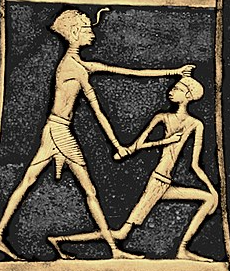
Manetho’s account claims the Hyksos were allowed to retreat to the Levant, though archaeological evidence suggests many remained in Egypt. Image of Pharaoh Ahmose I slaying a probable Hyksos on a ceremonial axe.
Religion and Culture
The Hyksos worshipped both Egyptian and Levantine deities, with Set (Seth), the Egyptian god of chaos, becoming associated with Baal, a Canaanite storm god. This syncretism is evident in artifacts and temples from the period.

Hyksos rulers worshiped both Egyptian and Canaanite deities, notably the storm god Baal, equated with the Egyptian Set. Temples at Avaris displayed a mix of architectural styles, reflecting their blended cultural heritage. Image: A statue portraying Baal, located at Exhibit in the Oriental Institute Museum, University of Chicago, Chicago, Illinois, USA.
Hyksos burials within settlements, often accompanied by horse sacrifices, reflect their Levantine heritage. Female sacrifices found in some tombs suggest unique ritual practices distinct from Egyptian traditions.
Diplomatic Reach: Connections Beyond Egypt
The Hyksos maintained extensive trade and diplomatic networks, evidenced by artifacts bearing their names found in Knossos (Crete), Hattusa (Anatolia), and possibly Babylon. These connections highlight their role as intermediaries in a broader Mediterranean and Near Eastern trade network.

Cartouche of Hyksos ruler Khyan
Legacy: Misunderstood Foreigners
The Hyksos period marked the first time foreign rulers governed Egypt, a fact that shaped their legacy in Egyptian history and beyond.
New Kingdom pharaohs portrayed the Hyksos as a cautionary tale of foreign domination. This perspective influenced later historians, including Josephus, who controversially linked the Hyksos to the Israelites and the biblical Exodus.
Despite their vilification, the Hyksos introduced technologies and practices that had a lasting impact on Egypt. Their innovations in warfare, trade, and craftsmanship were adopted and further developed by their successors.
Archaeological discoveries at Tell el-Dab’a (Avaris) have provided a clearer picture of Hyksos society, challenging earlier narratives of violent conquest. Instead, their rule is now seen as a complex interplay of migration, adaptation, and cultural exchange.

The final expulsion of the Hyksos occurred under Ahmose I, founder of the Eighteenth Dynasty, who besieged and captured Avaris. Image: The Expulsion of the Hyksos (1906)
Conclusion
The Hyksos era reflects the dynamic interactions between Egypt and its neighbors. While their rule was short-lived, their contributions to Egyptian culture and technology were profound. Today, they stand as a testament to the interconnectedness of ancient civilizations, challenging simplistic narratives of invasion and domination.

The Hyksos coexisted with native Egyptian dynasties in Thebes. Tensions culminated in a series of conflicts during the Seventeenth Dynasty. Seqenenra Tao’s mummy suggests he died in battle, likely against Hyksos forces. Image: Mummified head of Pharaoh Seqenenra Tao