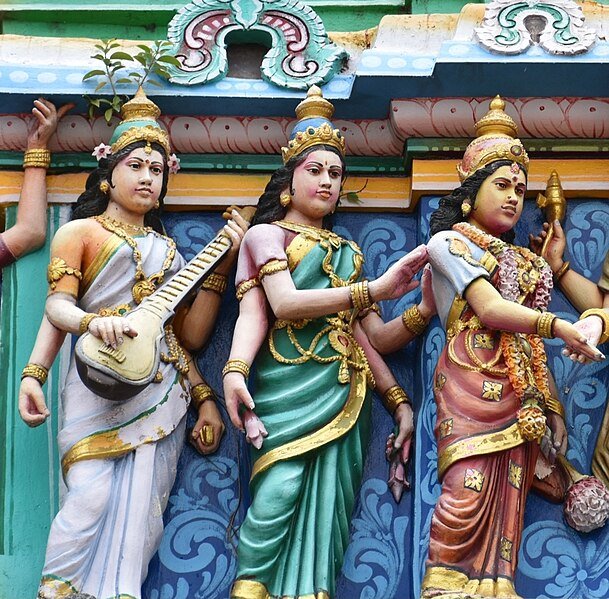
Sarasvati, Lakshmi and Parvati (from left to right)
The Tridevi, meaning “three goddesses,” forms a triad of supreme divinity in Hinduism, embodying feminine aspects of cosmic power. This divine trio typically consists of Saraswati, Lakshmi, and Parvati, representing knowledge, prosperity, and power, respectively. Depending on the Hindu denomination, these goddesses are either seen as consorts of the masculine Trimurti—Brahma, Vishnu, and Shiva—or as the supreme feminine counterparts of the Trimurti. In Shaktism, the Tridevi assumes paramount importance, with each goddess representing a crucial aspect of the universe’s creation, preservation, and transformation.
Feminine Trimurti and Their Supreme Roles
In traditional Hinduism, the Trimurti represents the cosmic roles of creation (Brahma), preservation (Vishnu), and destruction (Shiva). However, in Shaktism—a denomination that emphasizes the feminine divine—the Tridevi goddesses are seen as independent forces embodying these roles:
- Mahasaraswati (Creation): Represents the energy of creation, wisdom, and arts.
- Mahalakshmi (Preservation): Embodies prosperity, abundance, and sustenance.
- Mahakali (Destruction): Personifies transformation, time, and the destruction of ignorance.
In this perspective, the male Trimurti are subordinate agents of the Tridevi, highlighting the feminine divine’s ultimate authority over the cosmos.
Consorts of the Trimurti
The Tridevi also play essential roles as consorts to the Trimurti in traditional androcentric depictions:
Saraswati is the goddess of wisdom, learning, and arts. She governs intellectual and creative pursuits, serving as the divine muse for scholars, artists, and musicians. As the consort of Brahma, she complements his role as the creator, ensuring the cosmos is imbued with knowledge and harmony.
The Tridevi highlights the interplay of energies (gunas) that govern the cosmos, emphasizing the importance of balance.
Lakshmi is the goddess of fortune, wealth, and spiritual prosperity. Her blessings extend beyond material riches to include abstract qualities like glory, joy, and moksha (liberation). As Vishnu’s consort, she aids in the maintenance and preservation of cosmic order, signifying auspiciousness in all realms of existence.
Parvati is the goddess of love, power, and beauty. She embodies the dynamic force of Shakti, empowering Shiva, the cosmic destroyer and transformer. Parvati’s dual aspects—nurturing and fierce—highlight her role as both a loving mother figure and a powerful warrior who combats evil.
Shaktism’s Elevated View of the Tridevi
Shaktism assigns supreme roles to the Tridevi, with each goddess personifying specific energies (gunas) of the cosmos:
Mahasaraswati: The Creator
Mahasaraswati represents the energy of sattva (purity and balance). As the cosmic creator, she governs all forms of knowledge, including spiritual wisdom. In sacred texts like the Devi Bhagavata Purana, she is depicted as a warrior goddess who vanquishes demons such as Shumba, emphasizing her role as a protector of righteousness.
Mahalakshmi: The Preserver
Mahalakshmi embodies rajas (activity and dynamism). She oversees the preservation of the universe through abundance, prosperity, and virtue. Two significant forms of Mahalakshmi are:
- Vishnu-priya Lakshmi: Symbolizing chastity and devotion.
- Rajyalakshmi: Representing political power and fortune, entering spaces of virtue and departing from places devoid of it.
Mahakali: The Destroyer
Mahakali personifies tamas (inertia and darkness). She governs transformation through destruction, wielding time and cosmic energy to eliminate ignorance and decay. Mahakali is one of the most powerful aspects of the divine feminine, representing the ultimate force of change and renewal.
Symbolism of the Tridevi
The Tridevi personifies the foundational energies required for the universe’s balance and growth:
- Saraswati: Knowledge and creativity fuel innovation and cultural evolution.
- Lakshmi: Prosperity ensures the sustenance of life and societal well-being.
- Parvati (as Mahakali): Transformation eliminates obstacles, paving the way for new beginnings.
These goddesses represent not only individual virtues but also the interconnected cycles of existence, reinforcing the idea of balance between creation, preservation, and destruction.
Tridevi in Global Contexts
The influence of the Tridevi extends beyond Hinduism, entering other cultural and religious traditions through syncretism.
In Mahayana Buddhism, the Tridevi goddesses are revered in various forms:
- Saraswati: Venerated as Benzaiten in Japan, representing wisdom and eloquence.
- Lakshmi: Worshipped as Kishijoten, embodying happiness and prosperity.
- Parvati (Mahakali): Adopted as Daikokutennyo, symbolizing protective and transformative energy.
Festivals like Saraswati Puja, Lakshmi Puja, and Navaratri celebrate the goddesses, invoking their blessings for wisdom, wealth, and protection.
Through Buddhism, the Tridevi entered Japanese mythology, merging with Shinto deities to form powerful feminine archetypes. Their roles align closely with their Hindu origins, highlighting universal themes of knowledge, abundance, and transformation.
Frequently Asked Questions

What role do the Tridevi goddesses play in Shaktism?
In Shaktism, the Tridevi goddesses represent Mula-Prakriti or Mahadevi, the supreme feminine energy, embodying the roles of creation, preservation, and destruction.
Who are the consorts of the Trimurti?
The consorts of the Trimurti gods are Saraswati (consort of Brahma), Lakshmi (consort of Vishnu), and Parvati (consort of Shiva).
What does Saraswati symbolize?
Saraswati is the goddess of learning, arts, and music, and is known as the consort of Brahma, the creator.
What is Lakshmi’s significance in Hinduism?
Lakshmi is the goddess of wealth, prosperity, and spiritual fulfillment, serving as the consort of Vishnu, the preserver of the universe.
What is Parvati’s role in Hindu mythology?
Parvati is the goddess of power, beauty, love, and war, and is the consort of Shiva, the destroyer and transformer.
How are Mahakali, Mahalakshmi, and Mahasaraswati portrayed in Shaktism?
In Shaktism, Mahakali is the goddess of destruction, Mahalakshmi represents prosperity, and Mahasaraswati is the goddess of creation.
How did the Tridevi influence cultures outside India?
Through Buddhism and syncretism with Japanese Shinto deities, the Tridevi were adopted in Japan as Benzaitennyo, Kisshoutennyo, and Daikokutennyo.





