Léopold Sédar Senghor: The First Presiedent of Senegal
Léopold Sédar Senghor (1906–2001) was a Senegalese politician, poet, and cultural theorist. As the first president of Senegal from 1960 to 1980, Senghor played a vital role in shaping the post-colonial African political landscape. His advocacy for African socialism and cultural identity, coupled with his literary prowess, made him one of the most influential African intellectuals of the 20th century. Senghor’s leadership combined a vision of Pan-Africanism with a pragmatic approach to maintaining ties with France.
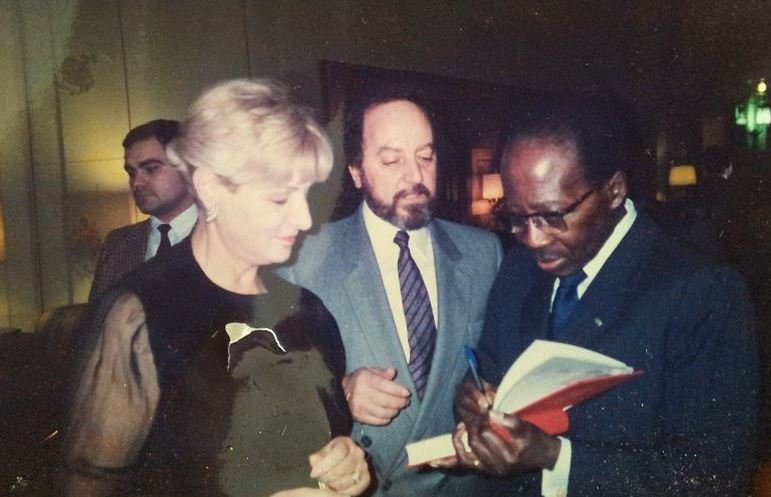
A 1988 photo of Léopold Sédar Senghor (right), signing a copy of his work.
READ MORE: Overview of African Independence and the First Presidents
Early Life and Education (1906–1928)
Born on October 9, 1906, in Joal, Senegal, Senghor grew up in a privileged Serer family. His father, Basile Diogoye Senghor, was a prosperous peanut merchant and landowner, while his mother, Gnilane Ndiémé Bakhoum, had Fula origins. Senghor’s middle name, “Sédar,” derived from the Serer language, means “one that cannot be humiliated.”
Senghor’s early education took place at a Catholic missionary school in Ngasobil and later at a seminary in Dakar. Displaying academic brilliance, he excelled in French, Latin, and Greek. His talents earned him a scholarship to study in France, marking the beginning of a formative period in his intellectual journey.
Academic Years and Intellectual Formation (1928–1944)
In 1928, Senghor moved to France, where he attended the prestigious Lycée Louis-le-Grand in Paris before enrolling at the Sorbonne. Though he initially struggled with the École Normale Supérieure entrance exams, Senghor persevered, eventually earning the agrégation in French grammar in 1935. This achievement made him one of the first Africans to receive this distinction.
Léopold Sédar Senghor was a visionary leader whose impact transcends his tenure as Senegal’s president. As a poet, philosopher, and statesman, Senghor championed the values of dignity, unity, and cultural pride.
During this period, Senghor developed his lifelong passion for literature and linguistics. He interacted with prominent intellectuals such as Georges Pompidou and began exploring themes of African identity and culture. Senghor and his peers, including Aimé Césaire, conceptualized the Négritude movement, a celebration of Black culture and heritage in response to colonial racism. The movement redefined the term “nègre” as a symbol of pride and resistance.
Military Service and World War II (1939–1942)
Senghor was conscripted into the French army during World War II, serving as part of the 3rd Colonial Infantry Regiment. Captured by German forces in 1940, he spent two years as a prisoner of war in various camps, where he wrote poetry and studied German literature. His experiences during the war deepened his resolve to fight for African dignity and self-determination.
Political Career and Vision for Africa (1945–1980)
After the war, Senghor transitioned into politics, advocating for African integration within the French colonial framework. He argued for a federal model that would empower African territories while maintaining ties with France. Senghor believed that African nations, as independent states, risked economic and political instability. Instead, he envisioned a cooperative structure within a French-led federation.
Senghor’s political career began in earnest when he was elected as a deputy to the French National Assembly in 1945. His efforts to extend French citizenship to all colonial territories and his support for workers’ rights in Senegal bolstered his reputation as a progressive leader.
Léopold Sédar Senghor’s reliance on French advisors and institutions has been interpreted as perpetuating neo-colonial structures.
In 1948, Senghor founded the Senegalese Democratic Bloc (BDS) alongside Mamadou Dia. This party aimed to promote African socialism while challenging the dominance of traditional colonial politics. The BDS gained significant traction, and Senghor became a prominent voice in African and French political circles.
Leadership of Independent Senegal (1960–1980)
Senghor became Senegal’s first president following its independence in 1960. His administration focused on education, infrastructure, and cultural development. Senghor believed in blending African traditions with modern governance, promoting what he termed “civilization of the universal.”
Under his leadership, Senegal adopted a single-party system, consolidating power within the presidency. However, his relationship with Mamadou Dia soured in 1962 when Dia was accused of plotting a coup and subsequently imprisoned. This incident marked the shift toward an authoritarian regime under Senghor.
One of Senghor’s lasting legacies was his emphasis on education and cultural preservation. He oversaw the establishment of institutions aimed at promoting Senegalese arts and heritage. Senghor also composed the Senegalese national anthem, further demonstrating his commitment to blending politics and culture.
While Senghor’s presidency is often lauded for its stability, critics have highlighted his authoritarian tendencies and the limitations of his economic policies.
Despite his achievements, Senghor faced criticism for suppressing political dissent and restricting press freedom. His decision to maintain close ties with France, including the use of French as Senegal’s official language, sparked debates about neo-colonialism. Nonetheless, Senghor’s leadership was characterized by relative stability and his peaceful transfer of power to Abdou Diouf in 1980.
Cultural Contributions and the Négritude Movement
Senghor’s poetry is celebrated for its lyrical exploration of African identity, spirituality, and the human experience. His works, such as Chants d’ombre (1945) and Éthiopiques (1956), reflect the ethos of Négritude, emphasizing the richness of African traditions and the universality of its values. Senghor viewed poetry as a means of bridging cultural divides and fostering understanding.
The Négritude movement, co-founded by Senghor, Césaire, and Léon Damas, sought to redefine Black identity in the face of colonial oppression. Senghor’s interpretation of Négritude emphasized the importance of African values, such as communalism and spirituality, in shaping a global cultural dialogue.
Global Impact and Francophonie
Senghor was a staunch advocate of Francophonie, promoting the French language as a tool for international cooperation. In 1982, he co-founded the International Organization of Francophonie, which sought to unite French-speaking countries in cultural and political collaboration. His efforts to bridge African and European cultures earned him widespread recognition.
Later Years and Legacy (1980–2001)
Senghor retired from politics in 1980, dedicating his later years to writing and cultural advocacy. In 1983, he became the first African elected to the Académie française, cementing his status as a global intellectual. Senghor received numerous honors, including honorary doctorates from prestigious universities and accolades for his contributions to literature and politics.
Death and Commemoration
Léopold Sédar Senghor passed away on December 20, 2001, in Verson, France. His funeral in Dakar was attended by global dignitaries, reflecting his international influence. The Dakar airport and various institutions were renamed in his honor, ensuring his legacy endures.
Senghor’s Philosophy and Vision
Senghor’s political ideology, African socialism, was rooted in the principles of communalism and cultural identity. Unlike Marxist socialism, Senghor’s vision emphasized the integration of African traditions with modern economic systems. He believed in a balanced approach to governance, combining African values with Western innovation.
Senghor’s life exemplified a quest for equilibrium—between Africa and Europe, tradition and modernity, and poetry and politics. He argued that humanity’s progress depended on mutual respect and cultural exchange.
Timeline of Léopold Sédar Senghor (1906–2001)
- 1906: Born on October 9 in Joal, Senegal, to a wealthy Serer family.
- 1922–1928: Studied in Dakar and Ngasobil, earning a scholarship to study in France.
- 1928: Moved to France for higher education, attending the Sorbonne and Lycée Louis-le-Grand.
- 1935: Became the first African agrégé in French grammar.
- 1935–1945: Taught at universities in Tours and Paris; co-developed the Négritude movement, celebrating African identity and culture.
- 1939–1942: Drafted into the French army, captured by Germans, and imprisoned during World War II.
- 1945: Entered politics, elected to the French National Assembly as a deputy for Senegal.
- 1948: Founded the Senegalese Democratic Bloc party.
- 1960: Became Senegal’s first president after independence; authored the national anthem.
- 1962: Consolidated power by arresting Prime Minister Mamadou Dia.
- 1967: Survived an assassination attempt.
- 1980: Resigned as president, succeeded by Abdou Diouf.
- 1983: Became the first African member of the Académie française.
- 2001: Died on December 20 in France; honored as a poet, philosopher, and statesman.
Frequently Asked Questions

A 1978 picture of Léopold Sédar Senghor
What is Négritude?
Négritude was a cultural and political movement founded by Senghor and others, celebrating African identity, culture, and heritage while countering colonial racism.
What were Senghor’s views on African independence?
Senghor advocated for federalism, where African territories could govern themselves internally while maintaining ties within a French federation. He believed this would promote development better than complete independence for smaller territories.
What were Senghor’s contributions to Senegal’s political system?
Senghor established Senegal as an independent nation, created a one-party state initially, later adopting a limited multi-party system. He prioritized education and retained close ties with France.
What challenges did Senghor face during his presidency?
Senghor survived an assassination attempt in 1967 and dealt with political conflict, including the arrest of Prime Minister Mamadou Dia in 1962 for an alleged coup attempt.
What is Senghor’s literary legacy?
Senghor’s poetry reflects the Négritude movement and African identity, blending African and Western influences. He is regarded as one of Africa’s most influential intellectuals and poets of the 20th century.
What was Senghor’s role in global culture and politics?
Senghor was a member of the Académie française, the first African to hold this distinction, and a key advocate for Francophonie. He supported international cooperation and the drafting of a global constitution.
What awards and honors did Senghor receive?
Senghor received numerous accolades, including the Grand-Croix of the Légion d’honneur, honorary doctorates from 37 universities, and the renaming of Dakar’s international airport in his honor.
10 significant events that shaped African history during the 20th century
FACT CHECK: At World History Edu, we strive for utmost accuracy and objectivity. But if you come across something that doesn’t look right, don’t hesitate to leave a comment below.





