Henry III was elected King of Poland and Grand Duke of Lithuania in 1573 but abandoned the throne in 1574 to claim the French crown after his brother Charles IX died. He had signed the Henrician Articles, ensuring religious tolerance and the nobles’ right to elect their king.
Childhood and Family
Henry III was born as Alexandre Édouard on 19 September 1551 at the Château de Fontainebleau. He was the fourth son of King Henry II of France and Catherine de’ Medici. Given his birth position, he was not initially expected to ascend the French throne. However, the early deaths of his elder brothers paved his way to kingship.
From an early age, he was his mother’s favorite, often addressed as chers yeux (“precious eyes”). Catherine lavished attention upon him, fostering an intense mother-son bond that lasted throughout his life. His brothers, particularly Charles IX, grew to resent this favoritism, leading to a tense sibling relationship.

An engraving depicting Henry III of France
Education and Interests
Henry III was raised in the French court under the supervision of Diane de Poitiers, his father’s mistress. His education was rigorous, covering Latin, history, philosophy, and theology. He was an excellent fencer and enjoyed hunting, riding, and courtly entertainments.
During his youth, Henry briefly flirted with Protestantism, even referring to himself as a “little Huguenot” at one point. However, under his mother’s influence, he became a staunch Catholic. His religious fervor and eventual support for Catholic dominance in France defined his political and military decisions in later years.
Henry as King of Poland-Lithuania (1573–1575)
Following the death of Sigismund II Augustus of Poland, the Polish-Lithuanian Commonwealth was in search of a new ruler. Henry was elected King of Poland and Grand Duke of Lithuania in 1573. His election was supported by France, as it sought to strengthen alliances in Eastern Europe.
Before being crowned, Henry had to sign the Henrician Articles, which limited monarchical power and ensured religious tolerance. These articles later influenced European constitutional developments.
Though crowned in 1574, Henry was largely uninterested in Polish affairs. He struggled with the Commonwealth’s political structure, which allowed nobles significant power.
Upon learning of his brother Charles IX’s death, Henry fled Poland in June 1574, returning to France to claim the throne. His departure angered the Polish nobility, leading to a constitutional crisis. The Polish throne was later declared vacant, as Henry never returned.
King of France (1574–1589)
Henry III inherited a France deeply divided by the Wars of Religion. The three main factions were:
- The Catholic League, led by Henry I, Duke of Guise, supported by Spain and the Pope.
- The Huguenots (Protestants), led by Henry of Navarre, backed by England and the Dutch Republic.
- The Malcontents, a mix of Catholic and Protestant aristocrats opposing the monarchy’s increasing absolutism.
Henry III, a politique, advocated for a strong, centralized, and religiously tolerant monarchy to stabilize France. However, his policies satisfied neither extreme Catholic nor Protestant factions, leading to ongoing conflicts.
War of the Three Henrys (1585–1589)
Following the death of his younger brother, Francis, Duke of Anjou, in 1584, Henry III had no direct heir. Under Salic Law, his successor was Henry of Navarre, a Protestant. This alarmed the Catholic League, which championed Cardinal Charles de Bourbon as the rightful heir.
The resulting conflict, known as the War of the Three Henrys, involved Henry III, Henry of Navarre, and Henry of Guise. Henry III’s shifting alliances and reliance on political maneuvering made him unpopular.
The Assassination of Henry I, Duke of Guise
By 1588, the Catholic League had gained control over Paris. In December of that year, Henry III ordered the assassination of Henry I, Duke of Guise and his brother, Louis II, Cardinal of Guise, at the Château of Blois.
The murders turned Catholic sentiment against Henry III, forcing him to flee and seek support from Henry of Navarre, his former enemy.
Personal Life and Controversies
Sexuality and Court Scandals
Henry III’s personal life was the subject of intense scrutiny and controversy. He surrounded himself with young male courtiers, known as “mignons”, whom he lavished with gifts and honors. This led to widespread rumors about his sexuality.
While some historians argue that Henry III engaged in same-sex relationships, others believe these accusations were politically motivated propaganda by his enemies. Despite these rumors, Henry III had several mistresses and was known for his appreciation of beauty in both men and women.
Marriage and Lack of Heirs
Henry III married Louise of Lorraine in 1575, but the union remained childless. This failure to produce an heir deepened the succession crisis, further fueling the Catholic League’s determination to prevent a Protestant successor.

Domestic and Foreign Policies
Henry III initially sought compromise between Catholics and Protestants, issuing the Edict of Beaulieu in 1576, which granted significant religious freedoms. However, due to Catholic opposition, he later rescinded these concessions, exacerbating tensions.
In 1585, under pressure from the Catholic League, Henry III annulled Henry of Navarre’s right to succession and outlawed Protestantism. However, he remained politically isolated, caught between extremist factions.
Henry III maintained diplomatic relations with Elizabeth I of England, despite religious differences. His policies fluctuated between seeking English support against the Catholic League and appeasing Spain to maintain peace.
France also expanded its interests in the New World, supporting explorers like Jacques Cartier’s nephew, Jacques Noël, in colonization efforts.
Assassination and Legacy
On 1 August 1589, while camped at Saint-Cloud, Henry III was stabbed by a Dominican friar, Jacques Clément, a fanatic loyal to the Catholic League. The attack initially seemed non-lethal, but the king died the next morning.
Before his death, he urged his followers to support Henry of Navarre, marking the transition from the House of Valois to the House of Bourbon.
Henry III was interred at Saint Denis Basilica. His assassination marked the end of the Valois dynasty and the beginning of Bourbon rule. Henry IV, the new king, ultimately converted to Catholicism to unify France, famously stating: “Paris is worth a Mass.”
Despite his failures, Henry III is remembered for:
- His attempts at religious tolerance amid civil strife.
- His cultural contributions, including the establishment of the Order of the Holy Spirit in 1578.
- His role in modernizing France’s monarchy, setting the stage for Bourbon absolutism under Louis XIV.

Frequently Asked Questions about Henry III of France
How did Henry III handle the French Wars of Religion?
As a politique, Henry III sought a strong, centralized monarchy with religious tolerance to stabilize France. However, his reign was plagued by conflicts among the Catholic League, the Huguenots, and the Malcontents, leading to the War of the Three Henrys.
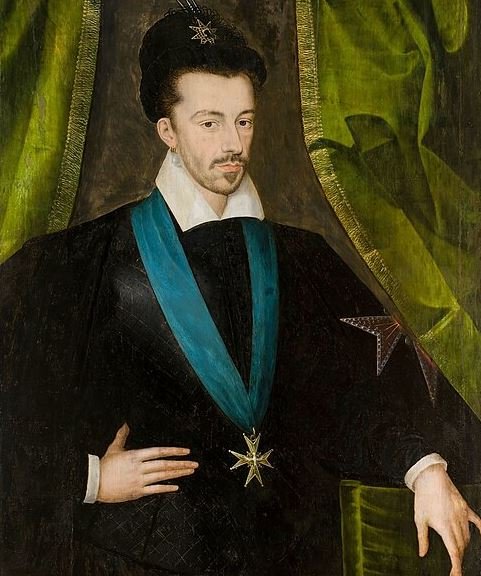
Portrait of Henry III by French artist Étienne Dumonstier.
Why was Henry III’s succession contested?
Since Henry III had no heir, his legitimate successor under Salic Law was Henry of Navarre, a Protestant. The Catholic League opposed this and supported Cardinal Charles of Bourbon, leading to a dynastic crisis.
What was the War of the Three Henrys?
It was a civil war (1585–1589) between Henry III, Henry of Navarre, and Henry I, Duke of Guise, over control of France. The conflict intensified after Henry III ordered the assassination of the Duke of Guise.
Why did Henry III assassinate the Duke of Guise?
The Duke of Guise, leader of the Catholic League, had gained significant influence and defied Henry III. Fearing a coup, Henry III had him murdered in 1588, which further turned public opinion against him.
How did Henry III die?
He was assassinated on 2 August 1589 by Jacques Clément, a Catholic League fanatic, while preparing to besiege Paris. His death paved the way for Henry of Navarre to become Henry IV of France.
What was Henry III’s legacy?
He was the last Valois king, and his reign saw deepening religious and political strife. His assassination marked the end of the Valois dynasty, leading to the rise of the Bourbon monarchy under Henry IV.





