The Arthurian Legend: Early Sources, Origins, and Literary Development
The Arthurian legend has undergone a vast literary evolution spanning over a millennium, shaping the mythical King Arthur and his knights into a timeless narrative. From early medieval chronicles to modern adaptations, the legend reflects changing cultural values, literary traditions, and political climates.

King Arthur
Early Sources and Origins
Celtic Myth and Oral Tradition
The roots of the Arthurian legend can be traced to Celtic folklore, where tales of a heroic figure resembling Arthur existed in oral traditions. Welsh mythology, in particular, played a crucial role in shaping the legend. Figures such as Arthur appear in the Mabinogion, a collection of medieval Welsh tales, where he is depicted as a leader with supernatural elements.
The Historia Brittonum (9th Century)
One of the earliest written references to Arthur comes from Nennius’ Historia Brittonum (c. 830), which presents him as a warrior who led the Britons against the Saxons. This historical account, while not strictly literary, introduced Arthur as a military figure, emphasizing his victories rather than chivalric ideals.
The Annales Cambriae (10th Century)
The Annales Cambriae, a 10th-century chronicle, mentions the Battle of Badon and Arthur’s role in it, reinforcing his image as a historical warrior. This work suggests Arthur’s role in history but remains vague on narrative details.
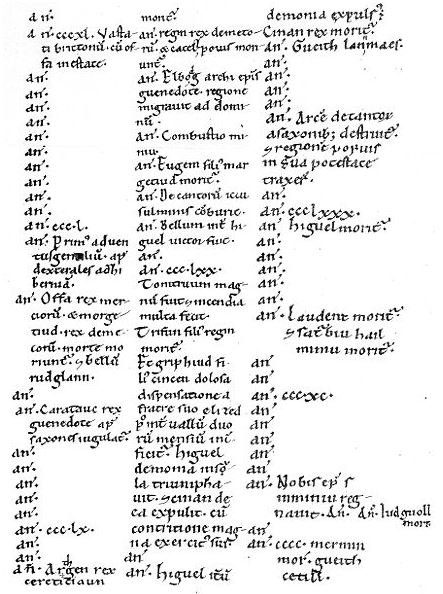
A page from the Annales Cambriae.
The French and Anglo-Norman Influence
Geoffrey of Monmouth’s Historia Regum Britanniae (1136)
The first significant literary development of the Arthurian legend occurred in Geoffrey of Monmouth’s Historia Regum Britanniae. Geoffrey crafted a pseudo-historical narrative that transformed Arthur from a warrior into a grand king who established a vast empire. This work introduced key elements, such as Merlin’s prophecy, Arthur’s birth, and his eventual downfall.
The Rise of Romance: Chrétien de Troyes (12th Century)
French poet Chrétien de Troyes introduced the concept of courtly love and chivalry to Arthurian literature. His works, such as Lancelot, or the Knight of the Cart and Perceval, the Story of the Grail, brought significant innovations, including the love affair between Lancelot and Guinevere and the Holy Grail motif. These elements reshaped Arthurian legend from a historical epic to a romance narrative.
The Vulgate Cycle (13th Century)
The Vulgate Cycle, also known as the Lancelot-Grail Cycle, expanded the Arthurian corpus significantly. Comprising multiple interconnected texts, it emphasized Christian themes, particularly in The Quest for the Holy Grail, and solidified Lancelot’s prominence. This cycle introduced the notion of Arthur’s illegitimate son, Mordred, who ultimately leads to the kingdom’s downfall.
Geoffrey of Monmouth named Arthur’s weapons, depicted Mordred’s betrayal, described Arthur’s mystical departure to Avalon, and established Arthur as a noble yet powerful ruler.
The English Tradition: Middle Ages
Sir Gawain and the Green Knight (14th Century)
An anonymous Middle English poem, Sir Gawain and the Green Knight, offered a unique perspective by focusing on Sir Gawain’s chivalric trials. This text introduced moral and supernatural elements, reinforcing the evolving complexity of Arthurian characters.
Thomas Malory’s Le Morte d’Arthur (15th Century)
Perhaps the most influential medieval English Arthurian work, Sir Thomas Malory’s Le Morte d’Arthur (1485), compiled and restructured earlier texts into a cohesive narrative. Malory’s work became the definitive English Arthurian text, emphasizing themes of loyalty, betrayal, and the tragic fall of Camelot. His version set the foundation for later retellings.

Were the Middle Ages that Dark as some historians often describe the period?
Arthurian Literature in the Renaissance and Enlightenment
During the Renaissance, interest in Arthurian legend declined as classical texts gained prominence. However, the legend persisted through ballads and folk stories. The Enlightenment’s rationalist tendencies further diminished interest in Arthur’s fantastical elements, relegating the legend to a more nostalgic literary status.
The Arthurian Revival: 19th and 20th Centuries
Alfred, Lord Tennyson’s Idylls of the King (1859-1885)
The Victorian era saw a resurgence of interest in Arthurian themes. Alfred, Lord Tennyson’s Idylls of the King presented a poetic retelling of Arthur’s rise and fall, emphasizing Victorian ideals of morality, duty, and faith. His work reinterpreted the legend through a lens of national identity and heroism.
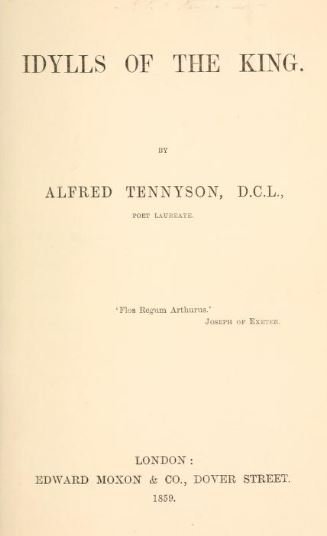
Front page of “Idylls of the King”
Mark Twain’s A Connecticut Yankee in King Arthur’s Court (1889)
Mark Twain provided a satirical take on Arthurian legend in A Connecticut Yankee in King Arthur’s Court, critiquing medieval romanticism through the lens of modernity. His work marked an early example of Arthurian parody and social commentary.
T. H. White’s The Once and Future King (1958)
A pivotal modern retelling, T. H. White’s The Once and Future King reimagined Arthur as a philosophical and flawed ruler. The novel introduced psychological depth to Arthur, Merlin, and other characters, influencing later interpretations in literature and film.
Arthurian Legend in Contemporary Literature and Media
Marion Zimmer Bradley’s The Mists of Avalon (1983)
Marion Zimmer Bradley’s The Mists of Avalon revolutionized Arthurian storytelling by presenting the tale from the perspective of Morgan le Fay and other female characters. This feminist reinterpretation challenged traditional narratives, focusing on themes of power, religion, and gender dynamics.
Modern Adaptations and Popular Culture
Arthurian themes continue to thrive in contemporary literature, film, and television. Works such as Bernard Cornwell’s The Warlord Chronicles offer historical realism, while films like Excalibur (1981) and television series like Merlin (2008-2012) introduce new generations to the legend.
Questions and answers
Who was Geoffrey of Monmouth?
Geoffrey of Monmouth was a Welsh cleric (c. 1100–c. 1155 CE) who transformed historical accounts into a legendary epic, elevating King Arthur from a historical figure to a legendary ruler.
Which earlier chroniclers mentioned a British war leader before Geoffrey?
Earlier chroniclers such as Gildas, Bede, and Nennius documented a British war leader who triumphed over the Saxons at Badon Hill.
What was Geoffrey’s main contribution to the Arthurian legend?
Geoffrey reimagined Arthur with unparalleled brilliance, introducing vivid storytelling, imaginative detail, and dramatic pacing to craft a compelling legendary narrative.
What is Geoffrey’s History of the Kings of Britain about?
It is a chronicle of British rulers from Brut (c. 12th century BCE) to Cadwallader (c. 7th century CE), with Arthur’s story spanning Books 9, 10, and 11.
Geoffrey of Monmouth claimed to have translated his work from an ancient book loaned to him by a friend, though scholars believe much of it was his own invention.
How did Geoffrey portray Arthur in his work?
Geoffrey depicted Arthur as a legendary hero with golden armor, a helmet bearing the Virgin Mary’s emblem, and powerful weapons like the lance Ron and the sword Caliburn.
Who was Arthur’s main adversary in Geoffrey’s account?
Arthur’s main adversary was the Saxon leader Cheldric, later known as Cerdic.
Geoffrey of Monmouth renamed it the Battle of the Bath and reframed it as an offensive campaign against the Saxons rather than a defensive stand.
What role did St. Dubric play in the battle?
St. Dubric, Archbishop of Caerleon, gave a speech before the battle, urging the Britons to fight without fear, promising them divine reward in heaven.
What was the significance of Arthur’s victory in Geoffrey’s account?
Arthur’s victory over the Saxons was not the climax but the beginning of his legendary reign, leading to his conquest of Europe and defiance of Rome.
Which characters did Geoffrey introduce to the Arthurian tradition?
Geoffrey introduced Guinevere, Merlin, Sir Kay, Sir Bedevere, Sir Gawain, Uther Pendragon, and Mordred.
Geoffrey of Monmouth’s work laid the foundation for all future Arthurian literature, influencing every subsequent retelling of the legend.
What distinction exists between Arthurian works before and after Geoffrey?
Arthurian tradition is divided into pre-Galfridian (before Geoffrey) and post-Galfridian (after Geoffrey), emphasizing his lasting influence.
How did Geoffrey’s work influence European literature?
His Latin text spread widely across Europe and inspired poets such as Wace, who introduced the Round Table, and Chretien de Troyes, who introduced Lancelot and the Grail quest.
What was Wace’s contribution to the Arthurian legend?
Wace translated Geoffrey’s work into Old French, added the Round Table, and renamed Arthur’s sword from Caliburn to Excalibur.
What elements did Chretien de Troyes introduce?
Chretien introduced courtly love, the Grail quest, and Sir Lancelot, shaping Arthurian romance.
What did Robert de Boron add to the legend?
Robert de Boron introduced the sword-in-the-stone motif, reinforcing Arthur’s divine right to rule.

A 13th-century French miniature depicting Merlin conveying his visions to his scribe, Blaise, from Robert de Boron’s “Merlin en prose.”
How did the Arthurian legend evolve in the 19th and 20th centuries?
It was revived by Alfred, Lord Tennyson’s Idylls of the King (1859) and further popularized by T. H. White’s The Once and Future King (1958).
Each generation finds inspiration in Arthur as a timeless hero, adapting his story to reflect contemporary values and ideals.





