Pope Clement VI’s reign combined intellectual rigor, political dexterity, and cultural patronage. His response to the Black Death, his defense of persecuted communities, and his architectural and artistic contributions transformed Avignon into a true papal capital. Below, our historians at WHE delve deeper into the the life of this renowned pope.

An image of Pope Clement VI, portrayed in a painting by Italian painter Matteo Giovanetti.
Early Life and Education
Pierre Roger, who would become Pope Clement VI, was born in 1291 at the Château of Maumont in Limousin, France. Originating from a noble family, he grew up alongside several siblings, including Guillaume, who would later benefit politically and economically from Pierre’s rise. His early environment was steeped in aristocratic influence, a factor that later shaped his close alignment with French royal interests during his papacy.
At the age of ten, Roger joined the Benedictine monastic order at the Abbey of La Chaise-Dieu, where he spent formative years in spiritual and academic preparation. Recognized for his intellectual promise, he pursued advanced studies at the University of Paris, where he studied theology and canon law for over a decade. His teachers and supporters, including Bishop Jean de Cumenis and Abbot Hugues d’Arc, facilitated his academic progress. In 1323, on the recommendation of King Charles IV, he earned his doctorate and became a licensed theological instructor. His education established a firm foundation in Thomistic thought and papal supremacy, preparing him for influential ecclesiastical roles.
Rise in the Ecclesiastical Hierarchy
Pierre Roger quickly ascended within the Church. In 1326, he became Abbot of Fécamp, a prestigious royal monastery. Shortly thereafter, he entered the diplomatic world, representing French interests, including an unsuccessful mission to demand Edward III of England’s homage to the French king. His diplomatic engagements revealed both his political acumen and his growing alignment with French monarchical goals.
In 1328, Roger was appointed Bishop of Arras and a royal counselor. His tenure was brief, as he was swiftly elevated to Archbishop of Sens in 1329 and then to Archbishop of Rouen a year later. As Archbishop of Rouen, Roger confronted significant legal and political challenges, including disputes over fealty to the newly appointed Duke of Normandy. He resolved these tensions diplomatically, reaffirming his allegiance while protecting ecclesiastical privileges.
At various synods and councils, Roger defended the Church’s jurisdiction against encroachments by secular courts. His eloquent rebuttal of Pierre de Cugnières’ anti-clerical proposals during a major assembly in 1329 marked him as a formidable ecclesiastical authority. His influence within the Church and at the royal court expanded steadily.
Cardinalate and Theological Disputes
Pope Benedict XII named Roger a cardinal in 1338. As Cardinal Priest of Santi Nereo e Achilleo, Roger participated in critical theological debates of the era. One major issue was the beatific vision controversy, sparked by Pope John XXII’s claim that the souls of the righteous did not see God until Judgment Day. Though ordered to support the pope’s view, Roger leaned toward traditional doctrine and attempted to moderate John XXII’s position.
This controversy highlighted Roger’s dedication to theological orthodoxy and his balancing act between papal loyalty and theological truth. He also held ecclesiastical councils, including a significant one in Rouen in 1335, where he promoted clerical reform and encouraged participation in crusading efforts.
Election as Pope Clement VI
Following the death of Benedict XII in 1342, the College of Cardinals convened in Avignon. French influence remained dominant, and Roger was elected pope on May 7, 1342. He took the name Clement VI and was crowned on Pentecost Sunday in the Dominican Church of Avignon. His reign immediately signaled a shift toward grandeur, courtly sophistication, and political maneuvering. He viewed the papacy as both a spiritual and temporal monarchy, and he acted accordingly.
Clement was generous to the clerical poor and began reserving Church benefices for his own appointments, claiming papal prerogative. In response to criticisms of his assertive use of power, he reputedly declared that his predecessors did not know how to be pope. This sentiment reflected his ambitious vision of papal authority, both doctrinal and administrative.
Promotion of Family and Supporters
One of Clement’s initial actions as pope was the creation of new cardinals. In September 1342, he appointed ten cardinals, many of whom were his relatives or from his native Limousin. This cemented French dominance in the College of Cardinals and ensured a supportive inner circle. Further appointments in 1344 and 1350 maintained this trend, with French candidates, especially from Clement’s home region, being heavily favored.
His appointments extended beyond the College. He placed trusted family members and allies in various positions of influence across Europe, reinforcing both spiritual and temporal bonds. While criticized for nepotism, Clement believed a stable papal administration required loyal and competent officials, especially during volatile times.
Cultural Patronage and Court Life
Clement VI embraced a lavish lifestyle that contrasted with the austere habits of his predecessor, Benedict XII. He invested heavily in expanding and decorating the papal palace in Avignon, commissioning chapels, grand staircases, and richly adorned halls. His refined tastes extended to music and art. He invited composers like Philippe de Vitry and supported the Ars Nova musical style, which flourished under his patronage.
He also employed painters, including Matteo Giovanetti, to embellish chapels with vibrant scenes from both sacred and courtly life. These efforts transformed Avignon into a vibrant cultural center and demonstrated Clement’s desire to present the papacy as a beacon of spiritual and aesthetic authority.
Responses to the Black Death
Perhaps the most defining event of Clement’s papacy was the Black Death, which reached Avignon in 1348. As plague ravaged Europe, killing millions, Clement remained in Avignon, organizing relief efforts and spiritual care. He reportedly surrounded himself with torches to purify the air, a precaution based on medical theories of the time.
Clement also issued a general absolution of sins for all who died of the plague, recognizing that many passed without the benefit of last rites. He consecrated the Rhône River to serve as a burial ground, as traditional cemeteries overflowed. Despite widespread death, Clement remained uninfected, continuing his pastoral duties and solidifying his reputation as a present and compassionate leader during crisis.
His physicians, including Gui de Chauliac, documented valuable observations about the plague, including its distinct forms. Chauliac’s work became a cornerstone of medieval medical literature.
Protection of Jewish Communities
During the plague, anti-Semitic violence surged as Jewish communities were falsely accused of poisoning wells and causing the disease. Pogroms erupted across Europe. Clement condemned these actions in two papal bulls issued in 1348, affirming the innocence of Jews and warning that they, too, suffered from the plague.
In his bull Quamvis Perfidiam, he denounced the violence as the work of the devil and called on clergy to defend Jewish communities. While the bulls did not prevent all violence, they provided critical moral and theological grounds for protection, showcasing Clement’s willingness to oppose widespread hysteria with reasoned papal authority.
Relations with European Monarchs
Clement VI maintained active diplomacy across Europe. He continued the papacy’s struggle with the Holy Roman Emperor Louis IV, ultimately excommunicating him in 1346. Clement supported the election of Charles IV, whose recognition in 1347 ended a prolonged imperial schism and restored papal influence in Germany.
In Italy, Clement navigated the challenge posed by Cola di Rienzo, a Roman populist who sought to restore republican governance. Initially supported by Clement, Cola’s growing power and populism eventually led to his excommunication and ouster. This incident highlighted the limits of papal authority in Italy during the Avignon Papacy.
Clement also intervened in the dynastic conflict in Naples, ultimately acquitting Queen Joanna I in a papal trial. He used the opportunity to purchase the city of Avignon from Joanna in 1348, securing it as papal territory and ensuring the continued presence of the Curia in France.
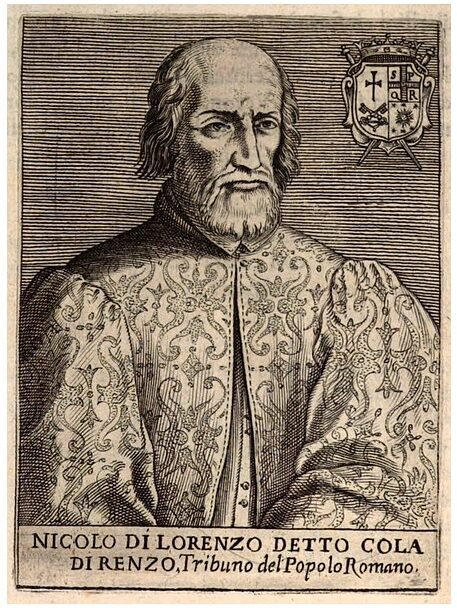
Cola di Rienzo
Eastern and Northern Policies
Clement also engaged with eastern Christian and Muslim powers. He proclaimed a crusade to recover the city of Smyrna from Turkish control. The campaign succeeded in capturing the city in 1344, and Latin Christians held it for several decades. His attempts to negotiate religious union with the Armenians and the Byzantine Empire were unsuccessful, but they reflected his broader vision of Catholic expansion.
In Central and Eastern Europe, Clement addressed ecclesiastical and political disputes. In Poland, he warned King Casimir III against persecuting the Church. In Bohemia, he elevated Prague to archiepiscopal status in 1344, granting it ecclesiastical independence and enabling its archbishop to crown kings. These moves strengthened Church authority in contested regions and deepened ties with local monarchs.
Theological and Legal Innovations
Clement’s bull Unigenitus, issued in 1343, formalized papal power in granting indulgences and shortened the interval between Jubilees from a century to fifty years. This doctrinal development became a key reference in later theological disputes, especially during the Reformation. Clement’s articulation of papal authority in this context reinforced his broader emphasis on centralized ecclesiastical control.
He also oversaw legal reforms within the Curia, expanded the responsibilities of papal courts, and supported efforts to compile canon law more systematically. Though not a theologian of originality, Clement was a decisive administrator who reshaped the legal framework of the Church.
Death and Legacy
Clement VI died on December 6, 1352, after suffering from kidney stones and an abscess. His death marked the end of a pontificate defined by cultural flourishing, political assertiveness, and spiritual leadership during crisis. He was temporarily buried in Avignon but later reinterred at the Abbey of La Chaise-Dieu in a lavish tomb surrounded by statues of his family. The tomb was later desecrated during the Wars of Religion, but the central sarcophagus survived.
Though criticized for nepotism and opulence, Clement was remembered as a generous patron, a capable leader, and a man who did not shy away from controversy. He left the papacy more centralized, culturally vibrant, and politically influential than he had found it.

Frequently Asked Questions about Pope Clement VI
What was Pope Clement VI’s response to the Black Death?
During the Black Death (1348–1350), Clement VI granted remission of sins to all who died from the plague, consecrated the Rhône River for mass burials, and remained in Avignon to supervise relief and care for the sick, showing exceptional leadership during the crisis.
How did Clement VI influence the arts and music?
Clement VI patronized the arts and promoted the Ars Nova musical style by recruiting composers and theorists, notably Philippe de Vitry. He also commissioned elaborate artwork and tapestries for the papal palace, transforming Avignon into a cultural hub.
What was Clement VI’s stance on accusations against Jews during the plague?
He issued bulls in 1348 condemning anti-Jewish violence, asserting that Jews were not to blame for the plague and had suffered from it like others. He urged protection for Jewish communities against baseless persecution.
How did Clement VI shape the College of Cardinals?
Clement VI significantly expanded and reshaped the College by appointing numerous French cardinals, many of whom were his relatives or from Limousin, strengthening French dominance in the Church’s leadership.
What role did Clement VI play in imperial politics?
He excommunicated Holy Roman Emperor Louis IV in 1346 and supported Charles IV’s election to end the imperial schism. His actions reinforced papal influence over imperial affairs.
How did Clement VI respond to Cola di Rienzo’s rise in Rome?
Although he initially supported Cola di Rienzo, Clement later excommunicated him when his populist rule threatened papal authority, helping to remove him from power in late 1347.

Pope Clement VI’s tomb
What contributions did Clement VI make to Church structure and doctrine?
He issued the bull Unigenitus in 1343, affirming papal authority over indulgences and reducing the interval between Jubilee years. This document later played a role in Reformation-era debates.
What were Clement VI’s final years and legacy like?
Suffering from illness, Clement VI died in December 1352. Remembered as generous and cultured, he was buried at La Chaise-Dieu in an elaborate tomb. Though not a saint, he left a legacy of cultural patronage, political activism, and decisive leadership.





