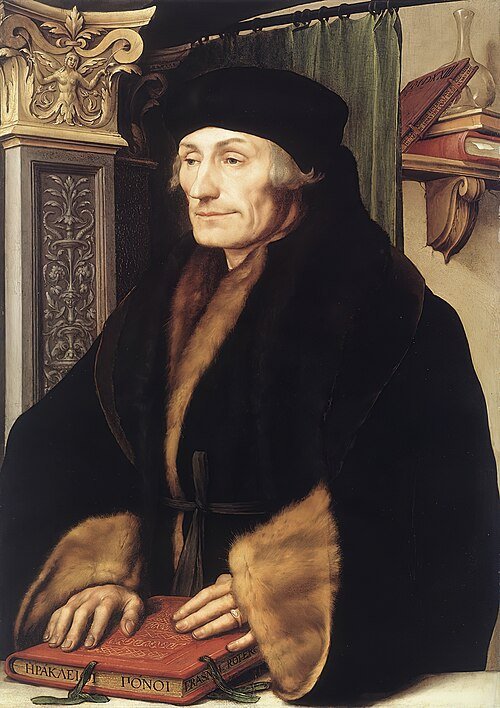
Portrait of Erasmus, painted by the German-Swiss artist Hans Holbein the Younger in 1523.
Picture this scene: It’s the early 1500s, the Renaissance is in full swing, and scholars across Europe are rediscovering the classical world. Enter Desiderius Erasmus, a Dutch humanist with an insatiable appetite for ancient texts. But Erasmus wasn’t just another scholar buried in dusty manuscripts—he had a vision. He wanted to collect the wisdom of the ancients, distill it, and make it useful for his own time. His tool of choice? The proverb.
This is how Adagia was born—a brilliant and evolving collection of Greek and Latin proverbs, gathered, explained, and often expanded into essays. What started as a slim book in 1500 grew over decades into one of the most ambitious intellectual projects of the Renaissance.
From a Modest Volume to a Towering Collection
The first version of Adagia was printed in Paris in 1500. It was called Collectanea Adagiorum, and it had over 780 entries—concise, elegant, and rich in classical references. But Erasmus wasn’t done. After a stay in Italy, which gave him access to even more ancient works and scholarly circles, he released a much-expanded version in 1508 called Adagiorum chiliades tres, or “Three Thousands of Proverbs.”
By the time of his death in 1536, the collection had grown to over 4,000 proverbs, complete with detailed notes, cultural context, and philosophical reflections. This wasn’t just a reference book—it was a living, breathing monument to classical wisdom.
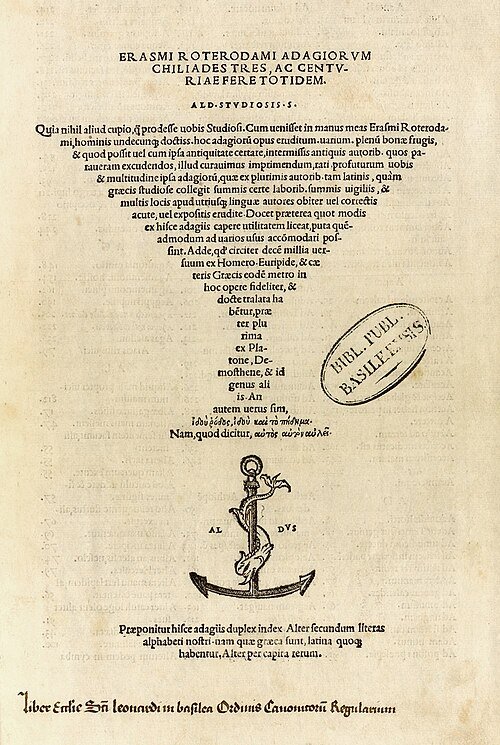
Title page of the 1508 edition, printed by Aldus Manutius.
Proverbs That Still Sound Familiar
One of the coolest things about Erasmus’ Adagia is how relevant many of the sayings still feel. Even if you’ve never read Erasmus, chances are you’ve heard dozens of these proverbs—or even use them without realizing their ancient roots.
Take a look:
-
The blind leading the blind
-
Between a rock and a hard place
-
To call a spade a spade
-
A rolling stone gathers no moss
-
Rome wasn’t built in a day
-
Time heals all wounds
-
Where there’s life, there’s hope
-
Kill two birds with one stone
-
Necessity is the mother of invention
-
Prevention is better than cure
These are just a few of the hundreds of timeless expressions Erasmus collected, translated, and explored. Some originated in Greek philosophy, others in Roman poetry, and many more came from Aesop’s fables—he included seventy from Aesop alone.
Erasmus didn’t just translate; he often reframed these adages, providing cultural or ethical insights, drawing parallels with Christian thought, or even using them to critique society and politics. That’s where the Adagia really shines—it’s more than a list. It’s a conversation with antiquity.
A Humanist Vision of Classical Wisdom
Now, to understand Adagia, you’ve got to understand something about the Renaissance mindset. During the Middle Ages, classical texts were revered but often read narrowly, especially in religious contexts. The Renaissance humanists, like Erasmus, took a broader approach. They believed the wisdom of antiquity was universal—not just theological, but moral, practical, and political.
That’s the spirit that runs through the Adagia. Erasmus didn’t treat the classics as sacred relics. Instead, he treated them as living sources of insight, ripe for reuse and reinterpretation. If something Cicero said could help people be better citizens—or help a prince govern more justly—Erasmus would quote it, expand on it, and make it speak to contemporary concerns.
This attitude—this blending of the old with the new, of ancient learning with Renaissance values—is part of what made Erasmus so influential, and why Adagia became a must-have book for scholars, statesmen, and theologians alike.
Were the Middle Ages that Dark as some historians often describe the period?
More Than Just Sayings: Essays and Commentary
One of the most fascinating parts of Adagia is how deeply Erasmus engages with some of the proverbs. Sure, many entries are brief, just a line or two. But others blossom into mini-essays on everything from friendship to leadership to the morality of war.
For example, the first proverb in the collection is: “Between friends all is common” (Latin: amicorum communia omnia). Erasmus uses this simple phrase to launch a whole discussion about property, generosity, and communal life, pulling in references to Plato, Aristotle, and the early Christians. As someone who had taken a religious vow of poverty, Erasmus was clearly reflecting on this proverb at a personal level, too.
Another standout is “The Sileni of Alcibiades”—a reference to unattractive figures who hide something beautiful inside. Erasmus spins this into a rich metaphor for Christ’s incarnation, for how true value often hides beneath rough appearances, and how judgment based on looks or status is deeply flawed.
Bidden or Unbidden, God is Present
One of the more spiritually poignant adages in the collection is: “Bidden or unbidden, God is present” (Latin: Vocatus atque non vocatus, Deus aderit). This was an old Spartan saying, but Erasmus traces its evolution through Roman thought and eventually into Christian theology. It’s a quietly powerful idea: that the divine is always with us, even when we don’t actively seek it.
This particular proverb was so meaningful that Carl Jung had it inscribed over the door to his study—proof that Adagia’s influence didn’t end in the 16th century.
Why Adagia Mattered So Much
The Adagia wasn’t just a fun read for intellectuals. It was a powerful cultural tool. During Erasmus’ time, quoting classical wisdom wasn’t just scholarly flair—it was a way of arguing, persuading, and establishing authority.
Want to convince a prince to rule more justly? Use Cicero. Want to promote peace? Drop in some Seneca. Want to preach a sermon? Pepper it with Aristotle or Homer—especially if you could show how their ideas aligned with Christian thought.
Books like Adagia helped Renaissance thinkers do just that. They gave them the language of antiquity, repackaged for Renaissance debates. That’s part of why it became one of the most widely read books of the century.
The Influence and the Censorship
Of course, not everyone appreciated all that ancient wisdom. Some of Erasmus’ commentaries were considered too bold or too critical of authority—especially the Church. In later editions of Adagia, particularly the 1537 Venice edition, certain passages were heavily censored by the Jesuits, who went so far as to strike out Erasmus’ name in some copies.
One of the most censored entries was “The Sileni of Alcibiades”. Why? Because its layered symbolism, with its critique of superficial power and false appearances, hit too close to home for some religious and political figures. It’s a classic example of how dangerous wit and wisdom can be when used to question the status quo.
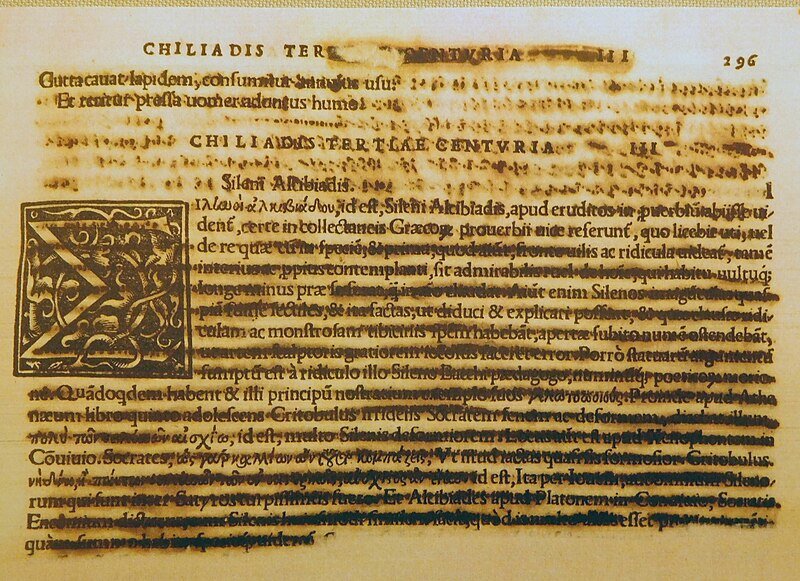
Page 296 of the 1537 edition of “Adagia”, featuring “Sileni Alcibiadis”, heavily censored by the Jesuits.
Neither with bad things nor without them (Women: can’t live with ’em, can’t live without ’em)
Why Erasmus Left Out the Bible
Interestingly, Erasmus originally planned to include Biblical adages in Adagia. That might seem natural, given his religious background. But he eventually decided it was too ambitious a task. The richness and complexity of the Bible deserved a project of its own.
So instead, Erasmus addressed biblical interpretation in separate works like his Annotations on the New Testament and Paraphrases, which offered commentary and translations of the scriptures. Adagia, then, stayed focused on Greek and Roman sources, keeping its identity firmly rooted in classical rather than scriptural tradition.
The Lasting Legacy of Adagia
So why does Adagia still matter? Well, for one, it’s an incredible window into how Renaissance thinkers reimagined the ancient world. But more than that, it’s a reminder of how ideas evolve, travel, and adapt across time.
Thanks to Erasmus, sayings once whispered in Athenian marketplaces or muttered by Roman generals now show up in our everyday language: when we say “Rome wasn’t built in a day” or “don’t look a gift horse in the mouth,” we’re echoing voices from thousands of years ago, passed down through the pen of a Dutch scholar with a deep love for words and wisdom.
And perhaps that’s the heart of Adagia: it’s not just a book of sayings—it’s a celebration of human expression, shared insight, and the enduring hope that by learning from the past, we might just navigate the present a little more wisely.
FREQUENTLY ASKED QUESTIONS
How did the collection evolve over time?
The first edition in 1500 had about 800 entries. By 1536, Erasmus had expanded it to over 4,000 proverbs, each annotated with scholarly and often essay-like commentary.
Why was Adagia significant during the Renaissance?
It reflected the humanist ideal of learning from classical sources and was widely used to support arguments in scholarly, political, and religious discourse.
What are some common sayings that come from Adagia?
Familiar phrases include “The blind leading the blind,” “Kill two birds with one stone,” “Crocodile tears,” and “Rome wasn’t built in a day.”
How did Erasmus use the proverbs?
He often used them as starting points for broader discussions on ethics, friendship, politics, and religion, blending classical wisdom with Renaissance humanist values.
Was the collection ever censored?
Yes, later editions—especially the 1537 Venetian one—were censored by the Jesuits, who objected to some of Erasmus’ more critical or symbolic commentary.
Why did Erasmus exclude Biblical proverbs?
He initially intended to include them but later decided they required separate treatment, which he addressed in his New Testament annotations and paraphrases.
What lasting impact has Adagia had?
It helped preserve and popularize classical wisdom, influenced Renaissance thought, and introduced many expressions still used in modern languages today.





