Fables by Ancient Greek Storyteller and Slave Aesop
Aesop’s Fables is a collection of stories attributed to Aesop, a storyteller and slave who lived in ancient Greece around the 6th century BCE. These fables are short narratives that convey moral lessons, often through the interactions of animals with human traits, but sometimes featuring humans, gods, or mythical creatures.
Below, World History Edu explores how over centuries these stories have transcended cultural boundaries to become part of global oral and written traditions.
Origins of Aesop’s Fables
The historical existence of Aesop remains a subject of debate among scholars. Ancient sources, including Herodotus and Aristotle, describe Aesop as a slave of remarkable intelligence and wit. Though details of his life are scarce and often mythical, he is commonly believed to have lived during the 6th century BCE in ancient Greece, possibly originating from Phrygia, Ethiopia, or Thrace.
Some accounts suggest that Aesop gained his freedom through his wit and storytelling skills, while others portray him as a wandering figure who used his tales to critique social norms, expose human flaws, and challenge authority. The lack of concrete evidence about Aesop’s life has allowed his persona to become as mythical as the tales attributed to him.

The opening page of the 1485 Italian edition of Aesopus Moralisatus, a moralized collection of Aesop’s fables.
Compilation and Transmission
Aesop’s Fables were initially part of an oral tradition, shared and adapted across regions. They were later compiled and written down by various authors over centuries. The earliest written collection is attributed to Demetrius of Phalerum, a Greek orator of the 4th century BCE. Later, during the Roman era, Phaedrus and Babrius translated and expanded upon the fables, solidifying their popularity in the ancient world.
Medieval and Renaissance adaptations ensured their preservation and proliferation across Europe. Today, modern editions and translations have further spread Aesop’s Fables worldwide.
Structure and Style
Aesop’s Fables are concise, rarely exceeding a few paragraphs. Their simplicity makes them accessible to audiences of all ages and backgrounds.
Key structural elements include:
- Anthropomorphism: Animals and inanimate objects often act and speak like humans, allowing for relatable and engaging narratives.
- Conflict and Resolution: Each fable centers on a conflict or dilemma, leading to a clear resolution that emphasizes the moral.
- Implicit Morals: While some fables state the moral explicitly, others leave it for the audience to infer, encouraging reflection and interpretation.

Diego Velázquez’s Portrait of Aesop, housed in the Prado Museum.
Examples of Common Characters
- The Fox: Often cunning or deceptive, as seen in The Fox and the Grapes.
- The Lion: Symbolizing power or pride, featured in stories like The Lion and the Mouse.
- The Hare: Representing arrogance or impulsiveness, such as in The Tortoise and the Hare.
- The Ant and Grasshopper: Contrasting diligence and idleness.
Major Themes in Aesop’s Fables
Moral and Ethical Lessons
The primary purpose of Aesop’s Fables is to teach moral lessons. These lessons often address universal human experiences, such as:
- Honesty and Integrity: The Boy Who Cried Wolf warns against lying and its consequences.
- Hard Work and Preparation: The Ant and the Grasshopper emphasizes the value of diligence and planning for the future.
- Humility and Gratitude: The Lion and the Mouse illustrates how even the smallest beings can offer help.

A depiction of Aesop (left) by Francis Barlow, featured in the 1687 edition of “Aesop’s Fables with His Life”, highlighting the enduring legacy of the ancient storyteller during the late 17th century.
Critique of Human Nature
Aesop’s Fables often serve as a mirror, reflecting the follies, weaknesses, and vices of human nature:
- Greed and Selfishness: In The Goose That Laid the Golden Eggs, greed leads to the destruction of a valuable resource.
- Pride and Arrogance: The Tortoise and the Hare highlights the dangers of overconfidence.
- Deception and Trust: The Fox and the Crow showcases how flattery can manipulate and deceive.
Power and Justice
Many fables explore dynamics of power, inequality, and justice:
- The Wolf and the Lamb reveals the arbitrary nature of power and the victimization of the weak.
- The Lion’s Share critiques greed and the exploitation of the powerless.
Survival and Adaptability
Several fables underscore the importance of wit, resourcefulness, and adaptability in overcoming challenges:
- The Town Mouse and the Country Mouse contrasts the risks and rewards of different lifestyles.
- The Crow and the Pitcher demonstrates ingenuity and problem-solving.
Cultural and Educational Significance
Aesop’s Fables have remained relevant for over two millennia, largely due to their universality and adaptability. Their moral lessons resonate across cultures, addressing timeless questions about human behavior, ethics, and society.
These fables have long been used as tools for teaching children moral values, critical thinking, and language skills. Their brevity and engaging storytelling make them effective for introducing ethical dilemmas and encouraging discussion. Additionally, the use of animal characters allows children to explore sensitive topics indirectly.
Aesop’s Fables have inspired countless works of literature, art, and philosophy. Writers such as Jean de La Fontaine, Ivan Krylov, and Ambrose Bierce drew from Aesop’s tradition to create their own fables. Artists and illustrators have brought the stories to life through visual interpretations, enriching their appeal.
Criticism and Interpretations
Critics argue that the simplicity of Aesop’s Fables sometimes oversimplifies complex moral and ethical dilemmas. The binary portrayal of right and wrong may not account for the nuances of real-world situations.
Some fables reflect values and attitudes specific to ancient Greek society, which may not align with contemporary norms. For instance, the hierarchical view of power in fables like The Wolf and the Lamb may seem outdated in modern contexts.
Many stories attributed to Aesop may not have been his original creations. The fables’ long history of oral and written transmission means they have been adapted and modified, making it difficult to determine their true origins.
Selected Fables and Their Lessons
The Fox and the Grapes
- Summary: A hungry fox tries to reach a bunch of grapes but cannot. Frustrated, he declares the grapes sour and walks away.
- Moral: It’s easy to despise what you cannot have.
- Lesson: The fable critiques rationalization and the tendency to belittle what is unattainable.
The Tortoise and the Hare
- Summary: A hare ridicules a tortoise for being slow. They race, and the tortoise wins because of the hare’s overconfidence and laziness.
- Moral: Slow and steady wins the race.
- Lesson: The story emphasizes perseverance and the pitfalls of arrogance.
The Ant and the Grasshopper
- Summary: A hardworking ant prepares for winter while a carefree grasshopper sings and dances. When winter arrives, the grasshopper regrets not working.
- Moral: Prepare today for tomorrow’s needs.
- Lesson: The fable underscores the value of hard work and foresight.
The Lion and the Mouse
- Summary: A lion spares a mouse’s life. Later, the mouse saves the lion by gnawing through a hunter’s net.
- Moral: No act of kindness is ever wasted.
- Lesson: The story highlights the interdependence of all beings, regardless of size or strength.
The Boy Who Cried Wolf
- Summary: A shepherd boy repeatedly tricks villagers by pretending a wolf is attacking his flock. When a wolf actually appears, no one believes him.
- Moral: Liars are not believed even when they tell the truth.
- Lesson: The fable warns against dishonesty and its long-term consequences.
Legacy of Aesop’s Fables
Aesop’s Fables have been translated into numerous languages and adapted into various cultural contexts, demonstrating their universal appeal. They are part of the literary heritage of countries as diverse as India, China, and the United States.
The fables have inspired plays, films, cartoons, and educational programs. Modern adaptations often update the settings and characters to reflect contemporary values while preserving the original morals.
Philosophical and Psychological Insights
Beyond their moral lessons, Aesop’s Fables offer insights into human psychology and behavior. The use of allegory and symbolism allows for multiple interpretations, making the fables relevant to diverse philosophical and ethical discourses.
Questions and Answers about the Aesop’s Fables

A Greek manuscript containing the fables of Babrius.
Who was Aesop, and what is he known for?
Aesop was a former Greek slave, traditionally believed to have lived in the mid to late 6th century BCE. He is known for creating a collection of morality tales, Aesop’s Fables, which use allegorical storytelling to teach moral lessons.
How were Aesop’s Fables originally shared?
The fables were originally shared orally, serving both as entertainment and as a means to teach morals and life lessons. They later transitioned into written form between the 10th and 16th centuries CE.
What themes are commonly depicted in Aesop’s Fables?
The fables highlight both desirable and undesirable human behaviors, offering moral guidance on what to emulate or avoid. They frequently critique human flaws and promote lessons about ethics, wit, and resourcefulness.
What role do animals play in Aesop’s Fables?
Animals in Aesop’s Fables are anthropomorphic, displaying human traits such as speech and behavior. They often serve as allegories for human situations, allowing audiences to reflect on moral lessons in an engaging and indirect way.
How do Aesop’s Fables differ from earlier Sumerian proverbs?
Both use animal characters and concise storytelling to convey practical advice. However, Aesop’s Fables evolved into narratives with clear morals, while Sumerian proverbs often focused on general wisdom without explicit lessons.
Why did Aesop avoid restricting animals to specific traits?
Aesop avoided strict stereotypes (e.g., the fox always being cunning) to allow animals to appear in different tales, playing varied roles and exhibiting diverse behaviors, making the stories more flexible and universal.
How were Aesop’s Fables used in Greek education?
The fables were used to teach children reading, writing, and ethical reasoning. They introduced young learners to life lessons through relatable and engaging narratives.
How did Aesop’s Fables serve as political tools?
During times of authoritarian rule, the fables provided a subtle way to critique leadership and societal norms. They allowed the powerless to challenge authority through allegory without fear of reprisal.
What did Aristotle say about the use of fables?
Aristotle praised fables in his Rhetoric, suggesting they were effective tools for persuasion, especially when concrete evidence was unavailable to support an argument.
How did Aesop’s Fables contribute to entertainment and reflection?
The fables entertained while teaching valuable lessons. They allowed children to explore adult themes in a relatable way and offered Greek society opportunities for self-reflection on cultural and moral shortcomings.
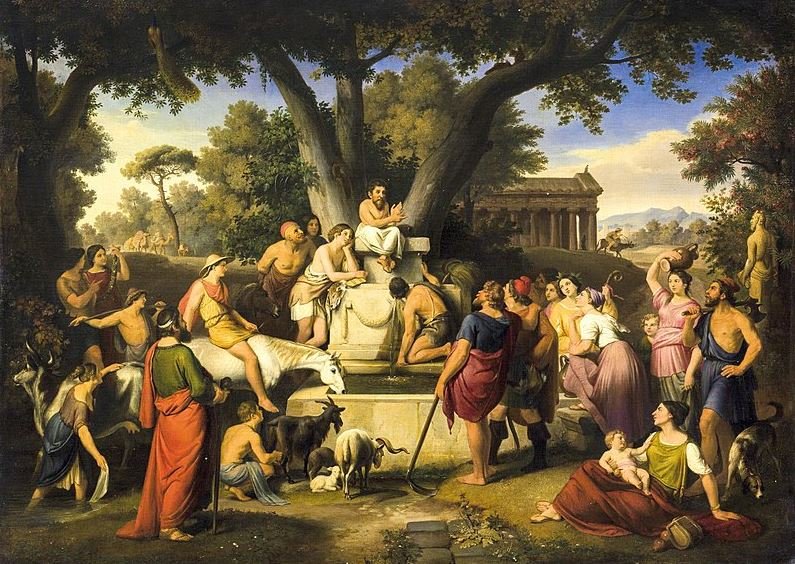
Diego Velázquez’s Portrait of Aesop, housed in the Prado Museum. Its titled “Aesop Tells His Fables”.
What is the moral of The Serpent and the Eagle?
The moral is: “One good turn deserves another.” The story emphasizes reciprocity and gratitude in helping others.
What lesson does The Horse and the Groom teach?
The moral is: “A man may smile yet be a villain.” It warns against trusting appearances and highlights the danger of deceit.
What does The Ant and the Grasshopper illustrate?
The moral is: “It is best to prepare for the days of necessity.” The fable teaches the importance of hard work and planning for the future.





