Julia Agrippina the Younger (AD 15–59) was a formidable Roman empress and mother of Emperor Nero. Daughter of Germanicus and sister of Caligula, she married Emperor Claudius, securing Nero’s succession by adopting him as heir. Influential during Nero’s early reign, her power waned as he asserted authority, ultimately leading to her assassination by her son.
Summary
Julia Agrippina the Younger (AD 15–59) was the mother of Emperor Nero and a significant influence during his early reign (54–68). Daughter of Germanicus Caesar and Vipsania Agrippina, she was sister to Emperor Caligula and wife of Emperor Claudius.
In AD 39, she was exiled for conspiring against Caligula but returned in AD 41. Her first husband, Gnaeus Domitius Ahenobarbus, fathered Nero. In AD 49, suspected of poisoning her second husband, she married Claudius, her uncle, and secured Nero’s adoption as heir.
As Augusta, she supported advisors Seneca and Burrus. After Claudius’s suspected poisoning in AD 54, she acted as regent until Nero asserted control. Opposing Nero’s affair with Poppaea Sabina, Nero orchestrated her murder in AD 59 by inviting her to Baiae and ultimately killing her at her villa.
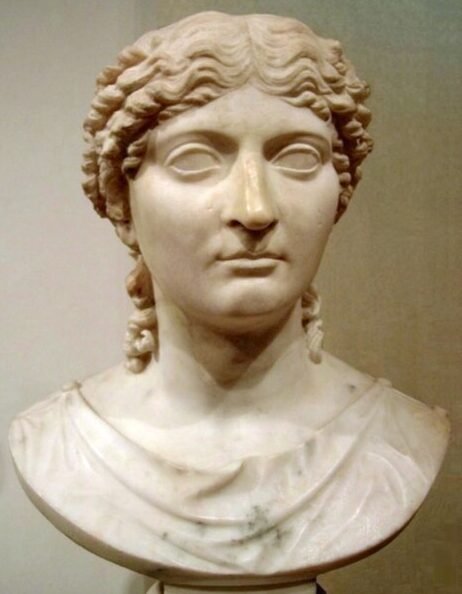
Julia Agrippina the Younger (November 6, AD 15 – March 23, AD 59) was a key Roman empress from AD 49 to 54. She was both the niece and fourth wife of Emperor Claudius and the mother of Emperor Nero. Image: A bust at the National Museum, Warsaw
Early Life and Family Background

After the death of Tiberius’ son, Drusus the Younger, in AD 23, Agrippina the Elder’s sons were elevated to heirs of the emperor.
Julia Agrippina the Younger, born on November 6, AD 15, was a central figure in the Julio-Claudian dynasty, the first imperial family of Rome.
She was the first daughter and fourth child of Agrippina the Elder and the renowned Roman general Germanicus. Agrippina’s lineage was exceptionally prestigious, positioning her at the heart of Roman elite society.

Germanicus – Agrippina the Elder’s husband
Her ancestry connected her directly to some of Rome’s most influential figures: she was the great-granddaughter of Augustus, Rome’s first emperor, through her mother Agrippina the Elder, who was the daughter of Marcus Vipsanius Agrippa and Julia the Elder.

Agrippina the Elder
On her father’s side, she was a descendant of both Augustus and Mark Antony, as Germanicus was the son of Antonia Minor and Nero Claudius Drusus. This illustrious heritage afforded Agrippina significant status and influence from an early age.
Agrippina grew up in a politically charged environment, surrounded by influential relatives and siblings who would later ascend to power. Her family included three elder brothers—Nero Caesar, Drusus Caesar, and Caligula, who would become emperor—and two younger sisters, Julia Drusilla and Julia Livilla. The family’s prominence was both a source of prestige and vulnerability, as political intrigues and power struggles often threatened their safety and positions.

Caligula’s younger sisters (L-R): Agrippina the Younger, Julia Drusilla, and Julia Livilla.
Tragedies and Political Intrigue
Agrippina’s early life was marked by significant familial tragedies. The machinations of Lucius Aelius Sejanus, the ambitious Praetorian Prefect under Emperor Tiberius, led to the untimely deaths of her two eldest brothers, Nero Caesar and Drusus Caesar, as well as her mother, Agrippina the Elder. These losses deeply impacted the family and heightened the precariousness of their position within the Roman political landscape.
Despite these setbacks, Agrippina remained a resilient and influential figure. After the death of her parents, she and her siblings were placed under the care of their paternal grandmother, Antonia Minor, and their great-grandmother, Livia Drusilla. This guardianship by strong matriarchs provided Agrippina with the guidance and support necessary to navigate the complexities of Roman aristocratic life.
Marriage to Gnaeus Domitius Ahenobarbus

Bust of Gnaeus Domitius Ahenobarbus, Agrippina the Younger’s first spouse
In AD 28, Agrippina entered into a politically advantageous marriage arranged by Emperor Tiberius. She married her first cousin once removed, Gnaeus Domitius Ahenobarbus, a member of a respected consular family. This union was strategic, aimed at strengthening familial alliances within the Roman elite. Gnaeus Domitius Ahenobarbus was connected to prominent figures, including being the first cousin to Claudius, who would later become emperor.
The marriage produced a son, Lucius Domitius Ahenobarbus, who would later ascend to the imperial throne as Emperor Nero. Despite the political nature of their union, historical records offer limited insight into the personal dynamics between Agrippina and Domitius. Nonetheless, Domitius’s death in AD 40 left Agrippina a wealthy and influential widow, further enhancing her standing and resources within Roman society.
Rise to Power During Caligula’s Reign
Agrippina’s political acumen became particularly evident during the reign of her brother Caligula, who ascended to the emperor’s throne in AD 37. Caligula’s rule was characterized by erratic behavior and increasing autocracy, which ultimately led to his assassination in AD 41. The assassination created a power vacuum that Agrippina skillfully navigated to maintain her family’s influence.

Emperor Caligula – the third Roman emperor, ruling from 37 to 41 – was the son of Agrippina the Elder
Following Caligula’s death, Agrippina’s uncle, Claudius, became emperor. Recognizing the precariousness of her position, Agrippina adeptly maneuvered within the imperial court to safeguard her son’s future. Her strategic thinking and alliances ensured that her family remained central to the governance of the empire despite the frequent shifts in power dynamics.

During the reign of Emperor Caligula, coins were issued depicting his three sisters, Drusilla, Livilla, and Agrippina the Younger. Image: Emperor Caligula and his three sisters
Strategic Marriage to Emperor Claudius
In AD 49, Agrippina made a pivotal move by marrying her uncle, Emperor Claudius. This union, though controversial due to the close familial ties, was a calculated strategy to consolidate power and secure her son Nero’s succession to the throne. Marrying Claudius not only elevated Agrippina’s status but also allowed her to exert significant influence over imperial policies and decisions.

Agrippina the Younger was renowned for her beauty, notably her distinctive double canine. Image: Coin of Agrippina and Claudius as the de facto co-rulers of the empire
The marriage was met with widespread disapproval and scandal, as incestuous relationships were frowned upon in Roman society. However, Agrippina leveraged her political savvy to mitigate the backlash, using her marriage to Claudius as a means to further her own ambitions and those of her son. This strategic alliance positioned Agrippina as a key power broker within the imperial court.
Motherhood and Nero’s Ascension
Agrippina’s most significant achievement was ensuring the rise of her son, Nero, to the position of emperor. She orchestrated Nero’s adoption by Claudius, thereby positioning him as the legitimate heir over Britannicus, Claudius’s biological son. This maneuver was crucial in securing Nero’s succession and eliminating Britannicus as a rival claimant.
Agrippina the Younger was suspected of poisoning Claudius, and was ultimately executed by Nero in AD 59.
Agrippina’s influence extended beyond mere familial connections; she actively participated in political decisions and appointed loyalists to key positions within the government. Her ability to manipulate political alliances and her strategic elimination of rivals, such as Lollia Paulina, underscored her determination to secure her son’s future and maintain her own power.

Agrippina the Younger’s portrayal in various cultural and historical narratives continues to captivate audiences, illustrating the enduring fascination with her intelligence, ambition, and the dramatic nature of her rise to power and eventual downfall. Image: Sculpture of Agrippina crowning her young son Nero (c. AD 54–59)
Agrippina as Empress and Augusta
Upon her marriage to Claudius, Agrippina was granted the honorific title of Augusta in AD 50, signifying her elevated status and official recognition as empress. This title placed her on par with other prominent women in Roman society, granting her a platform to exert substantial influence alongside Claudius.
As Augusta, Agrippina wielded significant power within the empire. She appeared on coins and had statues erected in her honor, symbolizing her prominent role in Roman society. Her presence in the Senate and her ability to influence imperial decisions demonstrated her effective control over political matters. Agrippina’s actions during this period were pivotal in shaping the early years of Nero’s reign, ensuring that he was firmly established as the rightful successor to Claudius.
Political Maneuvering and Elimination of Rivals
Agrippina’s rise to power was marked by her adept political maneuvering and strategic elimination of rivals. She identified and removed individuals who posed threats to her influence or her son’s succession. This included orchestrating the downfall of Lollia Paulina, a rival for Claudius’s favor, by accusing her of black magic and other misdemeanors. Such tactics were instrumental in consolidating Agrippina’s power and eliminating obstacles in her path.
Additionally, Agrippina influenced the appointment of loyalists to key governmental positions, ensuring that her allies held significant power within the empire. Her ability to manipulate political structures and her relentless pursuit of her objectives underscored her formidable presence within the Roman political landscape.
Influence During Nero’s Early Reign
Agrippina’s influence reached its zenith during the early years of Nero’s reign. As Nero ascended to the throne in AD 54, Agrippina continued to play a pivotal role in governing the empire. She was actively involved in administrative decisions, foreign policy, and the appointment of officials. Her influence was symbolized by her presence on imperial coins and statues, as well as her participation in state ceremonies and events.
Agrippina’s ability to maintain control alongside Claudius and later during Nero’s early reign demonstrated her exceptional political skills and her capacity to wield power in a male-dominated society. Her strategic positioning of loyalists and her manipulation of political alliances ensured that Nero’s initial years as emperor were stable and prosperous.
READ MORE: Atrocities committed by Emperor Nero
Deterioration of Relationship with Nero
Despite her significant influence, Agrippina’s relationship with Nero began to deteriorate as he matured and sought to assert his independence. Initially, Agrippina held considerable sway over Nero’s decisions, but as he grew older, he increasingly viewed her as a threat to his authority. This shift in dynamics led to a power struggle between mother and son, ultimately culminating in Agrippina’s downfall.
Nero’s desire for autonomy and his perception of Agrippina’s continued influence as overbearing and obstructive fueled the growing tension. Agrippina’s attempts to maintain her role in governing the empire were met with resistance from Nero, who sought to establish his own authority separate from his mother’s shadow.
Agrippina’s Downfall and Murder
The escalating conflict between Agrippina and Nero reached its climax in AD 59, leading to Agrippina’s assassination. Historical accounts of her death vary, but they consistently depict Nero’s determination to eliminate his mother as a means to secure his sole control over the empire.
Tacitus describes a failed assassination attempt involving a self-sinking boat, followed by a brutal attack that ultimately resulted in her death. Suetonius recounts multiple failed attempts, including poisoning and mechanical traps, before Nero successfully orchestrated her murder. Cassius Dio emphasizes Nero’s relentless efforts to remove Agrippina, highlighting his intent to consolidate power without her influence.
Regardless of the exact method, Agrippina was systematically removed from power through Nero’s calculated actions. Her murder marked the end of her significant influence in Roman politics and solidified Nero’s position as the sole emperor, free from his mother’s overshadowing presence.
Legacy and Historical Perception
Julia Agrippina the Younger’s legacy is multifaceted and continues to be a subject of historical debate. Ancient sources often portrayed her as manipulative, power-hungry, and ruthless, reflecting the biases of their authors who were critical of her role in Nero’s rise. These accounts emphasized her strategic elimination of rivals and her relentless pursuit of power, painting her in a predominantly negative light.
However, modern historians offer a more nuanced perspective, recognizing Agrippina as a formidable woman who navigated a complex and male-dominated political landscape with intelligence and determination. Her ability to secure her son’s succession and maintain significant influence within the empire underscores her exceptional political acumen and resilience.
Agrippina’s contributions to the establishment of Roman colonies, notably the foundation of Colonia Claudia Ara Agrippinensium (modern-day Cologne), highlight her lasting impact on the empire’s expansion and infrastructure. Her strategic marriages and political maneuvers exemplify her role as a key player in the Julio-Claudian dynasty, shaping the course of Roman history through her actions and decisions.
Agrippina’s Role in Roman Politics
Agrippina’s role in Roman politics was both influential and transformative. As empress, she actively participated in the administration of the empire, influencing decisions related to governance, foreign policy, and internal affairs. Her strategic appointments of loyalists to key positions ensured that her influence was felt across various levels of the government.
Agrippina’s ability to navigate the intricate and often treacherous political environment of ancient Rome demonstrated her exceptional skills in diplomacy and statecraft. Her strategic alliances and political maneuvers were instrumental in maintaining her family’s dominance within the empire, showcasing her as a masterful political operator.
Influence on Imperial Succession
One of Agrippina’s most significant contributions was her role in shaping the imperial succession. By ensuring Nero’s adoption by Claudius, Agrippina effectively secured his position as the rightful heir to the throne. This strategic move not only eliminated Britannicus as a rival but also established Nero’s legitimacy and authority as emperor.
Agrippina’s influence extended to her strategic marriages and alliances, which were carefully orchestrated to reinforce her family’s standing and secure Nero’s future. Her ability to manipulate imperial succession demonstrates her profound impact on the political structure of the Roman Empire, highlighting her as a key architect of its leadership dynamics.
Agrippina’s Political Alliances and Support Networks
Agrippina’s success in maintaining and expanding her influence was largely due to her adeptness at forming and leveraging political alliances. She established strong relationships with key figures within the imperial court, including loyalists and influential officials who supported her objectives. Her appointment of trusted individuals to important positions ensured that her policies and decisions were effectively implemented.
These alliances were crucial in consolidating her power and protecting her interests within the volatile environment of Roman politics. Agrippina’s ability to cultivate and maintain a robust support network underscored her strategic prowess and her capacity to navigate the complexities of political power.
Agrippina’s Impact on Women in Roman Society
Agrippina the Younger’s prominent role in Roman politics challenged the traditional expectations of women in ancient Rome. While women were generally expected to play supportive roles within the family and society, Agrippina defied these norms by actively participating in political decision-making and wielding significant influence over imperial affairs.
Her assertive presence in the political sphere demonstrated the potential for women to exercise power and agency within the constraints of Roman societal structures.
Agrippina’s legacy, therefore, extends beyond her political achievements to encompass her role as a pioneering figure for women in leadership positions within the Roman Empire.
READ MORE: Most Renowned Roman Emperor and their Accomplishments
Frequently Asked Questions
A prominent member of the Julio-Claudian dynasty, Agrippina was Augustus’s great-granddaughter and daughter of the general Germanicus. Ambitious and influential, Agrippina the Younger orchestrated Nero’s ascent to power. Image: Sculpture of Agrippina crowning her young son Nero (c. AD 54–59)
When and where was Julia Agrippina the Younger born?
She was born on November 6, AD 15, at Oppidum Ubiorum (present-day Cologne, Germany), though some sources suggest Trier in Gaul.
Who were Agrippina’s parents and notable siblings?
Her parents were Agrippina the Elder and the general Germanicus. She had three elder brothers—Nero Caesar, Drusus Caesar, and Caligula—and two younger sisters, Julia Drusilla and Julia Livilla.
What significant tragedies affected Agrippina’s early family life?
Her two eldest brothers, Nero Caesar and Drusus Caesar, along with her mother, were killed due to the intrigues of Lucius Aelius Sejanus.
Describe Agrippina’s ancestry and its significance.
Agrippina was the great-granddaughter of Augustus through her mother and a direct descendant of both Augustus and Mark Antony through her father Germanicus, placing her prominently within Roman elite society.
Who was Agrippina’s first husband, and who was their notable child?
She married Gnaeus Domitius Ahenobarbus in AD 28, and they had a son, Lucius Domitius Ahenobarbus, who later became Emperor Nero.
How did Agrippina navigate the political landscape during Emperor Claudius’s reign?
She married her uncle Claudius in AD 49, strategically securing power and ensuring her son Nero’s succession by manipulating political alliances and eliminating rivals.
What title was Agrippina granted in AD 50, and what did it signify?
She was bestowed the honorific title of Augusta, reflecting her elevated status and significant influence alongside Emperor Claudius.
How did Agrippina influence Nero’s rise to power?
She orchestrated Nero’s adoption by Claudius, positioned him as the rightful heir over Britannicus, and manipulated political alliances to secure his succession.
What led to the deterioration of Agrippina’s relationship with Nero?
As Nero sought independence, he perceived Agrippina as a threat to his authority, leading to a power struggle that culminated in her murder in AD 59.
How do ancient historians describe Agrippina’s death?
Accounts vary: Tacitus describes a failed assassination via a self-sinking boat followed by a brutal attack, Suetonius recounts multiple failed attempts before Nero succeeds, and Cassius Dio emphasizes Nero’s determination to eliminate her.
What is Agrippina’s legacy in Roman history?
She is viewed as a formidable and influential woman who navigated a male-dominated political landscape to secure her family’s legacy, though ancient sources often portrayed her negatively due to biases.





