Julio-Claudian Dynasty: Origin Story and Key Figures
The Julio-Claudian Dynasty was the first imperial dynasty of the Roman Empire, reigning from 27 BC, when Augustus established the empire, until AD 68, when Nero, the last emperor of the dynasty, died. This period, spanning over 90 years, is marked by the reigns of five emperors: Augustus, Tiberius, Caligula, Claudius, and Nero. These emperors were connected by blood, marriage, and adoption, forming a complicated family web that tied together two prominent Roman families, the Julii and the Claudii. The Julio-Claudian Dynasty played a crucial role in shaping the early Roman Empire, leaving behind a legacy of political innovation, territorial expansion, and imperial consolidation, despite being marred by internal conflict, political intrigue, and moral decline.
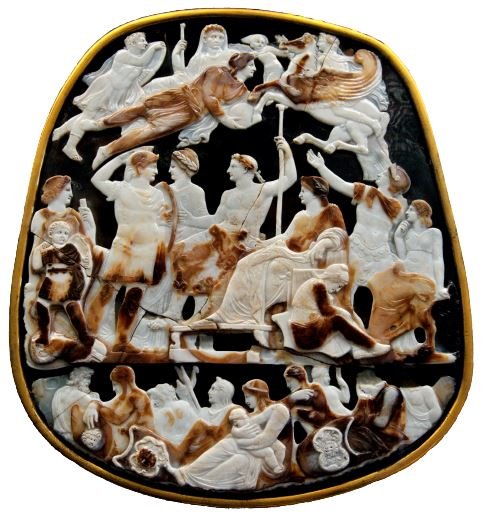
The Julio-Claudian dynasty ruled from the establishment of the Roman Empire by Augustus in 27 BC until the death of Nero in AD 68. Image: The Great Cameo of France showing emperors Nero, Augustus,Claudius, & Tiberus.
The Origins of the Julio-Claudian Dynasty
The origins of the Julio-Claudian Dynasty lie in two of Rome’s most influential patrician families: the Julii and the Claudii. The Julii traced their lineage back to Aeneas, the mythical Trojan War hero, and were well-established in Roman politics. Julius Caesar, the most famous member of the Julian family, played a pivotal role in transforming the Roman Republic into the Roman Empire through his conquests and political reforms. However, it was not Caesar but his great-nephew and adopted son, Gaius Octavius, better known as Augustus, who founded the Julio-Claudian dynasty.
The Claudii were another powerful family with a long history of military and political prominence in the Roman Republic. The merger of the Julian and Claudian families was facilitated by Augustus’ marriage to Livia Drusilla, a member of the Claudian family, bringing the two lineages together and forming the foundation of the dynasty.
Augustus: The Founder of the Roman Empire (27 BC – AD 14)
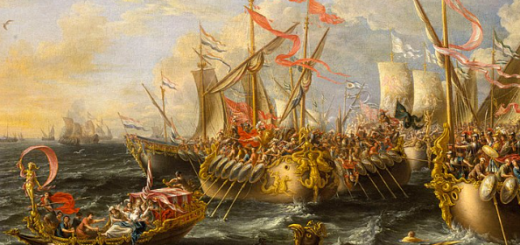
Gaius Octavius, later known as Augustus, was born in 63 BC. He was the great-nephew and adopted son of Julius Caesar, and after Caesar’s assassination in 44 BC, Augustus emerged as his political heir. He would go on to defeat his rivals, including Mark Antony and Cleopatra, in the final war of the Roman Republic, culminating in his victory at the Battle of Actium in 31 BC.
Augustus became the first Roman emperor in 27 BC, after a series of political maneuvers that gave him supreme power while preserving the outward forms of the Roman Republic. He never called himself emperor, preferring the titles “Princeps” (first citizen) and “Imperator” (commander), which helped maintain the facade of republican traditions. Augustus’ reign marked the beginning of the Pax Romana, a period of relative peace and stability across the Roman Empire that would last for over 200 years.
Under Augustus, the empire expanded significantly, incorporating new territories such as Egypt, Dalmatia, and parts of Spain and Germania. His political reforms solidified the power of the emperor while maintaining the illusion of senatorial authority. Augustus’ careful balancing of autocracy and republican forms allowed him to rule for over 40 years, setting the template for future emperors.

Image: Augustus
Tiberius: The Reluctant Emperor (AD 14 – AD 37)
Tiberius Claudius Nero, commonly known as Tiberius, was the stepson of Augustus. He was born into the Claudian family and became Augustus’ heir after a series of deaths and political shifts eliminated other potential successors, including Augustus’ grandsons, Gaius and Lucius Caesar.
Tiberius was a successful general, particularly noted for his campaigns in Germany and the Balkans, but he was reluctant to assume the role of emperor. After Augustus’ death in AD 14, Tiberius inherited the empire and continued many of Augustus’ policies. However, his reign was marked by increasing isolation and paranoia, particularly after the rise of his ambitious and treacherous advisor, Sejanus. Sejanus, as head of the Praetorian Guard, manipulated Tiberius and orchestrated the removal of political rivals, creating an atmosphere of fear and suspicion in Rome.
Tiberius’ reign saw little territorial expansion, but he maintained the stability and prosperity established by Augustus. In AD 26, Tiberius retired to the island of Capri, effectively leaving the administration of the empire in the hands of Sejanus. His final years were marred by political purges and executions, and he died in AD 37, leaving behind a legacy of competent but oppressive rule.

Image: Tiberius
Caligula: The Mad Emperor (AD 37 – AD 41)
Caligula, born Gaius Julius Caesar Germanicus, was the son of the popular general Germanicus and Agrippina the Elder, and the great-grandson of Augustus. He earned the nickname “Caligula” (meaning “little boot”) as a child, due to the miniature soldier’s boots he wore while accompanying his father on military campaigns.
Initially, Caligula’s ascension to power in AD 37 was greeted with great enthusiasm. He was seen as a link to the beloved Germanicus and Augustus, and his early reign was marked by generosity and public works. However, after a serious illness in AD 38, Caligula’s behavior became increasingly erratic and tyrannical.
Caligula’s reign was characterized by extreme extravagance, cruelty, and bizarre behavior. He allegedly declared himself a god, appointed his horse as a senator, and indulged in lavish and wasteful spending, which drained the imperial treasury. His rule alienated the Roman Senate, the military, and the general populace. In AD 41, after just four years as emperor, Caligula was assassinated in a conspiracy involving members of the Praetorian Guard, marking the first assassination of a Roman emperor.

Image: Caligula
Claudius: The Unlikely Emperor (AD 41 – AD 54)
Tiberius Claudius Caesar Augustus Germanicus, commonly known as Claudius, was the uncle of Caligula and the brother of Germanicus. Born in 10 BC, Claudius was considered an unlikely candidate for the throne due to his perceived physical disabilities and intellectual limitations. He was largely kept out of public life by his family, but after Caligula’s assassination, Claudius was declared emperor by the Praetorian Guard, who saw him as a safe and manageable candidate.
Despite low expectations, Claudius proved to be an able and effective ruler. His reign was marked by significant administrative reforms, including the expansion of the Roman bureaucracy and improvements in the legal and judicial systems. Claudius also expanded the empire, most notably through the conquest of Britain in AD 43.
Claudius’ personal life was tumultuous, particularly his marriages. His third wife, Messalina, was executed for conspiracy, and his fourth wife, Agrippina the Younger (the sister of Caligula), manipulated him into adopting her son, Nero, as his heir, bypassing Claudius’ biological son, Britannicus. Claudius died in AD 54, possibly poisoned by Agrippina to ensure Nero’s succession.

Image: Claudius
Nero: The Last of the Julio-Claudians (AD 54 – AD 68)
Nero Claudius Caesar Augustus Germanicus, born Lucius Domitius Ahenobarbus, was the son of Agrippina the Younger and the stepson and adopted son of Claudius. He became emperor at the age of 16 after Claudius’ death in AD 54.
Nero’s early reign was largely influenced by his mother, Agrippina, as well as his tutors, the philosopher Seneca and the Praetorian Prefect Burrus. However, as Nero grew older, he sought to assert his independence, eventually having Agrippina killed in AD 59. His reign was characterized by a series of political purges, extravagance, and increasing instability.
Nero is perhaps best remembered for his artistic ambitions, his persecution of Christians, and his controversial response to the Great Fire of Rome in AD 64. Although there is no concrete evidence that Nero started the fire, he was widely blamed for it, and his decision to build a lavish palace, the Domus Aurea, on the ruins fueled public outrage.
Nero’s later years were marked by revolts and military uprisings, including the rebellion led by Vindex in Gaul. In AD 68, facing widespread discontent and the defection of the Praetorian Guard, Nero fled Rome and committed suicide, bringing an end to the Julio-Claudian dynasty.

A monumental statue head of Nero on display at the Glyptothek Museum in Munich.
Key Themes of the Julio-Claudian Dynasty
1. Adoption as a Tool for Succession
One of the defining features of the Julio-Claudian dynasty was the use of adoption as a means of ensuring continuity and stability. Since primogeniture (direct father-to-son inheritance) was not always possible, emperors often adopted heirs from within the family or allied families. Augustus set this precedent by adopting his stepson, Tiberius, and the practice continued throughout the dynasty, with each emperor adopting successors when biological heirs were unavailable or unsuitable.
2. Family Intrigue and Political Struggle
The Julio-Claudian dynasty was rife with family conflicts, conspiracies, and political machinations. Marriages were often strategic, intended to strengthen alliances within the imperial family or secure the succession. However, these alliances frequently led to jealousy, intrigue, and betrayal. For example, Agrippina the Younger’s manipulation of Claudius and her eventual orchestration of his death to secure Nero’s succession exemplifies the cutthroat nature of Julio-Claudian family politics.
3. Public Works and Cultural Achievements
The Julio-Claudian emperors, particularly Augustus and Claudius, were responsible for numerous public works and cultural achievements. Augustus famously boasted that he “found Rome a city of brick and left it a city of marble,” and his reign saw the construction of numerous temples, public buildings, and aqueducts. Claudius continued this tradition with his conquest of Britain and infrastructure projects, such as the construction of new roads and the expansion of the Roman port of Ostia.
4. Tyranny and Excess
While Augustus and Claudius were generally seen as competent and benevolent rulers, Tiberius, Caligula, and Nero were infamous for their tyranny, excess, and cruelty. Tiberius’ later years were marked by paranoia and political purges, Caligula’s reign was characterized by madness and extravagance, and Nero’s rule descended into debauchery and persecution. These emperors’ misrule contributed to the decline of the Julio-Claudian dynasty and eroded the legitimacy of the imperial system in the eyes of many Romans.
The End of the Julio-Claudian Dynasty
Nero’s suicide in AD 68 marked the end of the Julio-Claudian dynasty, plunging the Roman Empire into a brief but intense period of civil war known as the “Year of the Four Emperors.” During this time, four different men—Galba, Otho, Vitellius, and Vespasian—claimed the imperial throne in quick succession. It was not until Vespasian’s victory in AD 69 that the Flavian dynasty was established, bringing a temporary end to the chaos.
Legacy of the Julio-Claudian Dynasty
Despite its eventual collapse, the Julio-Claudian dynasty left a lasting legacy on the Roman Empire. Augustus’ establishment of the principate, the system of government in which the emperor held ultimate authority while maintaining the outward forms of republican governance, set the model for future emperors. The territorial expansions, public works, and cultural achievements of the Julio-Claudian emperors also had a long-lasting impact on the empire.
However, the dynasty’s decline, particularly under the rule of Caligula and Nero, also exposed the vulnerabilities of the imperial system. The unchecked power of the emperor, combined with the influence of court intrigue and the Praetorian Guard, contributed to the instability and corruption that would plague the empire in later years. Nonetheless, the Julio-Claudian dynasty remains a defining period in Roman history, shaping the early years of the empire and leaving behind a complex and enduring legacy.
Timeline of the Julio-Claudian Dynasty
The timeline of the Julio-Claudian dynasty is marked by their reigns, significant events, and political transformations.
1. Augustus (27 BC – AD 14)
- 27 BC: Gaius Octavius (Augustus) becomes the first Roman emperor after defeating Mark Antony and Cleopatra, ending the Roman Republic. He is granted the title “Augustus” by the Senate, marking the beginning of the Roman Empire.
- Augustus’ reign brings stability to Rome after years of civil war and inaugurates the Pax Romana, a period of relative peace and prosperity. He enacts political reforms, centralizes power in the emperor, and expands the empire’s territory.
- Augustus adopts Tiberius, ensuring a clear line of succession, though he initially planned for his grandsons, Gaius and Lucius Caesar, to succeed him. Both died young.
- AD 14: Augustus dies, and Tiberius, his stepson and adopted son, succeeds him.
2. Tiberius (AD 14 – AD 37)
- AD 14: Tiberius, a Claudian by birth, becomes emperor after the death of Augustus. His reign is initially successful, continuing the policies of his predecessor, though marked by growing autocracy.
- Tiberius retires to the island of Capri in AD 26, leaving the administration largely in the hands of the ambitious Sejanus, head of the Praetorian Guard. Sejanus exploits his position, orchestrating political purges and eliminating rivals.
- AD 31: Sejanus is executed for treason, following suspicions of his aspirations to power. Tiberius’ rule grows increasingly oppressive and paranoid in his later years.
- AD 37: Tiberius dies, and Caligula, the son of Germanicus and great-nephew of Tiberius, becomes emperor.
3. Caligula (AD 37 – AD 41)
- AD 37: Caligula, born Gaius Julius Caesar Germanicus, ascends the throne to great public acclaim, largely due to his connection to Germanicus, a popular military leader.
- Caligula’s reign quickly turns tyrannical, marked by erratic behavior, extreme extravagance, and cruelty. He reportedly declares himself a god and engages in bizarre and despotic actions.
- AD 41: Caligula is assassinated by members of the Praetorian Guard after just four years of rule, leaving the empire in disarray. His uncle Claudius is declared emperor.
4. Claudius (AD 41 – AD 54)
- AD 41: Claudius, previously considered an unlikely ruler due to his perceived physical and intellectual weaknesses, is declared emperor. He surprises many by becoming an effective ruler.
- Claudius expands the empire, most notably through the conquest of Britain in AD 43. He also improves Rome’s bureaucracy, legal system, and infrastructure.
- His personal life, particularly his marriages, is marked by intrigue. His fourth wife, Agrippina the Younger, manipulates him into adopting her son, Nero, as his heir.
- AD 54: Claudius dies, possibly poisoned by Agrippina, and Nero becomes emperor.
5. Nero (AD 54 – AD 68)
- AD 54: Nero, adopted son of Claudius and biological great-great-grandson of Augustus, ascends the throne at the age of 16. His early reign is influenced by his mother, Agrippina, and advisors Seneca and Burrus.
- As Nero matures, he consolidates power, executing rivals, including his mother. His reign is notorious for extravagance, artistic ambitions, and political purges.
- AD 64: The Great Fire of Rome devastates the city, and Nero’s controversial rebuilding efforts spark outrage. He is also known for persecuting Christians.
- AD 68: Facing revolts and the loss of support from the Senate and Praetorian Guard, Nero commits suicide, bringing an end to the Julio-Claudian Dynasty.
After Nero’s death, the Roman Empire enters a brief period of civil war known as the “Year of the Four Emperors,” ending with the rise of the Flavian Dynasty.
Frequently Asked Questions
What is the Julio-Claudian dynasty, and how was it established?
The Julio-Claudian dynasty refers to the first ruling family of the Roman Empire, established by Augustus (formerly Gaius Octavius) after his adoption by Julius Caesar. This dynasty combined the prominent families of Julius and Claudius, known for their use of adoption to maintain succession. It ruled Rome from 27 BC, when Augustus became the first emperor, until Nero’s death in AD 68.
How did adoption play a significant role in the Julio-Claudian succession?
Adoption was crucial in the Julio-Claudian dynasty because several emperors, including Augustus, Caligula, and Nero, lacked biological sons. Primogeniture was uncommon, so adoption became a strategic method to secure a chosen heir. Augustus adopted his stepson Tiberius, who in turn adopted his nephew Germanicus, thus maintaining the continuity of the dynasty through non-biological means.
How did Augustus ensure the continuity of his dynasty?
Augustus, born Gaius Octavius and adopted by Julius Caesar, was the founder of the Roman Empire. He ensured the continuity of his dynasty by adopting Tiberius, his stepson, as his heir after the early deaths of his biological grandsons, Gaius and Lucius Caesar. Augustus also arranged marriages and adoptions to link his family with other powerful Roman families, securing a stable line of succession.
How was Tiberius related to Augustus, and what challenges did he face during his rule?
Tiberius was Augustus’ stepson and later adopted son, married to Augustus’ only daughter, Julia the Elder. Tiberius faced challenges such as strained relations with the Senate and increasing reliance on his advisor, Sejanus, who created a climate of fear through treason trials. Tiberius’ reign was also marked by the deaths of key family members, such as his son Drusus and his nephew Germanicus.
Who was Caligula, and why is he considered the first “true” Julio-Claudian emperor?
Caligula, born Gaius Julius Caesar Augustus Germanicus, was the first emperor to be born into both the Julian and Claudian branches of the imperial family. His father, Germanicus, was the son of Tiberius’ brother, and his mother, Agrippina the Elder, was the granddaughter of Augustus. Caligula’s reign is remembered for political instability and erratic behavior, which led to his assassination in AD 41.
How did Claudius become emperor, and what were his achievements and challenges?
Claudius, the younger brother of Germanicus, became emperor after Caligula’s assassination in AD 41. Although initially viewed as an unlikely ruler due to his physical and intellectual limitations, Claudius proved to be a capable administrator. His reign saw the expansion of the Roman Empire, including the invasion of Britain in AD 43. However, his reign was also marked by internal family strife, particularly through his marriages and the ambitions of his wife, Agrippina the Younger.
How did Nero’s reign contribute to the downfall of the Julio-Claudian dynasty?
Nero, the last Julio-Claudian emperor, became notorious for his extravagant lifestyle, political purges, and response to the Great Fire of Rome in AD 64. As he distanced himself from his advisors and executed rivals, including his own mother, Agrippina, his unpopularity grew. Nero’s reign ended in AD 68 when revolts against his rule led to his suicide, marking the end of the Julio-Claudian dynasty.
What led to the “Year of the Four Emperors,” and how did it affect Rome?
The “Year of the Four Emperors” followed Nero’s death in AD 68, plunging Rome into civil war as multiple claimants vied for control of the empire. This period of instability saw the rise and fall of several rulers in rapid succession. Eventually, the Flavian dynasty emerged victorious, restoring stability to Rome and ending the chaos caused by the collapse of the Julio-Claudian line.
What was the legacy of the Julio-Claudian dynasty on Roman politics and culture?
The Julio-Claudian dynasty, particularly through Augustus’ reign, established the model of imperial rule in Rome. The dynasty’s reign shaped Roman politics, with achievements like the expansion of the empire and the stabilization of its institutions. Despite its eventual decline, the legacy of Augustus and the Julio-Claudian emperors influenced Roman governance and culture for generations to come.