Alcamenes stands as a prominent figure in the annals of ancient Greek sculpture. Originating from Lemnos and later establishing his career in Athens, Alcamenes flourished during the latter half of the 5th century BC.
His artistic prowess and innovative techniques earned him recognition among his contemporaries, including the illustrious Phidias. Alcamenes is celebrated for his intricate and finely detailed sculptures, which exemplify the high standards of classical Greek art.
10 Most Famous Ancient Greek Sculptors and their Accomplishments
Early Life and Background
Alcamenes hailed from Lemnos, an island in the northern part of the Aegean Sea, which was known for its rich cultural and artistic heritage.
His move to Athens, the epicenter of Greek art and culture, was a strategic decision that positioned him at the heart of the classical artistic movement. Athens during this period was a vibrant hub for sculptors, architects, and artists, fostering an environment of creativity and competition that propelled artists like Alcamenes to excel.
Artistic Career and Style
Alcamenes emerged as a sculptor renowned for his ability to infuse grace and intricacy into his works. Unlike many of his contemporaries who focused on grandeur and heroic depictions, Alcamenes emphasized delicate craftsmanship and aesthetic refinement. This focus on detail set his work apart, making his sculptures highly sought after.
One of Alcamenes’ most notable qualities was his skill in portraying divine figures with both strength and elegance. His sculptures often depicted gods and goddesses in dynamic poses, capturing their divine essence while maintaining a sense of realism and lifelike presence. This balance between divine power and human-like grace made his works particularly admired.
Major Works and Contributions
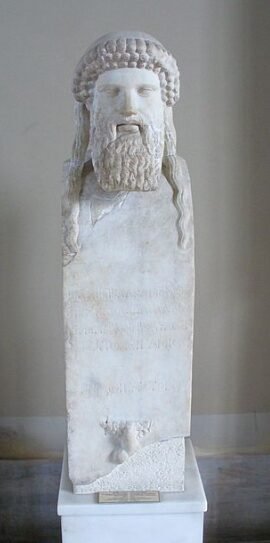
Alcamenes’ work exemplifies the high standards of classical Greek art and his influence is evident in the enduring appreciation of his sculptures. Image: The Herm of Hermes is a Roman replica of a late 5th-century BC Alcamenes original, dedicated by Pergamios, housed in Istanbul Museums.
Alcamenes is credited with several significant sculptures, though many of his original works have not survived to the present day. Among his most celebrated creations are:
Statues of Hephaestus and Aphrodite of the Gardens
These statues are renowned for their exquisite detail and lifelike portrayal of the gods. The statue of Hephaestus captures the god of craftsmanship with a robust and muscular form, emphasizing his role as a divine artisan.
In contrast, the Aphrodite of the Gardens showcases the goddess of love and beauty with a more delicate and graceful appearance, highlighting her enchanting allure. Both statues exemplify Alcamenes’ ability to convey the distinct personalities and attributes of the deities through meticulous craftsmanship.
Pediments of the Temple of Zeus at Olympia
Although ancient sources like Pausanias attribute one of the temple’s pediments to Alcamenes, this attribution is widely disputed. The temple’s pediments were likely created after Alcamenes’ time, suggesting that this claim might be a result of chronological and stylistic inconsistencies. Nonetheless, the association underscores Alcamenes’ reputation and the high esteem in which his work was held.
Statue of Ares in the Athenian Agora
Pausanias mentions a statue of Ares created by Alcamenes that was displayed in the Athenian Agora. Some scholars have attempted to link this statue to the Roman Ares Borghese, a marble statue traditionally identified as Ares.
However, discrepancies such as the depiction of a breastplate in Alcamenes’ known works versus its absence in the Ares Borghese cast doubt on this identification. This example highlights the challenges in attributing ancient sculptures to specific artists based solely on historical texts and stylistic analysis.
Hermes “Propylaeus”
Discovered in Pergamum in 1903, a Hellenistic copy of Alcamenes’ Hermes “Propylaeus” head was found. However, the copy exhibits a Neo-Attic and archaistic style, which does not accurately reflect Alcamenes’ original artistic innovations. This discrepancy suggests that while the copy provides some insights, it cannot be fully relied upon to understand Alcamenes’ true stylistic approach, which was likely more progressive and original than the conservative style of the copy.
Controversies and Misattributions
Alcamenes’ reputation has been subject to various controversies and misattributions over time. The most notable issue arises from the attribution of the Ares Borghese statue to Alcamenes.
While ancient sources like Pausanias credit Alcamenes with creating a statue of Ares, the timing and stylistic elements do not align with what is known of Alcamenes’ work. The Ares Borghese, a Roman marble statue from the 1st or 2nd century AD, likely incorporates elements from a lost 5th-century BC bronze original, but it does not match the specific attributes of Alcamenes’ known sculptures, such as the presence of a breastplate.
Additionally, the pediments of the Temple of Zeus at Olympia, although attributed to Alcamenes by Pausanias, are considered chronologically implausible. The temple’s pediments were constructed long after Alcamenes’ lifetime, indicating that this attribution is likely incorrect. These misattributions underscore the complexities of ancient art history, where limited surviving works and historical records make it challenging to accurately identify and attribute sculptures to their original creators.
Artistic Legacy and Influence
Despite the controversies surrounding specific attributions, Alcamenes’ influence on Greek sculpture remains significant. His emphasis on detail and aesthetic refinement set new standards for divine representation in sculpture. By portraying gods and goddesses with both strength and elegance, Alcamenes contributed to the evolution of Greek art, which increasingly favored realistic and lifelike depictions of deities and heroes.
While some attributions of his work, such as the pediments of the Temple of Zeus and the statue of Ares in the Agora, are disputed, his legacy is best appreciated through his contributions to the Parthenon’s sculptural decorations.
Alcamenes’ work also played a crucial role in the sculptural decorations of the Parthenon. Under the supervision of Phidias, Alcamenes contributed to the artistic embellishments of this iconic temple, showcasing his skill and creativity. His involvement in the Parthenon’s decoration underscores his prominence and the high regard in which he was held within the Athenian artistic community.
Recognition and Challenges
Alcamenes was highly esteemed in Athens, particularly after Phidias’ departure to Olympia. He was regarded as the leading sculptor in the city, a position that reflected his exceptional talent and the quality of his work. However, the exact scope of his oeuvre remains largely uncertain. Classical literature references to Alcamenes’ sculptures have not been definitively matched with surviving copies, making it difficult for modern scholars to fully assess his contributions.
The lack of securely attributed works complicates the study of Alcamenes, as many of his sculptures have either been lost or exist only as fragments. This scarcity of definitive evidence means that much of what is known about Alcamenes is based on historical texts and the interpretations of later art historians.
Conclusion
Alcamenes remains a celebrated yet enigmatic figure in the history of ancient Greek sculpture. His contributions to the art of his time, particularly through his refined and detailed representations of divine figures, mark him as a significant sculptor of the classical period. While controversies and misattributions cloud the full understanding of his work, Alcamenes’ legacy is evident in the high standards of craftsmanship and aesthetic quality he brought to Greek art.
His role in the decoration of the Parthenon and the enduring admiration for his statues of Hephaestus and Aphrodite of the Gardens underscore his impact on Greek sculpture. Alcamenes’ ability to blend strength with elegance and his commitment to intricate detail set him apart from his contemporaries, ensuring his place in the pantheon of great ancient Greek artists.
Frequently Asked Questions
With which renowned sculptor was Alcamenes a contemporary?
Alcamenes was a younger contemporary of the renowned sculptor Phidias.
For what qualities did Alcamenes gain recognition in his sculptures?
Alcamenes gained recognition for the exquisite detail, high quality, grace, and intricacy of his sculptures.
Name two notable works created by Alcamenes.
Alcamenes is known for his statues of Hephaestus and Aphrodite of the Gardens.
Why is the attribution of one of the Temple of Zeus at Olympia’s pediments to Alcamenes considered unlikely?
The attribution is considered unlikely due to chronological and stylistic inconsistencies, as the Temple of Zeus pediments were created after Alcamenes’ time.
What discrepancy exists between Alcamenes’ Ares and the Ares Borghese statue?
Replicas of Alcamenes’ Ares depict the god wearing a breastplate, a feature not present in the Ares Borghese, making the identification uncertain.
What was discovered in Pergamum in 1903 related to Alcamenes?
In 1903, a Hellenistic copy of Alcamenes’ Hermes “Propylaeus” head was discovered in Pergamum.
Why does the Hellenistic copy of Alcamenes’ Hermes “Propylaeus” offer limited insight into his original style?
The copy exhibits a Neo-Attic and archaistic style, which does not accurately reflect Alcamenes’ original artistic innovations, suggesting it was more conservative than his progressive and original craftsmanship.
What role did Alcamenes play in the sculptural decorations of the Parthenon?
Alcamenes played a significant role in the artistic embellishments of the Parthenon under the supervision of Phidias, showcasing his prominence and skill as a sculptor.
Why is it challenging for modern scholars to assess Alcamenes’ complete body of work?
It is challenging because classical literature references to his sculptures have not been definitively matched with surviving copies, leaving much of his oeuvre uncertain.
How was Alcamenes regarded in Athens after Phidias’ departure?
Alcamenes was regarded as the leading sculptor in Athens following Phidias’ departure to Olympia.





