Who was Aldus Manutius?
Aldus Pius Manutius, born between 1449 and 1452 in Bassiano near Rome, was a prominent figure of the Italian Renaissance. He came from a wealthy family, which enabled him to pursue education in the humanist tradition. He studied Latin under Gaspare da Verona in Rome and attended lectures by Domizio Calderini. Between 1475 and 1478, he furthered his education in Ferrara under Battista Guarino, learning Greek, which became the cornerstone of his future career as a printer and publisher.
In 1480, Manutius became a citizen of Carpi and developed a close relationship with Giovanni Pico della Mirandola, a philosopher and fellow humanist. During a two-year stay in Mirandola, he deepened his understanding of Greek literature and was recommended by Pico to tutor his nephews, Alberto and Leonello Pio. This role provided financial and intellectual support for Manutius’s printing endeavors.
Establishment of the Aldine Press
Manutius established the Aldine Press in Venice in 1494 with funding from the Pio and Pico families and a partnership with Andrea Torresano, a fellow printer. Venice, a hub for scholars and manuscripts, was an ideal location for his press. The city housed Cardinal Bessarion’s extensive Greek manuscript collection and hosted a large Greek expatriate community.
The press’s first publication, Constantine Lascaris’s Erotemata cum interpretatione Latina (1495), marked the beginning of its influential role in classical scholarship. Manutius chose to focus on Greek texts, filling a gap in Renaissance printing. His mission was to preserve and disseminate Greek and Latin classics, many of which had not yet been widely available in print.

Image: Aldus Manutius
Key Publications and Scholarly Contributions
One of the Aldine Press’s early achievements was the five-volume folio edition of Aristotle (1495–1498), a monumental work that exemplified Manutius’s dedication to classical scholarship. In 1498, the press published nine comedies of Aristophanes, followed by Pietro Bembo’s edition of Petrarch’s poems in 1501. These works were meticulously edited, often improving upon earlier versions printed in Florence, Rome, and Milan.
The Aldine Press was also known for its editions of lesser-known Greek works, such as those by Musaeus Grammaticus and Plutarch. These efforts preserved significant portions of the Greek literary tradition and helped disseminate it across Europe.
Innovations in Printing and Typography
Manutius introduced several innovations that revolutionized the printing industry. He is credited with creating the enchiridia—portable octavo editions that were compact and affordable. These books were designed for personal use, making classical literature more accessible to a broader audience. The 1501 edition of Virgil was the first to use this format and became a prototype for modern paperbacks.
Typography was another area where Manutius excelled. He commissioned Francesco Griffo to develop typefaces that mimicked humanist cursive handwriting. This collaboration produced the first italic typeface, which became a hallmark of Aldine publications. Italic type improved readability and allowed for more compact text layouts, which reduced production costs and made books more affordable.
Collaboration with Scholars
Manutius attracted renowned scholars to collaborate on his projects. Desiderius Erasmus, the Dutch humanist, sought out Manutius to publish his translations of Greek plays, such as Iphigenia in Aulis. This collaboration began in 1507 and resulted in the publication of Adagiorum Chiliades (1508), a collection of proverbs that significantly expanded Erasmus’s earlier work. Erasmus also assisted with proofreading and editing Greek texts for the Aldine Press, further enhancing its reputation for scholarly excellence.
Manutius also worked with Greek scholars like Marcus Musurus and Ioannis Grigoropoulos, who helped translate and edit manuscripts. Their contributions ensured the accuracy and quality of Aldine editions, particularly those of lesser-known Greek orators and Plutarch’s works.
Challenges and Persistence
The Aldine Press faced significant challenges, including interruptions during the Second Italian War and the League of Cambrai’s efforts to diminish Venice’s influence. Additionally, piracy and counterfeiting plagued Manutius’s work. Despite securing privileges from the Venetian Senate and the papacy to protect his typefaces and formats, unauthorized reproductions proliferated.
Manutius responded by issuing warnings in his publications, detailing errors in counterfeit editions to help readers identify authentic Aldine works. Although these efforts were only partially successful, they highlighted the demand and influence of his publications.
The New Academy and Greek Studies
In 1502, Manutius founded the New Academy, a group of Hellenist scholars dedicated to promoting Greek studies. Members included Erasmus, Pietro Bembo, and Scipio Fortiguerra. The academy’s rules were written in Greek, and its members used Greek names, reflecting Manutius’s commitment to preserving Greek culture. The Aldine Press published 75 Greek texts during Manutius’s lifetime, ensuring their survival and dissemination.

Symbolism and Philosophy
Manutius adopted the dolphin-and-anchor emblem as the Aldine Press’s imprint in 1502. This symbol, derived from a Roman coin and accompanied by the motto festina lente (“make haste slowly”), encapsulated his approach to publishing—balancing speed with meticulous precision. The emblem became widely recognized and was often imitated, further solidifying the Aldine Press’s reputation.
Impact on Renaissance Literature
Beyond Greek texts, the Aldine Press published Latin and Italian classics. Manutius’s editions of Dante, Petrarch, and Poliziano were highly regarded for their accuracy. Pietro Bembo’s De Aetna (1496), the press’s first Latin publication by a contemporary author, launched Bembo’s career and influenced Renaissance literary standards. The press also published works by Francesco Colonna, including the illustrated Hypnerotomachia Poliphili, and introduced standardized punctuation marks like the comma and semicolon.

Legacy and Influence
Manutius’s innovations in book design, typography, and publishing practices had a lasting impact on the industry. His octavo editions democratized access to classical literature, and his italic typeface became a standard in printing. The Aldine Press produced over 100 editions during his lifetime, and its influence extended across Europe, shaping the future of Renaissance humanism.
Manutius’s vision extended to creating a trilingual Bible, a project left incomplete at his death in 1515. However, his work on the Septuagint, published posthumously in 1518, marked a significant milestone in biblical scholarship.
Questions and Answers
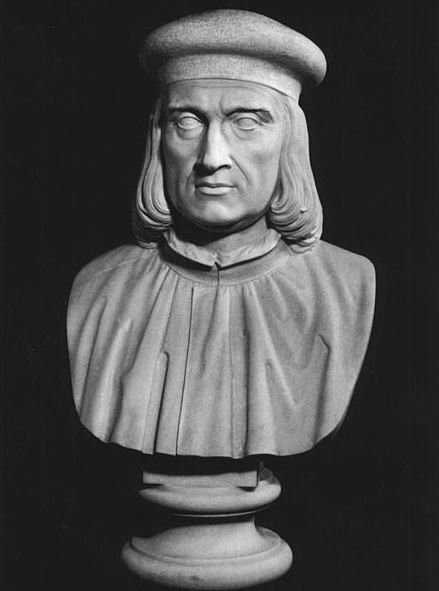
Aldus Pius Manutius (c. 1449/1452 – 1515) was a pivotal Italian printer and humanist who founded the Aldine Press. He is renowned for his contributions to printing, publishing, and preserving classical literature, particularly Greek and Latin texts, which significantly influenced Renaissance humanism. Image: Bust of Manutius.
What educational background did Aldus Manutius have that influenced his publishing career?
Manutius studied Latin under Gaspare da Verona and attended lectures by Domizio Calderini in Rome. Between 1475 and 1478, he studied Greek with Battista Guarino in Ferrara. This extensive education in humanist scholarship and Greek literature profoundly influenced his later work in publishing Greek texts.
How did Manutius establish the Aldine Press and why was Venice chosen as its location?
Funded by the Pico and Pio families, Manutius co-founded the Aldine Press in Venice in 1494 with Andrea Torresano. Venice was chosen for its rich resources, including a vast collection of Greek manuscripts donated by Cardinal Bessarion and a thriving community of Greek scholars, enabling access to numerous ancient Greek texts.
What were some of the Aldine Press’s early significant publications?
The Aldine Press’s inaugural publication was “Erotemata cum interpretatione Latina” by Constantine Lascaris in March 1495. Early significant works include a five-volume folio edition of Aristotle (1495-1498), nine comedies of Aristophanes (1498), and Pietro Bembo’s edited poems of Petrarch (1501), showcasing the press’s dedication to classical scholarship.
How did Aldus Manutius collaborate with Desiderius Erasmus, and what were the outcomes?
Desiderius Erasmus sought Manutius’s expertise to publish his translations of classical plays like “Hecuba” and “Iphigenia in Aulis.” Their collaboration began with the publication of “Iphigenia in Aulis” in December 1507 and led to the expanded collection “Adagiorum Chiliades” in 1508, enhancing the Aldine Press’s scholarly output.
What innovations did Manutius introduce in book design and typography?
Manutius introduced the enchiridia, a small, portable book format that preceded modern paperbacks. He also commissioned Francesco Griffo to create typefaces mimicking humanist cursive handwriting, resulting in the first known italic typeface. These innovations improved readability and accessibility of printed works.
What challenges did the Aldine Press face, and how did Manutius address them?
The Aldine Press faced interruptions from wars, piracy, and counterfeiting. Manutius addressed these by securing printing privileges, issuing warnings in publications, and detailing counterfeit errors to help identify genuine editions. Despite these efforts, piracy remained a significant challenge.
How did Manutius contribute to the preservation and dissemination of Greek classics?
Manutius expanded the repertoire of Greek texts by accessing Venice’s extensive manuscript resources and employing Greek scholars to ensure accuracy. He established the New Academy to promote Greek studies and published 75 texts by Classical Greek and Byzantine authors, preserving and disseminating these works widely.
What was the significance of the Aldine Press’s dolphin-and-anchor imprint and motto?
The dolphin wrapped around an anchor symbolized Manutius’s motto “festina lente” (“make haste slowly”), representing a balance between speed and precision. This emblem became widely recognized and imitated, reflecting the Aldine Press’s substantial influence in the publishing world.
What is Aldus Manutius’s lasting legacy in modern times?
Manutius’s legacy endures through the Aldine Press’s influential editions, the introduction of italic type and portable books, and his impact on modern publishing standards. His work is commemorated in various forms, including typefaces named after him, literary references, and continued appreciation of his editions by collectors and scholars.





