What triggered the rivalry between John Adams and Thomas Jefferson?
The rivalry between John Adams and Thomas Jefferson is one of the most fascinating and complex stories in American history. It reflects deep philosophical differences, personal ambitions, and the turbulent political landscape of the early United States.
Their rivalry was rooted in their divergent visions for the country, ideological conflicts, and personal disagreements.
Below, World History Edu dives into the key events and factors that triggered and fueled their rivalry over time.
Early Collaborations and Mutual Respect
In the early stages of the American Revolution, John Adams and Thomas Jefferson were allies. Both were ardent supporters of American independence and worked closely together in the Continental Congress. Adams played a significant role in persuading Congress to declare independence, while Jefferson was the principal author of the Declaration of Independence. During this period, they developed a mutual respect for each other’s intellect and commitment to the cause of liberty.
Adams admired Jefferson’s eloquence and writing skills, and Jefferson respected Adams’s fierce advocacy and leadership. Their collaboration during the drafting of the Declaration of Independence in 1776 marked a high point in their relationship. Adams even suggested Jefferson for the task of writing the Declaration because of his “masterly pen.” This period of cooperation laid the foundation for their future interactions, though the seeds of their eventual rivalry were already present in their differing temperaments and political philosophies.
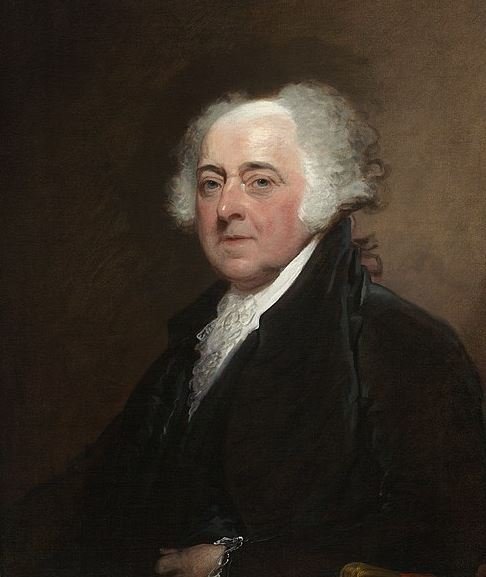
John Adams was an attorney, diplomat, writer, and a Founding Father. He was also the first vice president of the United States, serving from 1789 to 1797. Image: An early 17th century painting of Adams.
Diverging Philosophies and Political Beliefs
The divergence in their political philosophies became more pronounced as they assumed different roles in the new government. Adams, a Federalist, believed in a strong central government to maintain order and stability. He feared the potential chaos and anarchy of too much democracy and saw a need for a balanced government with checks and balances. Adams’s vision was influenced by his experiences during the Revolution and his study of classical history, which led him to value a mixed government that included elements of monarchy, aristocracy, and democracy.
In contrast, Jefferson, a Democratic-Republican, championed states’ rights and a more decentralized form of government. He believed in the goodness and wisdom of the common people and advocated for a more agrarian society where individuals could govern themselves with minimal interference from a central authority. Jefferson’s ideals were shaped by his Enlightenment beliefs and his deep faith in the potential of humanity to improve and govern themselves. He feared that a strong central government would lead to tyranny and the erosion of individual liberties.
READ ALSO: Founding Fathers of the United States of America
The Election of 1796: The Beginning of Open Rivalry
The presidential election of 1796 marked the beginning of open political rivalry between Adams and Jefferson. This was the first contested presidential election in American history and highlighted the growing partisan divide in the country. Adams ran as the Federalist candidate, while Jefferson was the candidate for the Democratic-Republicans. Adams won the presidency by a narrow margin, becoming the second President of the United States, and Jefferson, as the runner-up, became Vice President according to the electoral rules of the time.
The fact that they belonged to opposing political parties while serving in the two highest offices created immediate tension. Adams and Jefferson had to navigate their differing visions for the country while working together in the executive branch. This arrangement proved to be challenging and strained their relationship further, as they found themselves at odds on major issues such as foreign policy and the role of the federal government.
READ ALSO: President George Washington’s Farewell Address, 1796
Alien and Sedition Acts: Heightened Tensions
One of the most contentious issues during Adams’s presidency was the passage of the Alien and Sedition Acts in 1798. These acts, which included measures to deport foreigners and punish those who criticized the government, were seen by Jefferson and his allies as a severe infringement on individual liberties and free speech. The Federalists, including Adams, justified the acts as necessary for national security, particularly given the quasi-war with France at the time.
Jefferson vehemently opposed the Alien and Sedition Acts and saw them as an abuse of federal power designed to silence opposition. Along with James Madison, he drafted the Kentucky and Virginia Resolutions, which argued that states had the right to nullify federal laws they deemed unconstitutional. This episode deepened the ideological chasm between Adams and Jefferson and solidified their positions as leaders of their respective parties. The Alien and Sedition Acts became a symbol of the growing authoritarianism that Jefferson feared from a strong central government.
The Election of 1800: The “Revolution of 1800”
The presidential election of 1800, often referred to as the “Revolution of 1800,” was a pivotal moment in American history and a significant turning point in the Adams-Jefferson rivalry. The campaign was bitter and fiercely contested, with both sides engaging in personal attacks and partisan vitriol. Jefferson and the Democratic-Republicans portrayed Adams and the Federalists as monarchists who sought to subvert the republic, while Adams’s supporters depicted Jefferson as a radical who would lead the nation into chaos and ruin.
The election ended in a tie between Jefferson and his running mate, Aaron Burr, which was eventually resolved by the House of Representatives. Jefferson emerged victorious, and Adams left the presidency after serving a single term. The peaceful transfer of power from one party to another was unprecedented and marked a significant test for the young republic. Despite the bitterness of the campaign, it demonstrated the resilience of the American political system.
Personal and Political Reconciliation
After the tumultuous election of 1800, Adams and Jefferson’s relationship was severely strained. Adams returned to his farm in Quincy, Massachusetts, and largely withdrew from public life, while Jefferson went on to serve two terms as President. During these years, they had little contact and their earlier friendship seemed irreparably damaged.
However, in 1812, a remarkable reconciliation began, initiated by Dr. Benjamin Rush, a mutual friend and fellow signer of the Declaration of Independence. Rush encouraged Adams to reach out to Jefferson, believing that their friendship could be restored. Adams wrote a brief, cordial letter to Jefferson, which led to a renewed correspondence between the two former presidents. Over the next 14 years, they exchanged numerous letters, discussing a wide range of topics including politics, philosophy, and personal matters.
Their correspondence revealed a deep mutual respect and a shared sense of the historical significance of their lives and work. They reflected on their past disagreements and the early days of the republic, often with humor and introspection. This period of reconciliation allowed them to bridge the ideological divide that had separated them for so long and to reestablish the personal bond that had been strained by political conflict.

Did you know…?
- John Adams and his son John Quincy Adams were the only presidents among the first twelve who never owned slaves.
- John Adams was a strong advocate for education and believed it was essential for the survival of the republic. He wrote extensively on the subject and supported various educational institutions, including Harvard University and the American Academy of Arts and Sciences.
Legacies of Adams and Jefferson
John Adams and Thomas Jefferson both left enduring legacies that continue to shape the United States. Adams’s contributions include his advocacy for independence, his role in shaping the Constitution, and his efforts to build a strong, stable government. His writings and ideas about governance and law remain influential, and his commitment to principle and public service is widely respected.

The story of John Adams and Thomas Jefferson is not just about conflict but also about the enduring power of friendship, dialogue, and the shared commitment to the principles of liberty and democracy. Image: Thomas Jefferson.
Jefferson’s legacy is equally profound, encompassing his authorship of the Declaration of Independence, his vision for a democratic and agrarian society, and his contributions to the expansion and development of the United States. His ideas about liberty, education, and the rights of individuals have had a lasting impact on American political thought and practice.
The Adams-Jefferson rivalry, with its roots in deep philosophical differences and personal ambitions, is a testament to the complexity of human relationships and the challenges of political life. It reflects the dynamic and often contentious nature of the early American republic, as leaders with different visions for the country struggled to define its path forward.
Frequently Asked Questions about John Adams, America’s First Vice President
When was John Adams born and when did he die?
John Adams was born on October 30, 1735, and died on July 4, 1826.
Where was John Adams born?
He was born in Braintree, Massachusetts (now Quincy, Massachusetts).
Where did John Adams attend college?
John Adams attended Harvard College, graduating in 1755.

What was John Adams’ role in the American Revolution?
John Adams was a prominent leader of the American Revolution, playing a key role in achieving independence from Great Britain. He was a Massachusetts delegate to the Continental Congress, helped draft the Declaration of Independence, and was a primary advocate for its adoption in Congress.
During the latter part of the Revolutionary War and the early years of the new nation, Adams served as a senior diplomat in Europe. He helped negotiate the peace treaty with Great Britain and secured essential governmental loans.
Who represented the Kingdom of Great Britain at the Treaty of Paris in 1783?
What was John Adams’ position on legal rights before the Revolution?
John Adams was committed to the right to counsel and presumption of innocence. He famously defended British soldiers charged with murder following the Boston Massacre, despite prevailing anti-British sentiment.
What significant documents did John Adams contribute to?
John Adams assisted in drafting the Declaration of Independence in 1776 and authored the Massachusetts Constitution in 1780, which influenced the United States Constitution. He also wrote the essay Thoughts on Government.
When was John Adams elected President?
John Adams was elected as the second President of the United States in 1796 and served from 1797 to 1801.
What was notable about John Adams’ presidency?
John Adams’ presidency was marked by the French Revolutionary Wars and his insistence on American neutrality, which led to criticism. He signed the controversial Alien and Sedition Acts and bolstered the Army and Navy during the undeclared naval war with France. He was also the first president to reside in the White House.

John Adams is known for his role in the Quasi-War with France, the passing of the Alien and Sedition Acts, and for peacefully transferring power to Thomas Jefferson after losing the 1800 election. A 1785 portrait of Adams.
What was the outcome of the 1800 presidential election for John Adams?
In the 1800 presidential election, John Adams faced strong opposition and accusations of despotism, resulting in his defeat by Thomas Jefferson. He subsequently retired to Massachusetts.
How did John Adams’ relationship with Thomas Jefferson evolve after his presidency?
After his presidency, John Adams eventually resumed his friendship with Thomas Jefferson through extensive correspondence.
Who was John Adams married to?
John Adams was married to Abigail Smith Adams. They had six children, including John Quincy Adams, who would later become the sixth President of the United States.

READ MORE: 10 Most Influential U.S. First Ladies and their Accomplishments
When did John Adams die?
John Adams died on July 4, 1826, the same day as Thomas Jefferson, marking the 50th anniversary of the Declaration of Independence.
Are there any monuments or memorials dedicated to John Adams?
Yes, there are several, including the Adams National Historical Park in Quincy, Massachusetts, which preserves his home and legacy, and a statue in the National Statuary Hall Collection in the U.S. Capitol.
Most influential intellectuals of the American Revolution Era





