Amistad Ship: Origin Story and Major Facts
The Amistad ship holds a significant place in history due to the remarkable events that unfolded aboard it in the early 19th century. The story of the Amistad involves themes of slavery, freedom, and justice, and it highlights the resilience and courage of those who sought to secure their freedom against formidable odds.
Origin of the Amistad
The ship La Amistad, meaning “Friendship” in Spanish, was a 19th-century schooner built in Spain. It was a relatively small vessel, measuring around 120 feet in length and capable of carrying cargo and passengers. The Amistad was not originally designed or intended for the transatlantic slave trade. Instead, it was used for general cargo purposes along the Cuban coast.
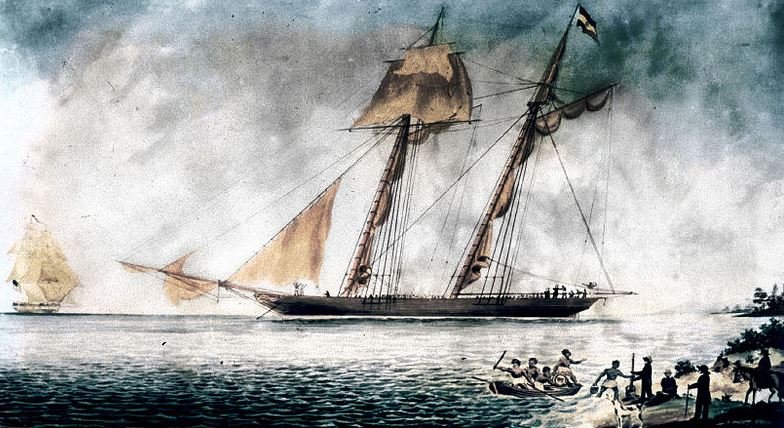
Image: An illustration showing the Amistad at sea.
The Capture and Enslavement of Africans
The story of the Amistad begins in the context of the transatlantic slave trade, which was still prevalent in the early 19th century despite growing international opposition. In February 1839, a group of Africans from the Mende ethnic group in what is now Sierra Leone were captured by African slave traders and sold to Portuguese slave traders. These individuals were then transported to Havana, Cuba, aboard the Portuguese slave ship Teçora. Upon arrival in Cuba, the Africans were fraudulently classified as native-born Cuban slaves to circumvent international laws banning the importation of enslaved Africans.
Aboard the Amistad
In June 1839, 53 of these enslaved Africans, including four children, were purchased by two Spanish plantation owners, José Ruiz and Pedro Montes, who intended to transport them to their plantations in Puerto Principe, Cuba. They were loaded onto the Amistad under the command of Captain Ramón Ferrer.
The conditions aboard the Amistad were dire. The captives were shackled and confined to the ship’s hold, enduring harsh treatment and inadequate provisions. However, the Africans, led by Sengbe Pieh (known as Joseph Cinqué in the United States), managed to unshackle themselves and organize a revolt. On the night of July 1, 1839, they seized control of the ship. In the ensuing struggle, they killed Captain Ferrer and some of the crew. Ruiz and Montes were spared to help navigate the ship back to Africa.

Image: A painting portraying Sengbe Pieh.
The Struggle for Freedom
After taking control of the Amistad, Cinqué and his fellow captives directed Ruiz and Montes to sail eastward towards Africa. However, the Spaniards deceived them by sailing north during the day and east at night. This erratic course led the ship towards the United States. After nearly two months at sea, the Amistad was intercepted by the U.S. Navy brig Washington near Long Island, New York, on August 26, 1839.
The Africans were taken into custody and brought to New Haven, Connecticut, where they were imprisoned and charged with mutiny and murder. The case of the Amistad quickly gained national and international attention, becoming a symbol of the abolitionist movement and the struggle for human rights.
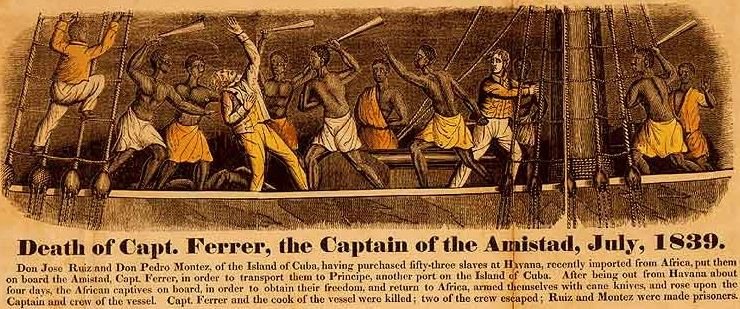
Image: A depiction of the battle that ensued on the Amistad.
Legal Battle and Abolitionist Support
The legal battle that ensued over the fate of the Amistad captives was a complex and highly publicized affair. The key legal questions were whether the Africans were legally enslaved and, consequently, whether they had the right to use force to escape their captivity.
The abolitionist movement in the United States, spearheaded by figures such as Lewis Tappan and the American Missionary Association, rallied to support the Amistad captives. They provided legal representation and financial assistance, and their efforts brought the case to the forefront of public consciousness.
District and Circuit Court Rulings
The initial hearings took place in the U.S. District Court in Hartford, Connecticut. The captives were represented by a legal team that included prominent abolitionist lawyers, such as Roger S. Baldwin. The defense argued that the Africans were not legally enslaved and had been illegally transported to Cuba in violation of international treaties banning the transatlantic slave trade.
In January 1840, the district court ruled in favor of the Africans, declaring them free individuals who had been kidnapped and illegally sold into slavery. The court ordered that they be returned to their homeland. However, the U.S. government, under President Martin Van Buren, appealed the decision, fearing diplomatic repercussions with Spain.
Supreme Court Decision
The case eventually reached the U.S. Supreme Court in January 1841. Former President John Quincy Adams, a staunch abolitionist, joined the defense team and delivered a powerful and eloquent argument on behalf of the Amistad captives. Adams emphasized the principles of justice and human rights, arguing that the Africans had a natural right to fight for their freedom.
On March 9, 1841, the Supreme Court delivered its historic ruling. In a decision written by Justice Joseph Story, the Court affirmed the lower court’s ruling, declaring that the Africans were free individuals who had been unlawfully enslaved. The decision stated that they had exercised their natural right to self-defense and should be allowed to return to their homeland.
Aftermath and Legacy
Following the Supreme Court’s decision, the Amistad captives were released from custody. Abolitionists and supporters provided funds to arrange for their return to Africa. In November 1841, 35 of the surviving captives, along with several American missionaries, set sail for Sierra Leone aboard the ship Gentleman.
The Amistad case had a profound impact on the abolitionist movement and the broader struggle for civil rights. It galvanized public opinion against slavery and highlighted the moral and legal contradictions inherent in the institution of slavery. The case also underscored the importance of legal advocacy and public support in advancing the cause of justice and human rights.
Major Facts and Significance
- The Amistad Revolt: The revolt aboard the Amistad was a rare and dramatic instance of enslaved Africans successfully seizing control of a slave ship. Led by Sengbe Pieh (Joseph Cinqué), the captives’ bravery and determination to secure their freedom made their story a powerful symbol of resistance against oppression.
- Legal Precedent: The legal battle over the fate of the Amistad captives set a significant precedent in U.S. law. The Supreme Court’s ruling affirmed the principle that individuals who were illegally enslaved had the right to fight for their freedom. This decision was an important step towards the eventual abolition of slavery in the United States.
- Abolitionist Movement: The Amistad case energized the abolitionist movement in the United States. It brought together a coalition of activists, lawyers, and supporters who worked tirelessly to secure justice for the captives. The case demonstrated the power of grassroots activism and legal advocacy in challenging unjust systems.
- International Implications: The Amistad case had diplomatic repercussions, as Spain had demanded the return of the captives as property. The U.S. government’s initial efforts to appease Spain were overridden by the Supreme Court’s decision, highlighting the tension between domestic justice and international diplomacy.
- Cultural Impact: The story of the Amistad has been memorialized in various forms of art, literature, and film. Steven Spielberg’s 1997 film “Amistad” brought the story to a wide audience, further cementing its place in the public consciousness. The Amistad’s legacy continues to inspire discussions about justice, freedom, and human rights.
- Educational Efforts: The Amistad case has become an important subject of study in the fields of history, law, and African American studies. Educational institutions and organizations continue to explore and teach the significance of the Amistad revolt and its implications for the ongoing struggle for civil rights and justice.