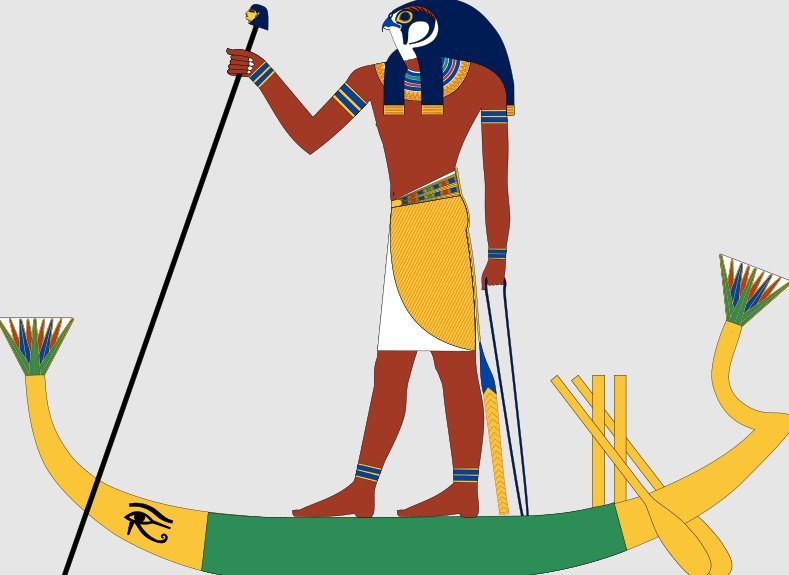
A depiction of Nemty aboard a boat.
Nemty was an ancient Egyptian god whose worship centered at Antaeopolis in Upper Egypt, known as the god of ferrymen and depicted as a falcon standing on a boat.
Origins of Nemty’s Worship
Nemty, an ancient Egyptian god, held a significant place in early Egyptian religious practices. His worship dates back to at least the 2nd Dynasty, with priests already devoted to his cult by that time.
Initially, Nemty was associated with the region around Badari, which was a central hub for the worship of Horus, the falcon-headed god. Despite the prominence of his cult, little is known about Nemty’s original role or whether he represented a distinct deity or merely a title of Horus.
READ MORE: 10 Most Revered Gods and Goddesses in Ancient Egypt
Nemty as a God of Ferrymen
Over time, Nemty’s identity evolved. He came to be known primarily as the god of ferrymen, a role symbolized by his depiction as a falcon standing on a boat. This imagery ties directly to Horus, who was also depicted as a falcon in Egyptian mythology.
Nemty’s name translates to “(one who) travels,” reflecting his connection to transportation and movement. His later worship centered in Antaeopolis, a city in northern Upper Egypt, and also in Per-Nemty, located in the 12th Upper Egyptian nome.
Role in Egyptian Mythological Tales
Nemty’s involvement in mythological narratives further highlights his importance. In “The Contendings of Horus and Seth,” a story depicting the struggle for Osiris‘ inheritance and symbolizing the unification of Upper and Lower Egypt, Nemty plays a pivotal role.
Seth, representing Upper Egypt, organizes a council of gods on an isolated island to argue his case. He instructs Nemty, acting as a ferryman, not to transport anyone resembling Isis, Horus’ wife and ally. However, Isis disguises herself as an old woman and deceives Nemty, offering him a gold ring as payment for passage. Nemty, after initially refusing her offer of gruel, agrees to ferry her across. This act allows Isis to disrupt the council through her magical powers. Nemty is punished for his mistake, and his toes are cut off—a severe consequence, as it prevents him, in falcon form, from perching on a boat.
The Conflict between Horus and Seth over the Throne of Ancient Egypt
Theophoric Names and Dynastic Connections
Nemty’s influence extended into the royal sphere, with two pharaohs of the Sixth Dynasty bearing theophoric names incorporating his. Merenre Nemtyemsaf I and Merenre Nemtyemsaf II both carried names meaning “Nemty is his protection,” underscoring the deity’s role as a divine protector. These names reflect the reverence and significance of Nemty within the religious and political framework of ancient Egypt during the Old Kingdom.
Interpretation of Hieroglyphs and Linguistic Studies
Historically, Nemty’s name has been subject to misinterpretation. Earlier scholars read the hieroglyphs associated with him as “Anti” or “Anty.” However, modern linguistic studies have clarified that this reading is incorrect. These findings have refined our understanding of Nemty’s name and its proper usage in the context of Egyptian mythology and history.
Nemty’s journey from an ancient Egyptian deity associated with Horus to a distinct god of ferrymen reflects the dynamic nature of Egyptian mythology.
Modern Associations: Nemty in Technology
In contemporary times, the name “Nemty” has taken on an entirely different connotation as the name of a ransomware program. This modern usage is unrelated to the ancient deity but serves as a reminder of how ancient names and concepts can find their way into present-day contexts, even in unexpected ways.
Frequently Asked Questions
How old is Nemty’s worship?
Nemty’s worship dates back to at least the 2nd dynasty, where he already had priests dedicated to his cult.
What was Nemty’s connection to Horus?
Nemty was initially associated with the ancient area of Badari, a center for the cult of Horus, and may have originally been a title or function of Horus.
What does the name “Nemty” mean?
“Nemty” translates to “one who travels,” reflecting his role as a ferryman god.
What is Nemty’s role in “The Contendings of Horus and Seth”?
In the tale, Nemty ferries Isis, disguised as an old woman, to Seth’s council, violating orders and causing disruptions, leading to his punishment of losing his toes.
How was Nemty punished in the myth?
Nemty had his toes cut off, a severe punishment since, as a falcon, it hindered his ability to perch.
Were any Egyptian pharaohs associated with Nemty?
Yes, two Sixth Dynasty pharaohs bore theophoric names incorporating Nemty’s, Merenre Nemtyemsaf I and II, meaning “Nemty is his protection.”
FACT CHECK: At World History Edu, we strive for utmost accuracy and objectivity. But if you come across something that doesn’t look right, don’t hesitate to leave a comment below.





