Ancient Egyptian God Ra’s Symbols and Iconography
by World History Edu · December 12, 2024
Ra, one of ancient Egypt’s most revered deities, is intricately associated with symbols that embody life, power, and the eternal cycle of rebirth. His primary symbols include the Wadjet sun disk, the ankh, and the staff, each holding significant meanings within Egyptian mythology.

Ra, the sun god, is depicted with a falcon head and a sun-disk encased by an Uraeus on his head.
Wadjet Sun Disk
The Wadjet sun disk is perhaps Ra’s most prominent symbol, representing the Sun’s vital role in the emergence and sustenance of life. This disk often signifies fire and rebirth, reflecting the daily resurrection of the sun as it travels across the sky. The sun disk is typically depicted encircled by a cobra, known as the Uraeus, which symbolizes protection and sovereignty. This combination emphasizes Ra’s authority and his protective nature over the pharaohs and the land.

Ra’s major symbols include the Wadjet sun disk, the ankh, and the staff. The Wadjet sun disk represents the sun’s life-giving force and its role in rebirth and creation. Image: Inlay depicting the squatting Ra with the sun-disk placed atop his falcon head
Ankh and Staff
Ra’s use of the ankh and the staff further underscores his dominion over life and power. The ankh, a symbol resembling a cross with a loop at the top, is universally recognized as the emblem of life and immortality in ancient Egypt. It signifies Ra’s ability to grant life and his role in the creation and maintenance of the world. The staff, on the other hand, represents authority and control, highlighting Ra’s position as a supreme deity wielding immense power over the cosmos and the natural order.
Depictions of Ra
Ra was portrayed in various forms, each reflecting different aspects of his divine nature. Commonly, he was depicted as a man with the head of a falcon, likely a lanner or peregrine falcon, crowned with the sun disk and the Uraeus. This imagery connects him to Horus, the sky god, emphasizing Ra’s celestial dominion. Additionally, Ra shared characteristics with Horus, reinforcing his status as a central figure in the Egyptian pantheon.
In his role as Khepri, Ra took on the form of a man with a beetle head, symbolizing the scarab beetle’s association with rebirth and transformation. This incarnation highlights Ra’s connection to the cyclical nature of life and the renewal processes inherent in the natural world.
Alternatively, Ra was sometimes depicted with the head of a ram, especially in representations associated with the Underworld. Known as the “ram of the west” or “ram in charge of his harem,” this form underscores his role in guiding souls through the afterlife.

The ankh symbolizes life and immortality, reflecting Ra’s power to grant and sustain life. The staff signifies authority and control, highlighting his dominion over the natural and divine realms. Image: Ra sails daily on his solar barque across the sky, adorned with a sun-disk.
Composite Deities
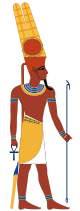
The temple complex at Karnak in Thebes served as the main worship place of Amun-Ra. Image: Amun depicted as Amun-Ra.
Ra’s influence extended through various composite deities, blending his attributes with other gods to enhance his divine persona. Amun-Ra, a fusion of Amun and Ra, retained Amun’s attributes while incorporating Ra’s solar symbolism, often depicted with a sun disk on his headdress. Similarly, Ra-Khepri combined Ra’s solar aspects with Khepri’s scarab symbolism, sometimes shown as a scarab pushing the sun disk, symbolizing the dawn and the renewal of life each day.

Image: Painting of Khepri in QV66, the entrance to the tomb of Queen Nefertari.
In some instances, Amun-Ra was further combined with Min, creating Amun-Ra-Min. This deity retained Min’s characteristics while displaying Ra’s sun disk, blending fertility and creation with solar power. In the Underworld, Ra was sometimes referred to as Khnum-Ra, depicted with a ram’s head and the sun disk, emphasizing his role in the afterlife and his power over both life and death.

Wall relief of Amun-Ra, Mut and Khonsu (left to right), mortuary temple of Ramses III, Medinet Habu, Theban Necropolis, Egypt

Amun-Ra, combining Amun and Ra, was sometimes merged with Min as Amun-Ra-Min, depicted with a sun disk.
Egyptian God Khnum: Myths, Origin Story, Powers, & Importance
Ra-Horakhty
Another significant representation is Ra-Horakhty, where Ra is depicted similarly to Horus but adorned with the sun disk instead of the traditional Pschent crown. This modern depiction of Ra highlights the seamless integration of solar elements with Horus’s attributes, symbolizing the harmonious blend of sky and sun deities.

Ra-Horakhty resembles Horus with a sun disk instead of a Pschent; modern Ra is similarly depicted.
Conclusion
Ra’s symbols and varied depictions reflect his multifaceted role in ancient Egyptian religion as a god of the sun, life, and power. From the Wadjet sun disk and the ankh to his many forms and composite identities, Ra’s iconography captures the essence of creation, authority, and the eternal cycle of rebirth, underscoring his central place in Egyptian mythology.
Frequently Asked Questions about Ra

Jewelry of Ra as a falcon with spread wings, adorned with the sun-disk and holding the ankh, the hieroglyphic symbol of life
How was Ra typically depicted in ancient Egyptian art?
Ra was most commonly portrayed as a man with the head of a falcon, specifically a lanner or peregrine falcon, adorned with the Wadjet sun disk encircled by a cobra (Uraeus). This imagery underscores his association with the sky and protection. Ra was also depicted in various other forms, such as a man with a beetle head (Khepri), a ram’s head in the Underworld, or as composite deities like Amun-Ra and Ra-Horakhty.

Pyramidion of Khonsu, with the image of Ra-Horakhty in the middle.
What roles and aspects did Ra embody beyond being a sun god?
Beyond his solar attributes, Ra was associated with creation, order, and kingship. He was believed to travel through the underworld each night, battling chaos to ensure the sun would rise again. Ra’s journey symbolized the eternal cycle of death and rebirth, maintaining cosmic order (Ma’at). Additionally, as a supreme deity, Ra was linked to the pharaohs, who were considered his earthly embodiments.

Ra is one of ancient Egypt’s most important deities, revered as the sun god and the ruler of the heavens. He embodies creation, life, and the cyclical nature of the sun’s journey across the sky. Image: Ra Ra in his ram-headed sailing on the divine boat through the underworld
Who are some of the composite forms of Ra, and what do they represent?

Ra and Amun, from the tomb of Ramses IV of the 20th Dynasty.
Ra was often merged with other gods to form composite deities, enhancing his attributes. Notable examples include:
- Amun-Ra: Combines Ra with Amun, the god of air and creation, symbolizing both hidden and visible aspects of divinity.
- Ra-Khepri: Merges Ra with Khepri, the scarab beetle god of creation and rebirth, representing the morning sun and renewal.
- Ra-Horakhty: Fuses Ra with Horus the Younger, emphasizing the union of sky and sun deities, often depicted with a sun disk instead of Horus’s traditional crown.

A woman honors Ra-Horakhty, who showers her with luminous rays of divine light as blessings.
What myths are associated with Ra’s journey through the underworld?
A central myth involves Ra’s nightly voyage through the Duat (underworld), where he confronts various challenges and adversaries, including the serpent Apophis (Apep), who embodies chaos. Ra’s successful navigation ensures the sun’s rebirth each morning. This journey symbolizes the struggle between order and chaos, reinforcing Ra’s role as the sustainer of cosmic balance and the guarantor of life’s continuity.

Ra in his sun barque while his offspring the god Seth pierces the fierce serpent of the underworld
How did Ra influence Egyptian society and religion?
Ra’s significance permeated Egyptian culture, influencing art, architecture, and statecraft. Temples dedicated to Ra, such as the famous sun temple at Heliopolis, were centers of worship and pilgrimage.
Pharaohs often associated themselves with Ra to legitimize their rule, adopting solar imagery and titles. Ra’s prominence also shaped Egyptian cosmology, emphasizing the importance of the sun in daily life, agriculture, and the afterlife, thereby integrating his worship into both public and private spheres.

Ra was considered the king of the gods and was central to Egyptian religious beliefs, symbolizing authority and the sustaining power of the sun. Image: Ra and Egyptian goddess Imentet from the tomb of Queen Nefertari, 13th century BC
READ MORE: The Ennead of Heliopolis in Ancient Egypt





