Meretseger, whose name translates to “She Who Loves Silence,” was a significant but localized deity in ancient Egyptian religion, primarily revered during the New Kingdom period (1550–1070 BC).
As the guardian of the Theban Necropolis and the patron goddess of the workers who built and decorated the royal tombs, Meretseger embodied both protective and punitive aspects.
Her unique role in Egyptian mythology highlights the complex relationship between the people and their gods, especially concerning concepts of sin, repentance, and divine retribution.
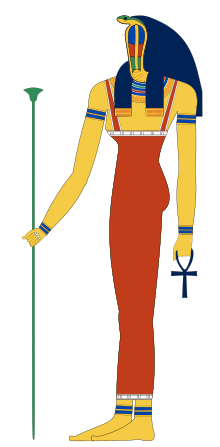
Meretseger, meaning “She Who Loves Silence” and also known as Mersegrit or Mertseger, was a Theban cobra goddess in ancient Egyptian religion. Image: Ancient Egyptian goddess Meretseger holding a staff and the ankh (a symbol of life).
Etymology and Meaning of Her Name
The name Meretseger carries profound significance, reflecting the goddess’s association with silence and the sacredness of the necropolis she protected. Literally meaning “She Who Loves Silence,” her name underscores the quietude of the desert cemeteries and the solemnity expected within such hallowed grounds.
Some interpretations suggest an alternative meaning: “Beloved of Him Who Makes Silence,” linking her to Osiris, the god of the afterlife and the silent realms beyond death. This dual interpretation reinforces her connection to both the physical silence of the necropolis and the spiritual silence of the afterlife.
READ MORE: Interpretation of the Afterlife in Ancient Egyptian Religion
Role and Significance in Egyptian Religion
Meretseger was intimately connected with the artisans and workers of Deir el-Medina, the village located on the west bank of the Nile opposite Thebes. This village housed the craftsmen responsible for constructing and adorning the tombs in the Valley of the Kings and the Valley of the Queens. The workers revered Meretseger as their patron goddess, believing she watched over them and the sacred tasks they performed.
Her role extended beyond mere guardianship; she was seen as a divine enforcer of ma’at, the concept of cosmic order, justice, and truth. Meretseger was believed to punish those who violated sacred laws, particularly offenses like tomb robbing, oath-breaking, or any form of sacrilege against the sanctity of the necropolis. Such transgressions were not uncommon, even among the workers themselves, given the allure of the wealth buried within royal tombs. As a result, the need for a protective deity who could also mete out justice became paramount.
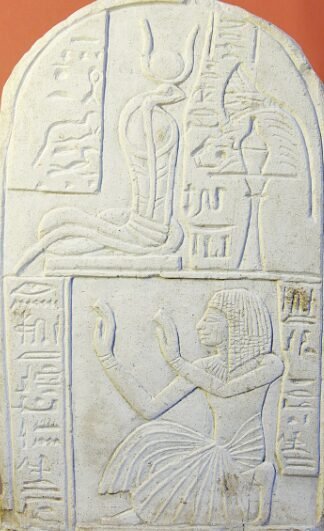
Meretseger’s cult was prominent during the New Kingdom (1550–1070 BC), and she was revered by workers who believed she watched over them. Image: Stela with the drawer Nakhtimen adoring Meretseger. Louvre, Paris.
Association with the Theban Necropolis and el Qurn
Meretseger’s domain was the vast Theban Necropolis, a sprawling complex of tombs and mortuary temples. Central to this landscape was the mountain known today as el Qurn, or “The Horn,” which in ancient times was called “The Peak” (tꜣ-dhnt). Standing at 420 meters, el Qurn is the highest point in the Theban Hills and possesses a pyramid-like shape when viewed from certain angles. This natural resemblance to a pyramid may have influenced the choice of the area as a royal burial site.
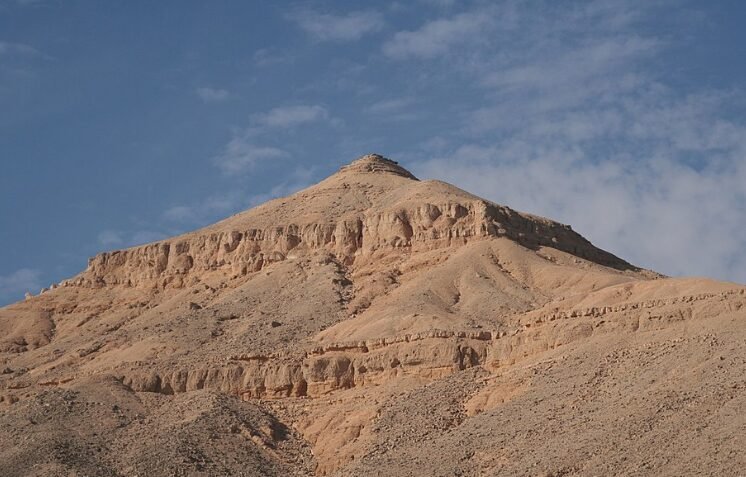
The goddess Meretseger was closely associated with the Theban Necropolis, especially the Valley of the Kings, serving as a guardian and protector of the tombs.. Image: El Qurn, the sharp peak overlooking the Valley of the Kings.
Meretseger was considered the personification of this mountain. Her close association with el Qurn earned her epithets such as “Peak of the West” and “Lady of the Peak.” The mountain was not only a physical landmark but also held spiritual significance, possibly regarded as an entrance to the Duat, the Egyptian underworld. By embodying el Qurn, Meretseger stood as both a physical and spiritual guardian, overseeing the transition of the deceased into the afterlife.
READ MORE: Field of Reeds in Ancient Egyptian Religion
Worship and Cult Practices
The worship of Meretseger was primarily localized, centered around Deir el-Medina and the immediate vicinity of the necropolis. Unlike major deities with temples throughout Egypt, Meretseger’s shrines were modest, often rock-cut chapels or small temples integrated into the landscape she embodied.
One notable shrine was a series of caves arranged in a semicircle at the base of el Qurn. Although much of this shrine has collapsed due to earthquakes, numerous stelae and devotional artifacts have been discovered there, attesting to the workers’ devotion.
Depicted often as a cobra or a woman with a cobra’s head, Meretseger personified the mountain el Qurn, which overlooked the necropolis.
The workers of Deir el-Medina maintained a personal and communal relationship with Meretseger. They offered prayers, left offerings, and dedicated stelae inscribed with hymns and petitions. Their reverence was a blend of fear and respect; they sought her protection and favor while acknowledging her capacity for wrath. Meretseger’s worship was intertwined with their daily lives, reflecting the intimate connection between their labor and their spiritual beliefs.
Meretseger’s Dual Nature: Punisher and Healer
Meretseger’s dual nature is one of the most compelling aspects of her character. She was both a punisher of wrongdoers and a healer of the penitent. This dichotomy is vividly illustrated in the story of Neferabu, a draftsman from Deir el-Medina.
The story of Neferabu illustrates Meretseger’s dual nature as both punisher and healer.
Neferabu claimed that Meretseger struck him blind as punishment for his misdeeds, which may have included perjury or theft. In a stela he dedicated to her, now housed in the Museo Egizio in Turin, he recounts his suffering and subsequent repentance:
I was a man who swore falsely by Ptah, Lord of Truth. He punished me. I was in his grip. I appealed to my mistress, the Peak of the West. After a period of great suffering, she came in mercy to me. She caused me to forget my sickness; she made me like one who is healed.
This account highlights several unique elements in Egyptian religious thought. Concepts of personal sin, divine punishment, sincere repentance, and forgiveness are not commonly emphasized in Egyptian theology, which typically focuses on maintaining cosmic order rather than individual morality. Meretseger’s willingness to forgive and heal those who genuinely repented set her apart from many other deities.
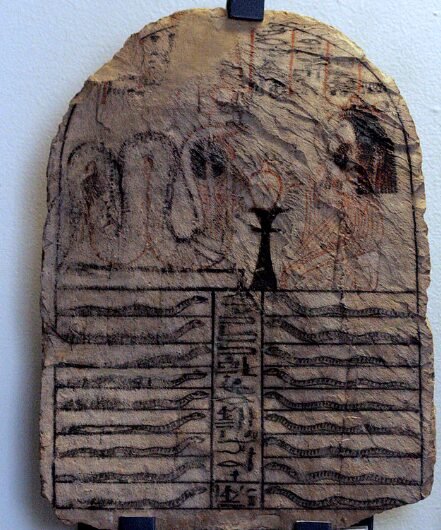
Neferabu, a draftsman who claimed to have been struck blind for his misdeeds, recorded on a stela how he suffered under her wrath but was healed after sincerely repenting and seeking her forgiveness. Image: Stela with a woman adoring Meretseger above many snakes. Louvre, Paris.
Iconography and Depictions
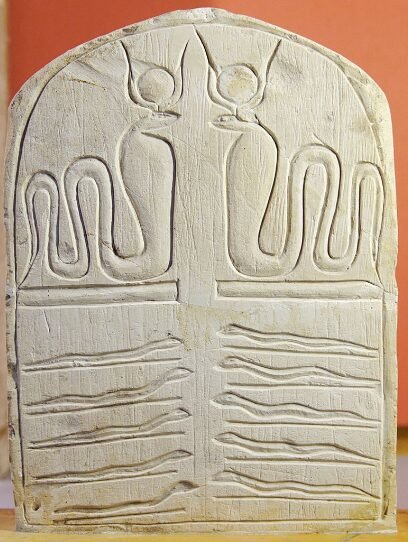
Double image of the goddess Meretseger (upper tier) and snakes (lower tier). Louvre, Paris.
In artistic representations, Meretseger was depicted in forms that emphasized her protective and sometimes fearsome qualities. Common depictions include:
- Cobra or Serpent Form: Reflecting her role as a protective deity and her association with venom and healing. The cobra was a symbol of royalty and divine authority in Egypt, often linked to the goddess Wadjet.
- Woman with a Cobra’s Head: This anthropomorphic portrayal combines human and serpent features, signifying her connection to both the mortal and divine realms.
- Three-Headed Serpent: Featuring the heads of a woman, a serpent, and a vulture, symbolizing her multifaceted nature and dominion over various aspects of life and death.
- Cobra-Headed Sphinx: Merging the concepts of wisdom, protection, and royal power.
In these depictions, she might be adorned with a modius (a type of headdress) topped with a solar disk and feathers, or the Hathoric crown featuring bovine horns and a solar disk, linking her iconography to other prominent deities like Hathor and Ra.
Relationship with Other Deities
Meretseger was sometimes associated with Hathor, the “Lady of the West” and a goddess of love, beauty, music, and the afterlife. Both goddesses shared roles as protectors of the necropolis and guides for the deceased. However, while Hathor’s influence was widespread throughout Egypt, Meretseger remained a local deity.
Her association with other gods worshipped by the workers of Deir el-Medina, such as Ptah (the god of craftsmen), Amun, Thoth, and the deified Pharaoh Amenhotep I, reflects the syncretic nature of Egyptian religion. The workers sought the favor of multiple deities relevant to their professions and personal lives, creating a rich tapestry of religious practice.
Decline of Her Cult
Meretseger’s worship was inherently tied to the Theban Necropolis and the community of Deir el-Medina. When the New Kingdom began to wane and the capital shifted away from Thebes, the Valley of the Kings ceased to be the primary royal burial site. Consequently, the village of Deir el-Medina was abandoned, leading to the decline of Meretseger’s cult. By the Third Intermediate Period (c. 1069–664 BC), her worship had largely disappeared.
Her decline illustrates how the fortunes of a deity could be closely linked to specific places and communities. Without the workers to venerate her and the necropolis to protect, Meretseger’s presence faded from the religious landscape of Egypt.
Meretseger in Royal Tombs
Despite being a local deity, Meretseger’s significance extended into the royal sphere. She appears in several royal tombs, indicating her recognized role in the afterlife journey of pharaohs. For instance:
- Tomb of Userhat (TT56): Meretseger is depicted alongside the god Montu, suggesting her protective role over the tomb’s occupant.
- Tomb of Queen Twosret and Pharaoh Setnakhte (KV14): She appears in a genuflected position, a gesture of reverence and supplication.
- Tomb of Pharaoh Ramesses VI (KV9): Meretseger is shown receiving offerings from the pharaoh himself, accompanied by other deities like Khonsu and Amun-Ra, highlighting her importance in royal funerary rituals.
These depictions underscore her acceptance into the broader pantheon of gods involved in the pharaonic afterlife, even if her primary worship remained localized.
Cultural and Religious Significance
Meretseger’s cult provides valuable insights into the personal piety of ordinary Egyptians, especially those closely connected to the royal tombs. Her worship reflects a blend of fear, respect, and reliance on divine justice. The workers’ relationship with her was deeply personal; they saw her as an immediate and tangible force in their lives, capable of enacting swift punishment or granting mercy.
Moreover, Meretseger’s emphasis on repentance and forgiveness introduces themes that are relatively rare in ancient Egyptian religion. This focus may have been influenced by the unique circumstances of the workers, who lived in close proximity to immense wealth and were entrusted with sacred duties.
The moral and ethical dimensions of her cult suggest a community grappling with the temptations and responsibilities inherent in their work.
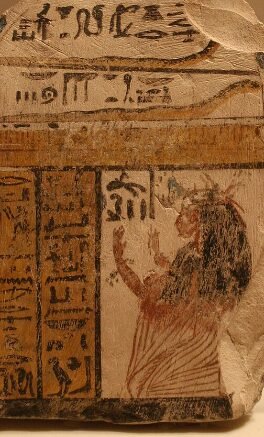
Stela with a woman adoring Egyptian goddess Meretsenger. Egyptian Museum of Berlin.
Not to be confused with Queen Meretseger
Meretseger is a name shared by both a goddess and a queen in ancient Egypt, but they are distinct figures with different roles and historical contexts.
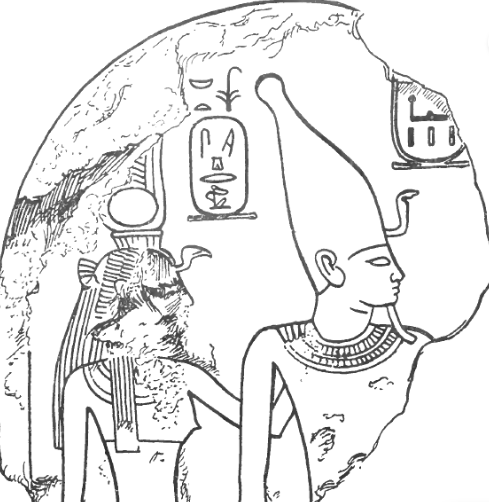
While both share the name Meretseger, the goddess and the queen represent different aspects of ancient Egyptian culture—one divine and protective, the other royal and possibly symbolic—with their similarities in name highlighting the cultural practice of invoking deities through personal names. Image: Meretseger with her husband Senusret III on a New Kingdom stela. British Museum, EA846
Queen Meretseger was a royal consort, possibly the wife of Pharaoh Senusret III during the Middle Kingdom (circa 1878–1839 BC). She is considered potentially the first queen to bear the title “Great Royal Wife” and the first whose name was enclosed within a cartouche, signifying royal status
However, no contemporary records from the Middle Kingdom confirm her existence; references to her appear in sources from the New Kingdom. This has led some scholars to suggest that Queen Meretseger might be a later creation or that her prominence was retrospectively enhanced during the New Kingdom.
Conclusion
Meretseger stands as a fascinating example of how localized worship and specific community needs shaped the Egyptian religious landscape. As the guardian of the Theban Necropolis and the patroness of the Deir el-Medina workers, she embodied the delicate balance between protection and punishment.
Her dual nature as both a fearsome enforcer and a compassionate healer resonated deeply with those who sought her favor.
The story of Meretseger highlights the complexities of ancient Egyptian spirituality, where gods could be both distant cosmic powers and immediate personal deities.
Her cult reminds us that religion in ancient Egypt was not monolithic but was richly varied, adapting to the needs and experiences of different communities. Through Meretseger, we gain a deeper understanding of the interplay between geography, occupation, and faith in shaping the divine relationships of the past.
Frequently Asked Questions
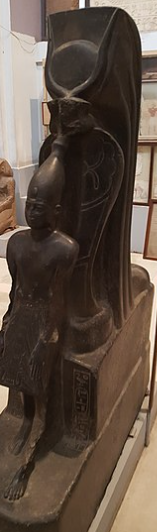
Black granite statue of Meretsger protecting Pharaoh Amenhotep II (1427–1401 BC).
What does the name Meretseger mean, and how is it interpreted in relation to Egyptian deities?
Meretseger’s name means “She Who Loves Silence.” Some interpretations suggest it could also mean “Beloved of Him Who Makes Silence,” linking her to Osiris, the god of the afterlife. The name reflects her association with the quiet and sacred necropolis she guarded.
During which period was Meretseger particularly revered, and where was her worship primarily centered?
Meretseger was particularly revered during the New Kingdom period (1550–1070 BC). Her worship was primarily centered in Thebes, especially in the Theban Necropolis on the west bank of the Nile opposite the city.
Who were Meretseger’s primary worshippers, and why did they both respect and fear her?
Her primary worshippers were the artisans and workers of Deir el-Medina, the village where those who built and decorated royal and noble tombs lived. They respected and feared her because she was believed to punish those who committed sacrilege, such as tomb robbing or breaking oaths, embodying both protective and punitive qualities.
What was the role of Meretseger in relation to the Theban Necropolis and the Valley of the Kings?
Meretseger served as the guardian and protector of the Theban Necropolis, particularly the heavily secured Valley of the Kings. She was believed to watch over the tombs, safeguarding them from desecration and punishing wrongdoers.
How was Meretseger associated with the hill known as el Qurn, and what significance did this location have?
Meretseger was seen as the personification of the hill el Qurn, also called “The Peak” (tꜣ-dhnt), which is the highest point in the Theban Hills overlooking the Valley of the Kings. Its pyramid-like shape may have influenced the choice of the area as a royal burial site, and it was considered sacred, possibly serving as an entrance to the underworld (Duat).
In what forms was Meretseger commonly depicted in artistic representations?
Meretseger was commonly depicted as a serpent with a woman’s head, a cobra-headed sphinx, or a three-headed cobra combining human, serpent, and vulture features. Less frequently, she appeared as a woman with a cobra’s head, sometimes holding a was-scepter and adorned with a feathered headdress.
READ MORE: Major Ancient Egyptian Symbols and their Meanings
What evidence exists of Meretseger’s worship among the workers of Deir el-Medina?
Evidence includes numerous small stelae and chapels at the foot of el Qurn dedicated to her, artifacts bearing her likeness, and devotional items found in her main shrine—a series of caves forming a semicircle. These artifacts highlight the personal devotion of the workers to Meretseger.
How did Meretseger’s worship compare to that of other deities like Hathor, Ptah, Amun, and Thoth among the workers?
While Meretseger was a localized deity specifically associated with the necropolis, workers also worshipped other gods like Hathor, Ptah, Amun, and Thoth, who had broader roles in Egyptian religion. Meretseger’s worship was more personal and directly connected to the daily lives and concerns of the workers, particularly regarding protection and justice.
Why did Meretseger’s cult eventually diminish and disappear?
Meretseger’s cult diminished and eventually disappeared around the 11th or 10th century BC when the Valley of the Kings ceased to be used as a royal burial site and Thebes lost its status as the capital. Her deep connection to this specific location and community limited her prominence, and without the necropolis’s central role, her worship declined.
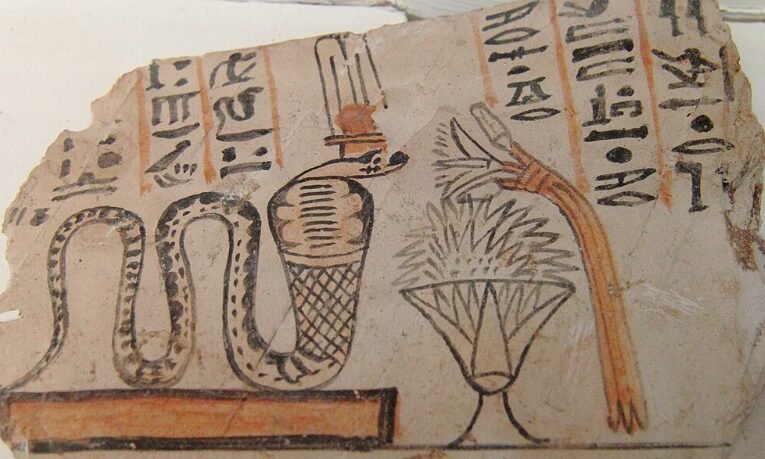
Meretseger on an ostracon. Egyptian Museum, Cairo.
In which royal tombs is Meretseger depicted, and what does her inclusion signify?
Meretseger is depicted in several royal tombs, including the tomb of Userhat (TT56), the tomb of Queen Twosret and Pharaoh Setnakhte (KV14), and the tomb of Pharaoh Ramesses VI (KV9). Her inclusion signifies her importance in the afterlife beliefs and her protective role over both the living and the dead.
How does Meretseger’s role highlight the complex nature of Egyptian religious beliefs?
Meretseger embodies both protective and punitive aspects of divinity, reflecting a deity who could both harm and heal. This duality highlights the complex and personal nature of Egyptian religious beliefs, where gods interacted directly with individuals, rewarding or punishing them based on their actions, and where local deities held significant influence over specific aspects of life.





