What is the Theban Necropolis?
The Theban Necropolis is a vast burial site situated on the west bank of the Nile River, directly across from the ancient city of Thebes, which is now modern-day Luxor in Upper Egypt.
This necropolis was used as a final resting place for many of the elite members of Egyptian society, including pharaohs, high-ranking officials, and nobles, primarily during the New Kingdom (circa 1550–1070 BCE).
The site has become one of the most significant archaeological locations in the world, known for its monumental tombs, mortuary temples, and rich historical context. Its preservation of ancient Egyptian art, architecture, and religious beliefs has made it a key focus of study for Egyptologists and historians.

Image: A bird-eye view of the Theban Necropolis.
Geographic and Historical Context
The Theban Necropolis occupies a prominent place on the west bank of the Nile. In ancient Egyptian belief, the western side of the river was associated with death and the afterlife, symbolized by the setting sun. For this reason, it became the natural choice for the burial grounds of the deceased, particularly the royal and noble figures who required elaborate tombs and funerary temples to honor their lives and ensure a successful journey to the afterlife. The east bank, where the sun rises, was associated with life and rebirth, and it was here that the bustling city of Thebes, the religious and political capital of Egypt during much of the New Kingdom, was located.
During the New Kingdom, Thebes was the center of power and home to some of Egypt’s most celebrated rulers, such as Thutmose III, Amenhotep III, and Ramses II. It was during this period that the Theban Necropolis reached its height as a burial ground, with the construction of some of the most famous tombs and mortuary temples. However, the necropolis was not limited to the New Kingdom; it had been used as a burial site in earlier periods as well, though the scale and grandeur of the tombs increased significantly during the New Kingdom.
Ancient Egyptian Kings of the New Kingdom and their Accomplishments
Key Areas of the Theban Necropolis
The Theban Necropolis encompasses a wide area and contains several distinct zones, each with its own historical and archaeological significance. These zones include the Valley of the Kings, the Valley of the Queens, Deir el-Medina, and various mortuary temples.
Valley of the Kings
The Valley of the Kings is perhaps the most famous part of the Theban Necropolis. It served as the burial site for many of the New Kingdom’s most prominent pharaohs, including the well-known tomb of Tutankhamun, discovered by Howard Carter in 1922. Other significant tombs in the valley belong to rulers such as Ramses II, SetiI, and Thutmose III.
The pharaohs of the New Kingdom, seeking to protect their tombs from looting, abandoned the earlier tradition of building large pyramids and opted for hidden tombs cut into the cliffs of the valley. These tombs were elaborately decorated with scenes from Egyptian mythology, religious texts, and depictions of the deceased’s journey through the underworld, all meant to guide and protect the soul in the afterlife.
The tombs vary in size and complexity, but many follow a general pattern of a descending corridor that leads to a burial chamber deep within the rock. The walls of the tombs are covered in intricate carvings and paintings that provide a wealth of information about ancient Egyptian beliefs, artistic styles, and burial practices.

Image: Valley of the Kings
Valley of the Queens
Located to the southwest of the Valley of the Kings, the Valley of the Queens served as the burial place for the wives of pharaohs, as well as some royal children. One of the most famous tombs in this valley is that of Queen Nefertari, the wife of Ramses II. Nefertari’s tomb is renowned for its vivid wall paintings, which are among the most beautifully preserved examples of ancient Egyptian art.
Like the Valley of the Kings, the tombs in the Valley of the Queens were carved into the rock and decorated with scenes intended to ensure the deceased’s safe passage to the afterlife. The walls of these tombs often depict the queens interacting with gods and goddesses, emphasizing their divine status and the religious importance of their roles.
Deir el-Medina
Deir el-Medina is another important part of the Theban Necropolis, though it differs from the royal burial sites. It was a village that housed the workers and craftsmen who built and decorated the tombs in the Valley of the Kings and the Valley of the Queens. The inhabitants of Deir el-Medina were skilled artisans, and their own tombs, though smaller than those of the royalty, were often finely decorated.
What makes Deir el-Medina particularly valuable to historians is the wealth of written records found at the site. The villagers left behind a large number of documents, including letters, legal texts, and records of daily life, providing a rare glimpse into the lives of ordinary Egyptians. These records offer insights into the organization of labor, the social structure of the village, and the religious beliefs of the workers.
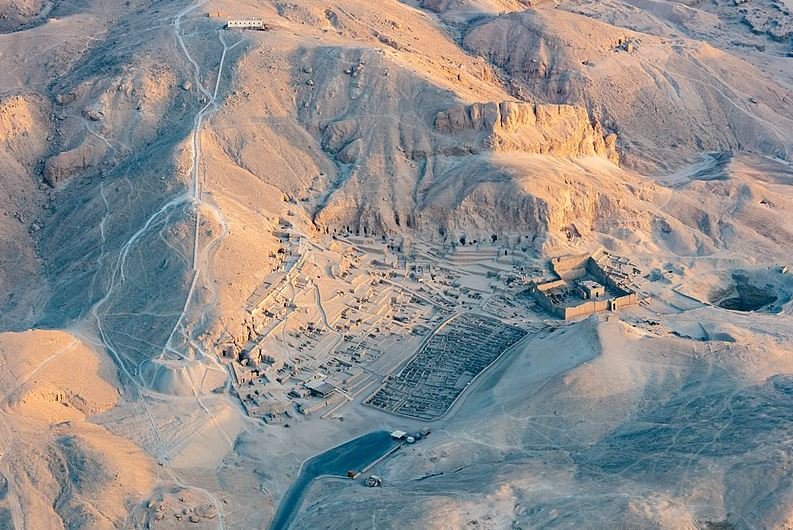
Image: Deir el-Medina
Mortuary Temples
In addition to the tombs, the Theban Necropolis is also home to several large mortuary temples, which were built to honor the deceased pharaohs and serve as places for the living to offer prayers and make offerings to the dead. These temples were often built near the tombs, though separate from the burial chambers themselves.
One of the most impressive examples is the Mortuary Temple of Hatshepsut, located at Deir el-Bahari. This massive, terraced structure was built into the cliffs and served as a place to commemorate Hatshepsut, one of Egypt’s few female pharaohs. The temple is renowned for its architectural innovation and its well-preserved reliefs that depict scenes from Hatshepsut’s reign, including her famous expedition to the land of Punt.
Another significant mortuary temple is the Ramesseum, built by Ramses II. This temple, although partially in ruins today, was once a grand complex filled with statues, obelisks, and reliefs celebrating the military victories and divine status of Ramses II.
Art and Religion in the Theban Necropolis
The Theban Necropolis is a remarkable repository of ancient Egyptian art, particularly the paintings, reliefs, and carvings found within the tombs. The artwork in these tombs was not merely decorative but played a crucial role in the religious and funerary practices of the Egyptians. The scenes depicted in the tombs were meant to guide the deceased through the afterlife, helping them overcome the dangers and obstacles of the underworld.
Common themes in tomb art include depictions of the deceased making offerings to the gods, scenes of the soul’s journey through the afterlife, and images of the pharaoh being welcomed by gods such as Osiris, Anubis, and Ra. The walls of the tombs are often inscribed with passages from religious texts, such as the Book of the Dead and the Amduat, which provided instructions for navigating the afterlife.
The construction and decoration of the tombs were deeply intertwined with ancient Egyptian religious beliefs, particularly their view of the afterlife. Egyptians believed in an eternal life after death, and the preservation of the body through mummification, combined with the protection of the tomb and the offerings made within it, were essential to ensure the deceased’s immortality. The tombs in the Theban Necropolis are designed as eternal homes for the dead, filled with the goods and provisions they would need in the next world.

Image: The exact location of the Theban Necropolis in Egypt.
Archaeological Significance
The Theban Necropolis has been a focal point for archaeological exploration since the late 18th century, when European explorers and antiquarians began to visit the site. Early explorers like Giovanni Belzoni, Jean-François Champollion, and John Gardner Wilkinson made significant discoveries, documenting the tombs and their contents. Wilkinson, in particular, played a crucial role in recording many of the inscriptions and artwork in the necropolis and was responsible for developing the numbering system for the tombs in the Valley of the Kings, which is still in use today.
The discovery of Tutankhamun’s tomb by Howard Carter in 1922 was one of the most famous archaeological finds in history, bringing global attention to the Theban Necropolis and sparking renewed interest in ancient Egypt. Carter’s excavation of the tomb revealed thousands of artifacts, including the iconic golden death mask, offering unparalleled insights into the wealth and burial practices of New Kingdom pharaohs.
Since then, excavations in the Theban Necropolis have continued, with archaeologists uncovering new tombs, artifacts, and inscriptions that shed light on ancient Egyptian society, religion, and politics. Many of the tombs and temples have undergone extensive conservation efforts to preserve their artwork and structures, ensuring that future generations can continue to study and appreciate them.

The Theban Necropolis Today
Today, the Theban Necropolis is a UNESCO World Heritage Site, recognized for its outstanding cultural and historical significance. It is a popular destination for tourists and scholars alike, offering a unique opportunity to explore some of the most important tombs, temples, and monuments of ancient Egypt.
The Egyptian government, along with international organizations, has invested heavily in the preservation and restoration of the necropolis, recognizing its value as both a cultural treasure and a key to understanding ancient Egyptian civilization. New technologies, such as 3D scanning and digital mapping, have been employed to document the tombs and artwork, allowing researchers to study them in greater detail and ensuring their preservation for future generations.