Ancient Greek Coinage: History and Major Facts
Ancient Greek coinage is a remarkable reflection of the culture, politics, and economy of one of history’s most influential civilizations. Its development spans four distinct periods: Archaic, Classical, Hellenistic, and Roman. Each era contributed unique features to the evolution of coinage, leaving a lasting legacy in monetary systems and artistic traditions.
Archaic Period (7th Century BC–480 BC)
The earliest coins appeared in the 7th century BC in Lydia and Ionia. Made of electrum, a natural gold-silver alloy, these coins were small, uninscribed, and often decorated with simple symbols like animals. They facilitated trade by offering a standardized medium of exchange.
Around 550 BC, King Croesus of Lydia introduced coins made of pure gold and silver, called Croeseids. These standardized coins influenced Greek city-states (poleis), many of which began producing their own coinage. For instance, Aegina issued silver staters with sea turtles, reflecting its maritime power.
While most Greek cities adopted coinage, Sparta resisted, using iron ingots instead. This policy discouraged wealth hoarding and reinforced Spartan ideals of frugality and equality. Despite such exceptions, coinage spread widely across the Greek world by the end of this period.

Image: An ancient Athenian coin featuring Athena’s image on the front, with an olive sprig, an owl, and the initials “ΑΘΕ” for “Athens” on the back.
Classical Period (480–323 BC)
The Classical period marked the height of Greek coin artistry. Cities like Athens, Corinth, and Syracuse produced coins with intricate designs showcasing their patron deities, civic pride, and identity. Athenian coins, featuring Athena and her owl, became iconic.
Athens’ silver tetradrachms, known as “owls,” were widely used across the Mediterranean due to their consistent weight, high silver purity, and Athens’ dominance in trade. Their success was bolstered by silver from the Laurion mines.
Syracuse, in Sicily, became renowned for its decadrachms, which depicted the nymph Arethusa and quadriga chariots. These coins reflected the city’s wealth and artistic ambition, setting a high standard for numismatic art.
Coins played a crucial role in funding wars. Greek cities minted large quantities of silver and gold coins to pay soldiers and mercenaries, fueling both military campaigns and economic expansion.
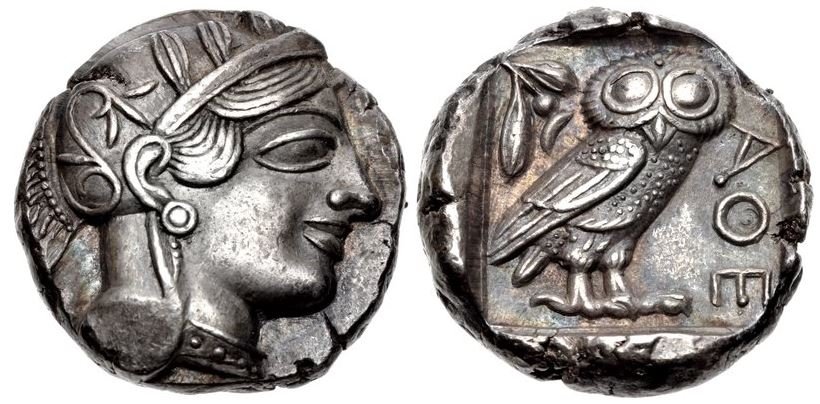
Image: Tetradrachm of Athens. Front: A depiction of Athena, the city’s patron goddess, wearing a helmet. Back: The Athenian owl, accompanied by an olive sprig and the inscription ΑΘΕ[ΝΑΙΟΝ], meaning “of the Athenians.”
Hellenistic Period (323–31 BC)
The Hellenistic period began with Alexander the Great’s conquests, spreading Greek culture and coinage across a vast empire. Alexander introduced a unified currency system, and his silver tetradrachms, often depicting him as Heracles, became a standard throughout his territories.
After Alexander’s death, his generals established large Hellenistic kingdoms, such as the Ptolemaic, Seleucid, and Antigonid realms. These centralized states issued coins on a larger scale, often in gold and silver. Royal portraits, a new feature in Greek coinage, became common, showcasing rulers like Ptolemy I and Seleucus I as divine or heroic figures.
Alexander’s empire unified a currency system, spreading Greek coins across a vast area from Egypt to India.
Greek coinage extended its influence far beyond Greece. Coins from this period have been found in regions as distant as India, where Greco-Bactrian and Indo-Greek kings minted bilingual coins blending Greek and local styles. These coins reflect the cultural and economic exchange of the Hellenistic world.
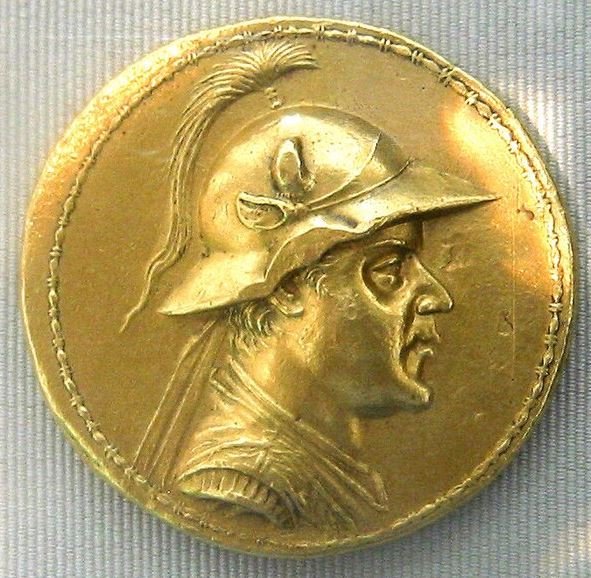
Image: Gold stater of Eucratides I
Roman Period (31 BC–3rd Century AD)
By the 1st century BC, Rome had absorbed the Greek world, yet many Greek cities continued minting their own coins under Roman oversight. These Roman provincial coins often combined Greek artistry with Roman motifs, reflecting the fusion of cultures.
Greek coins during the Roman period retained much of their traditional aesthetic but served local economies within the Roman Empire. This continuation highlights the enduring influence of Greek numismatic practices.
Weight Standards and Denominations
Greek coinage operated on several weight standards. The Attic standard, based on a 4.3-gram drachma, was the most widely used. Other notable systems included the Corinthian and Aeginetan standards, each tailored to regional economic needs.
Coins were denominated in drachmae, obols, and smaller fractions like tetartemorioi. The drachma, meaning “a handful,” was divided into six obols, allowing for a wide range of transactions from daily purchases to large-scale trade.
Symbolism and Artistry
Greek coins often depicted symbols unique to their issuing city-state. For example, Corinthian coins featured Pegasus, while Rhodian coins depicted a rose, playing on the Greek word for the flower, rhodon. Athenian coins showcased Athena and her owl, symbols of wisdom and protection.
The imagery on Greek coins frequently had religious meaning. Deities, sacred animals, and mythological figures adorned coins, emphasizing the close ties between religion, politics, and civic life.
Coins from cities like Syracuse, with their detailed depictions of Arethusa and quadrigas, exemplify the artistic sophistication of Greek engravers. These miniature masterpieces were as much about cultural expression as economic utility.
Economic and Political Roles
Greek coins facilitated trade across the Mediterranean, serving as a trusted medium of exchange. Athenian “owls” and other widely accepted currencies helped integrate regional economies into a broader trading network.
Coins also served as a medium for political messaging. The use of royal portraits in the Hellenistic period, for example, projected the authority and divinity of rulers. Similarly, city symbols reinforced civic pride and autonomy.
Legacy of Greek Coinage
Greek coinage set standards in weight, design, and symbolism that influenced subsequent monetary systems, including those of the Romans and later European states. The artistic and technical achievements of Greek coins remain unparalleled.
Today, ancient Greek coins are highly valued by collectors and historians. Major collections in institutions like the British Museum and the American Numismatic Society preserve thousands of coins, offering insights into ancient economies and artistry.
Thanks to their durability and historical abundance, ancient Greek coins remain accessible to collectors worldwide. They continue to be appreciated not only for their aesthetic appeal but also for the rich history they embody.
Frequently Asked Questions

The four periods are the Archaic (7th century BC–480 BC), Classical (480–323 BC), Hellenistic (323–31 BC), and Roman (31 BC–3rd century AD) periods. Image: Alexander the Great tetradrachm.
Where and when were coins first introduced to the Greek world?
Coins were first introduced in the 7th century BC in Lydia and parts of Ionia.
What was the significance of the Croeseids introduced by King Croesus of Lydia?
Croeseids were the first coins made of pure gold and silver, marking a standardization in weight and composition that influenced Greek coinage.
Why did Sparta resist adopting coinage?
Sparta used iron ingots for trade to discourage wealth accumulation and promote a frugal, egalitarian society.
What made Athenian silver tetradrachms, known as “owls,” so widely accepted?
Their consistent weight, high silver purity, and Athens’ dominance in trade and silver production contributed to their widespread use.
How did Hellenistic coins differ from those of earlier periods?
Hellenistic coins were often larger, mass-produced, made of gold and silver, and featured royal portraits, symbolizing the power of the issuing kings.
What was the primary function of coin symbolism in Greek city-states?
Symbols represented a city’s identity and heritage, such as Athena’s owl on Athenian coins or Pegasus on Corinthian coins.
What were the main weight standards for Greek coins, and which was most widely used?
The main standards were the Attic, Corinthian, and Aeginetan. The Attic standard, based on a 4.3-gram drachma, became the most popular.
How did Greek coinage influence the Roman period?
Under Roman rule, Greek cities continued issuing coins, blending Greek artistry with Roman motifs, maintaining their cultural and economic traditions.