
A 16th-century engraving depicting Strabo, the ancient Greek geographer and historian.
Strabo (64/63 BC – c. 24 AD) was a prominent ancient Greek geographer, historian, and philosopher who lived during the transitional period from the Roman Republic to the Roman Empire. His most notable work, Geographica, is an encyclopedic masterpiece that provides a descriptive history of various regions, peoples, and cultures known in his era. Despite the loss of most of his historical writings, Geographica remains a valuable resource for understanding ancient geography, history, and ethnography.
Below, World History Edu explores Strabo’s life, education, travels, works, and his contributions to geology and geography.
Early Life and Family Background
Strabo was born in Amaseia, Pontus (modern-day Amasya, Turkey), around 64 BC. His family was affluent and politically active, with ties to the Pontic royal court under Mithridates VI. Strabo’s maternal lineage connected him to Dorylaeus, a general under Mithridates VI. His paternal grandfather also played a significant role in the Mithridatic Wars, aiding the Romans by surrendering Pontic fortresses. This alliance with Rome likely influenced Strabo’s family’s standing and possibly granted them Roman citizenship.
Strabo (64/63 BC – c. 24 AD) was a prominent ancient Greek geographer, historian, and philosopher who lived during the transitional period from the Roman Republic to the Roman Empire
Amaseia, Strabo’s hometown, was a center of Persian culture, which persisted even after Pontus fell under Roman control. This multicultural environment may have contributed to Strabo’s broad intellectual interests and his eventual focus on documenting the diverse cultures of the ancient world.
The last king of Rome before the establishment of the Roman Republic
Education and Philosophical Influences
Strabo’s education was comprehensive, encompassing rhetoric, philosophy, grammar, and geography. He began his studies in Nysa, where he was tutored by Aristodemus, a renowned rhetorician and grammarian. Aristodemus, an expert in Homeric literature, likely inspired Strabo’s lifelong admiration for Homer’s epics, which often influenced his geographical descriptions.
At the age of 21, Strabo moved to Rome, where he studied philosophy under Xenarchus, a prominent Peripatetic philosopher. Although initially influenced by Aristotelian thought, Strabo eventually adopted Stoic principles, likely due to his association with Athenodorus Cananites, a Stoic philosopher and mentor to Strabo. In addition, he studied grammar and geography with Tyrannion of Amisus, further shaping his intellectual development.
Extensive Travels
Strabo’s life was characterized by extensive travels, which enriched his geographical knowledge. He journeyed across the Mediterranean and Near East, visiting Egypt, Ethiopia, coastal Tuscany, and Asia Minor. His travels extended as far west as Spain and as far east as Armenia. Notably, he explored Egypt around 25 BC, sailing up the Nile to Philae. These firsthand experiences informed his descriptions of various regions and peoples in Geographica.
During the reign of Emperor Augustus (27 BC – 14 AD), travel across the Mediterranean was relatively safe, enabling scholars like Strabo to pursue their intellectual endeavors. Strabo’s observations provided valuable insights into the political, cultural, and economic conditions of the regions he visited.
The Geographica
Strabo’s most significant work, Geographica, consists of 17 books that blend geography with history, ethnography, and cultural studies. Written during the reign of Emperor Tiberius, the work aimed to provide a comprehensive account of the known world, covering Europe, Asia, and Africa. Unlike earlier geographical texts that focused on mathematical measurements, Strabo emphasized descriptive geography, making his work accessible to statesmen and scholars.
Geographica covers a wide range of topics, including:
- Europe: Descriptions of Britain, Gaul, Germania, the Iberian Peninsula, and the Alps.
- Asia Minor and the Middle East: Detailed accounts of Anatolia, Mesopotamia, and Persia.
- North Africa: Insights into Egypt, Libya, and Ethiopia.
The work integrates historical and cultural details, providing readers with a holistic understanding of each region. For example, Strabo’s descriptions of Alexandria highlight its thriving economy, architectural grandeur, and sophisticated urban planning.
Strabo relied on earlier works by renowned scholars, including Homer, Eratosthenes, and Hipparchus. He also incorporated information from his travels and observations. While he acknowledged the contributions of mathematical geographers, Strabo argued that descriptive geography was more practical for understanding the character of regions and their inhabitants.
Historical Works and Legacy of Strabo
In addition to Geographica, Strabo wrote a historical work titled Historical Sketches (Historica Hypomnemata), which chronicled events from the Roman conquest of Greece onward. Unfortunately, this work is almost entirely lost, with only fragments surviving in quotations by later authors.
Despite its initial obscurity, Geographica gained recognition during the Byzantine era and was later rediscovered in Renaissance Europe. The first Latin translation appeared in 1469, and the first printed edition was published in Venice in 1516. Isaac Casaubon’s critical edition in 1587 further cemented Strabo’s reputation as a foundational figure in the field of geography.
Strabo’s Contributions to Geology
Strabo’s observations extended beyond geography to geology and natural phenomena. He discussed the formation of marine fossils found at high altitudes, attributing their presence to geological upheavals rather than ancient seas drying up. Strabo also theorized about the role of earthquakes and volcanic activity in shaping the Earth’s surface. For example, he described the volcanic region of Katakekaumene in Asia Minor, noting its fertile soil and evidence of past eruptions.
Strabo’s Geographica remains a monumental achievement in the history of geography and ethnography.
Strabo’s geological insights, such as his explanation of land uplift and subsidence, anticipated modern geological theories. He emphasized the importance of observable phenomena, such as volcanic eruptions and earthquakes, in understanding the Earth’s dynamic processes.
Strabo’s View of the Roman and Greek Worlds
Strabo was pro-Roman in his political outlook, often praising the stability and prosperity brought by Roman rule. However, he also sought to highlight Greek cultural and intellectual achievements. For instance, he portrayed Greece as the cradle of civilization, emphasizing its contributions to philosophy, science, and art. This dual perspective reflects Strabo’s effort to reconcile his Greek heritage with his admiration for Roman governance.
Scientific and Cultural Observations
Strabo provided detailed accounts of India, although he never visited the region. His descriptions included both factual and mythical elements, such as flying reptiles and winged scorpions. While some of these accounts seem fanciful, they reflect the blend of observation and hearsay common in ancient geography.
Strabo’s depiction of Alexandria offers a vivid portrait of the city as a hub of commerce and culture. He praised its wide streets, public parks, and well-planned infrastructure. His observations underscore the city’s importance as a center of learning and trade in the ancient world.
Influence on Later Thinkers
Strabo’s work influenced both ancient and modern scholars. His descriptive approach to geography inspired later Byzantine and Islamic geographers, while his emphasis on firsthand observation resonated with Renaissance scientists. Strabo’s integration of history, culture, and geography laid the groundwork for interdisciplinary studies in the humanities.
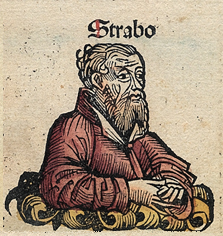
Strabo as portrayed in the “Nuremberg Chronicl”, an early printed book from the 15th century.
Frequently asked questions about Strabo
Where was Strabo born, and how did his family influence his life?
He was born in Amaseia, Pontus (modern Turkey), to an affluent family involved in politics, aligning with Rome during the Mithridatic Wars, which likely influenced his pro-Roman perspective.
What is significant about Strabo’s education?
Strabo studied under renowned teachers like Aristodemus, Xenarchus, and Athenodorus, learning rhetoric, geography, and Stoic philosophy, which shaped his works.
What regions did Strabo explore during his lifetime?
He traveled extensively across the Mediterranean, including Egypt, Kush, Tuscany, Ethiopia, and Asia Minor, gaining firsthand knowledge for his writings.
When and why did Strabo write Geographica?
Written between 7 BC and AD 23, Geographica aimed to provide a practical, descriptive account of the world for statesmen rather than relying on mathematical geography.
How did Strabo view geology and volcanism?
Strabo theorized land elevation changes due to subterranean forces and described volcanic activity in regions like Katakekaumene, emphasizing its effects on the landscape.
Why is Strabo’s Geographica still valuable today?
It offers unique insights into ancient geography, culture, and Roman-Greek interactions, serving as a historical source when corroborated by other evidence.
How did Strabo depict Alexandria?
He described it as a thriving port city with wide streets, public parks, and a robust economy, highlighting its urban and cultural significance.





