The last king of Rome before the establishment of the Roman Republic
Lucius Tarquinius Superbus, also known as Tarquin the Proud, was the seventh and final king of Rome. His reign marked a turbulent period in Roman history, filled with political intrigue, tyranny, and violence, which ultimately led to the end of the Roman monarchy and the establishment of the Roman Republic.
Frequently Asked Questions about Romulus and the Founding of Rome
To understand Tarquin’s life and reign, ancient Roman historians at World History Edu explore his background, his rise to power, his rule, and his eventual downfall.

Background and Family Lineage
Tarquin was a member of the Tarquin family, a powerful Etruscan dynasty that played a crucial role in early Roman politics. The earliest sources, such as Quintus Fabius Pictor, claim that Tarquin was the son of Lucius Tarquinius Priscus, the fifth king of Rome. However, modern historians argue that this is unlikely due to chronological inconsistencies. Instead, it is believed that Tarquin was more likely the grandson of Priscus, or that the traditional timeline of events in early Roman history may be flawed.
Tarquin’s mother was said to be Tanaquil, an influential figure in Roman politics. Tanaquil was a strong and ambitious woman who, after her husband Priscus’ death, helped ensure the succession of Servius Tullius to the throne. Tanaquil’s political machinations set the stage for the rise of Tarquin Superbus.

Image: Portrait of Lucius Tarquinius Superbus.
The Rise to Power: A Story of Betrayal and Murder
Tarquin’s path to the throne was marked by violence, betrayal, and manipulation. He was married to Tullia Minor, one of the daughters of King Servius Tullius. Servius had strategically married his daughters—Tullia Major and Tullia Minor—to Tarquin and his brother Arruns to avoid conflict within the royal family. Tullia Major, who married Tarquin, was mild and peaceful, while Tullia Minor, who married Arruns, was ambitious and fierce.
Tullia Minor despised her husband Arruns for his lack of ambition, and she conspired with Tarquin to rid themselves of their spouses. The two orchestrated the murders of both Tullia Major and Arruns, leaving them free to marry each other. Once married, Tullia Minor encouraged Tarquin to seize the throne from her father, Servius Tullius.
Tarquin, with the support of several patrician senators, launched a campaign of slander against Servius. He accused the aging king of favoring the lower classes over the nobility, of redistributing land, and of being an illegitimate ruler, as Servius had not been formally elected by the Roman people or the Senate. Tarquin also courted the favor of the wealthier class, particularly those senators who had gained their positions under his father, Tarquinius Priscus.
With growing support, Tarquin made his move. He stormed the Senate with a group of armed men and publicly claimed the throne. Servius arrived at the Senate to confront Tarquin, but the younger man physically attacked him, throwing him down the steps of the Senate House. Servius, weakened and injured, was later murdered in the street by Tarquin’s assassins, possibly under the orders of Tullia. Tullia herself drove her chariot over her father’s corpse, further cementing the brutal nature of Tarquin’s rise to power. The street where this grisly act occurred became known as the “Vicus Sceleratus,” or “Street of Crime.”

The Reign of Tarquin: Tyranny and Fear
From the moment Tarquin seized power, his reign was characterized by tyranny and a disregard for Roman traditions. One of his first actions as king was to refuse Servius Tullius a proper burial, a significant break from the Roman custom of honoring deceased leaders. Tarquin then began a systematic purge of senators whom he believed were loyal to Servius. By killing these senators and not replacing them, he effectively weakened the Senate, reducing its power and limiting its influence in the governance of Rome.
Tarquin’s autocratic rule extended to his handling of legal matters. Unlike his predecessors, who consulted a council of advisors in judging capital crimes, Tarquin judged these cases alone. This created a climate of fear, as people feared arbitrary judgment and punishment from the king. By consolidating all power in himself, Tarquin alienated much of the aristocracy and undermined the traditional checks on royal authority.
To secure political alliances, Tarquin arranged the marriage of his daughter to Octavius Mamilius, the prince of Tusculum and one of the most powerful leaders among the Latin peoples. This alliance would later play a key role in Tarquin’s efforts to maintain power and wage war.
Wars and Building Projects
Despite his tyrannical nature, Tarquin was a competent military leader, and his reign was marked by a number of military campaigns. Early in his reign, he focused on strengthening Rome’s alliances with the Latin cities. He convened a meeting of Latin leaders in a sacred grove dedicated to the goddess Ferentina. During this meeting, a Latin noble named Turnus Herdonius accused Tarquin of arrogance and warned his fellow leaders not to trust him. In response, Tarquin framed Turnus for plotting his assassination by planting weapons in his quarters. Turnus was subsequently executed by drowning, and Tarquin was able to persuade the Latin leaders to renew their treaty with Rome and form a united military force.
With the Latins as allies, Tarquin waged a successful war against the Volsci, capturing the wealthy town of Suessa Pometia. The spoils of this victory allowed him to fund several major construction projects in Rome, including the construction of the Temple of Jupiter Optimus Maximus on the Capitoline Hill, which had been vowed by his father, Tarquinius Priscus. Tarquin also fought against the Latin city of Gabii. When he was unable to capture the city by force, he employed a cunning stratagem. Tarquin’s son Sextus pretended to defect to Gabii, claiming to have been mistreated by his father. Once Sextus had gained the trust of the Gabians, he systematically eliminated their leaders, allowing Tarquin to capture the city without resistance.
In addition to his military campaigns, Tarquin is credited with several ambitious building projects that contributed to Rome’s urban development. He oversaw the construction of Rome’s great sewer, the Cloaca Maxima, which helped drain the marshy areas of the city and made expansion possible. He also began the construction of tiers of seats for spectators at the Circus Maximus, where public games and races were held.
Tarquin’s reign also saw his interaction with the legendary Cumaean Sibyl. According to the story, the Sibyl offered Tarquin nine books of prophecy at an exorbitant price. When Tarquin refused, she burned three of the books and offered him the remaining six at the same price. Tarquin hesitated again, and she burned three more books. Finally, he purchased the last three at the original price. These remaining books, known as the Sibylline Books, were considered sacred and contained prophecies that were consulted during times of crisis in Roman history.
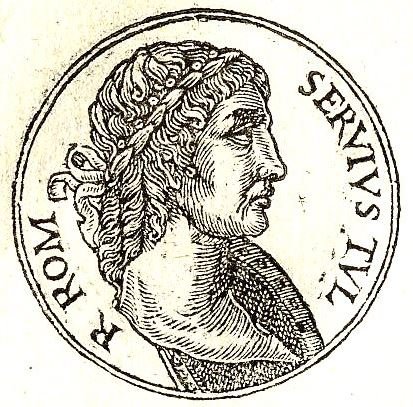
Tarquin reportedly seized the throne through a series of murders, including those of his wife, elder brother, and his predecessor, Servius Tullius. Image: A portrait of Servius Tullius.
The Beginning of the End: The Rape of Lucretia
The event that led directly to the downfall of Tarquin and the Roman monarchy was the infamous rape of Lucretia by Tarquin’s son, Sextus Tarquinius. During the siege of the Rutulian city of Ardea, the Roman noblemen, including Sextus and his cousin Lucius Tarquinius Collatinus, were boasting about the virtues of their wives. Collatinus claimed that his wife, Lucretia, was the most virtuous of them all. To test this claim, the men visited their homes unannounced. While most of the noblemen’s wives were found enjoying themselves, Lucretia was discovered engaged in domestic activities, demonstrating her chastity and loyalty.
Sextus was infatuated with Lucretia and returned to her home a few days later. He threatened her with violence and disgrace, telling her that if she did not submit to him, he would kill her and claim that he had caught her in the act of adultery with a slave. To avoid this humiliation, Lucretia reluctantly yielded to Sextus. Afterward, Lucretia called for her husband Collatinus, her father, and their friend Lucius Junius Brutus, and revealed the crime that had been committed against her. Despite their attempts to console her, Lucretia took her own life, unable to live with the dishonor that had been forced upon her.
The rape of Lucretia outraged the Roman people, and it became a catalyst for rebellion. Led by Brutus, Collatinus, and other prominent Roman nobles, the people rose up against Tarquin and his family. Brutus, who had long harbored resentment against the Tarquin family, took advantage of the situation to ignite a revolution. As Tribune of the Celeres, Brutus was in a position of authority over the king’s personal bodyguard, and he summoned the comitia, an assembly of Roman citizens, to revoke the king’s powers.
The uprising spread quickly, and Tarquin, along with his wife Tullia and their children, was forced to flee Rome. The royal family sought refuge with the Etruscan cities that had been their allies, but the Roman people declared the monarchy abolished and established the Roman Republic in 509 BC. Brutus and Collatinus were elected as the first consuls of Rome, marking the end of the Roman Kingdom and the beginning of a new era in Roman governance.
The Aftermath: Tarquin’s Attempts to Reclaim the Throne
Even after being deposed, Tarquin did not give up his ambitions to reclaim the throne. He sought the support of Etruscan allies, including the cities of Veii and Tarquinii, and prepared to march on Rome. However, he was met by Roman forces led by Brutus at the Battle of Silva Arsia. In this battle, both Brutus and Tarquin’s son, Arruns, were killed, but the Roman army ultimately emerged victorious, forcing Tarquin to retreat.
Tarquin then turned to Lars Porsena, the powerful king of Clusium, for help. Porsena agreed to aid Tarquin and marched his army on Rome. The defense of the city during Porsena’s siege became legendary, with stories of Roman heroism such as that of Horatius at the bridge, who defended the city from Porsena’s forces. Although Porsena initially appeared to have the upper hand, he eventually withdrew from Rome, either because of the resilience of the Romans or due to a negotiated settlement. In the end, Porsena’s support was not enough to restore Tarquin to power.
Tarquin’s final attempt to regain control of Rome came in 499 or 496 BC when he allied with his son-in-law, Octavius Mamilius, the dictator of Tusculum. Mamilius led a Latin army against the Romans in the Battle of Lake Regillus. This battle was one of the fiercest in early Roman history, with both sides suffering heavy casualties. The Romans, under the command of the dictator Aulus Postumius Albus, eventually won the battle. Mamilius was killed in the fighting, and Tarquin’s remaining son, Titus, barely escaped with his life. Following this defeat, Tarquin’s hopes of reclaiming the throne were dashed.
Polybius: The Greek historian who explained how the Roman Republic came to be great
Tarquin’s Final Years and Legacy
After his defeat at Lake Regillus, Tarquin sought refuge with Aristodemus, the tyrant of Cumae, in southern Italy. He lived out the remainder of his life in exile and died in 495 BC, far from the city he had once ruled.
Tarquin’s reign left a lasting legacy in Roman history and culture. His tyranny, violence, and disregard for Roman traditions were seen as the epitome of despotic rule, and his expulsion marked the end of the Roman monarchy. The establishment of the Roman Republic was, in part, a reaction to the abuses of power seen during Tarquin’s reign, and the Roman people were determined never to allow a single ruler to hold such absolute power again.
In literature and art, Tarquin’s downfall became a symbol of the dangers of unchecked authority. William Shakespeare famously portrayed the events leading to the fall of the Roman monarchy in his poem “The Rape of Lucrece,” capturing the tragic events that ignited the revolution. Tarquin is also alluded to in several of Shakespeare’s plays, including Titus Andronicus, Julius Caesar, Coriolanus, Macbeth, and Cymbeline.
The story of Tarquin’s interaction with the Sibylline Books also influenced Roman culture. The Sibylline Books were regarded as sacred prophecies and were consulted during times of crisis throughout Roman history. The episode of Tarquin purchasing these books after rejecting them at a higher price serves as a cautionary tale about the value of foresight and wisdom.
Conclusion
The life and reign of Lucius Tarquinius Superbus were marked by ambition, violence, and tyranny. His rise to power through betrayal, his despotic rule, and his eventual overthrow by the Roman people profoundly shaped the course of Roman history. The fall of Tarquin paved the way for the Roman Republic, a new political system that would dominate the Mediterranean world for centuries.
Conflict between Romulus and Remus over the founding of Rome
Questions and answers about Lucius Tarquinius Superbus
Who were the earliest sources that claimed Tarquin was the son of Tarquinius Priscus?
The earliest sources, such as Quintus Fabius Pictor, claimed that Tarquin was the son of Tarquinius Priscus.
However, modern historians find it improbable due to the traditional timeline, which suggests Tarquin was more likely Priscus’ grandson or that the chronology itself is flawed.
Who was Tarquin’s mother, and what role did she play in Roman history?
Tarquin’s mother was Tanaquil, who helped secure her husband Priscus’ ascension to the Roman throne after Ancus Marcius’ death. She later placed Servius Tullius on the throne after Priscus’ assassination.
What was the Etruscan tradition involving the hero Macstarna, and how might it relate to the Tarquin dynasty?
The Etruscan tradition speaks of the hero Macstarna, often identified as Servius Tullius, who killed Gnaeus Tarquinius, possibly recalling an attempt by Priscus’ sons to reclaim the throne.

Why did Servius Tullius marry his daughters to Lucius Tarquinius Superbus and his brother Arruns?
Servius Tullius married his daughters, Tullia Major and Tullia Minor, to Lucius Tarquinius Superbus and Arruns to prevent further dynastic conflict.
What conspiracy did Tullia Minor and Tarquin engage in, and what were the results?
Tullia Minor and Tarquin conspired to murder both Tullia Major and Arruns. After their deaths, they married and had three sons and a daughter.
How did Tullia encourage Tarquin to take power, and what actions did he take?
Tullia pushed Tarquin to seize power from her father, King Servius. Tarquin gained support from patrician senators, stormed the senate house, and threw Servius down the steps, leading to his assassination.
What was the significance of the “Vicus Sceleratus” or “Street of Crime”?
The “Vicus Sceleratus” became infamous after Tullia drove her chariot over her father’s body following his murder by Tarquin’s assassins.

Image: An illustration by English humorist, Gilbert Abbott à Beckett, depicting Tarquinius declaring himself King.
How did Tarquin weaken the Roman Senate during his reign?
Tarquin refused to replace senators loyal to Servius whom he had executed, reducing the senate’s size and authority. He also judged capital crimes without consulting advisers, creating fear among his opponents.
What led to Tarquin’s eventual fall from power?
Tarquin’s downfall began after his son Sextus raped Lucretia, sparking an uprising led by Brutus and other nobles. They expelled the royal family, establishing the Roman Republic.
How did Brutus and Collatinus contribute to the overthrow of the Roman monarchy?
Brutus and Collatinus rallied the Roman people, revoked Tarquin’s authority through the comitia, and were elected as the first consuls of the new Republic.
What were Tarquin’s attempts to reclaim the throne after his exile, and how did they end?
Tarquin sought help from Etruscan allies and fought at the Battle of Silva Arsia, where he was defeated. He later allied with Lars Porsena, but their attempt to retake Rome failed. Tarquin’s final attempt ended in defeat at the Battle of Lake Regillus.
How did Tarquin’s life end?
After his final defeat, Tarquin sought refuge with Aristodemus of Cumae, where he died in 495 BC.
How is Tarquin’s tyranny captured in literature and culture?
Tarquin’s tyranny and downfall are famously depicted in Shakespeare’s “The Rape of Lucrece” and other works, leaving a lasting impact on Roman history and literature.